
Standard visit
A ruined Lanna temple just outside Chiang Saen's old walls, known for a stucco-covered stupa that is one of the best early Lanna monuments in the north.
A monk-free ruin on the edge of Chiang Saen whose stucco stupa is among the best-preserved early Lanna monuments.
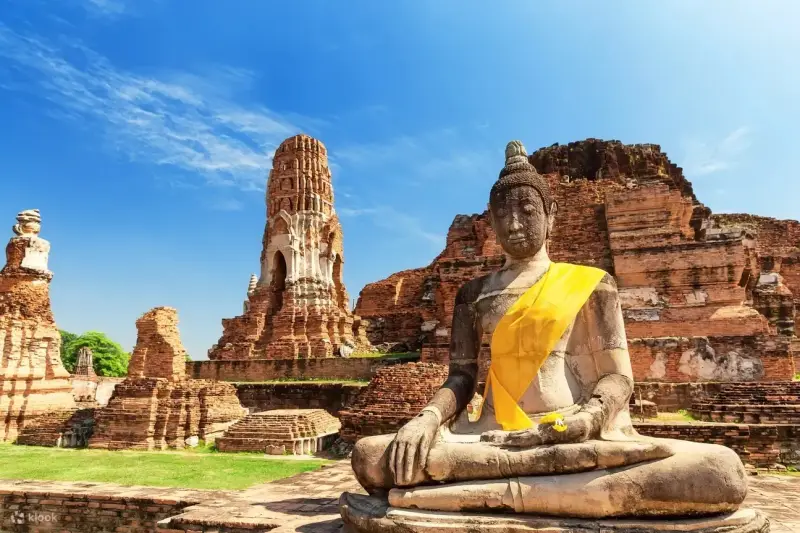
Wat Pa Sak is a temple without monks. What remains is a brick compound of foundations and one tall stupa, still wearing much of its original stucco, set among grass and a few old teak trees on the edge of Chiang Saen. The closer you stand to that stupa, the more figures appear in the plaster.
The name translates as "temple of the teak forest." Chronicle tradition says around 300 teak trees were planted when the temple was founded, and a handful of mature trees still shade parts of the grounds. Exactly when that founding happened is unsettled: sources give dates from 1295 to the 1340s, and later restoration by Lanna rulers in the 15th century makes the original fabric hard to date. Tradition links the temple to King Saen Phu, after whom Chiang Saen is named.
The stupa stands about 12.5 meters tall on a square base. Its decoration borrows openly from three older traditions. Walking and standing Buddhas in the niches point to Sukhothai, the stacked tiers recall Hariphunchai, and some of the ornament echoes Bagan in Burma. Look low on the tiers for small dwarf guardians, then higher for makara, lion-like singha and garuda figures.
Thai Holiday Guide counts about 22 ancient structures inside a walled area of roughly 16 rai. Most are low brick bases of halls and smaller chedis, so the layout reads best if you walk the perimeter first and then cross to the stupa.
The Chiang Saen National Museum is a few minutes away on foot and holds Lanna-era bronzes and finds from the old city, which makes the ruins easier to place.
Checked against trusted sources:
Thai Holiday Guide, Wat Pa SakLove Thailand, Wat Pa Sak
A ruined Lanna temple just outside Chiang Saen's old walls, known for a stucco-covered stupa that is one of the best early Lanna monuments in the north.
Guided tours and experiences that include Wat Pa Sak. See tours
The excavated grounds are flat and landscaped for walking around the monument, but climbing on any of the brick structures is not permitted.
No age limit; keep children off the ruins.
Sunscreen and sunglasses
Sturdy closed shoes and light clothing
Not confirmed yet. Please check with the venue before you visit.
None listed on site; restaurants such as 3 Ying Chiang Saen are about 1 km away
Walk the outer edge first to understand the layout, then study the stupa from all four sides. The stucco figures show best in low, angled light.
From Chiang Saen town center head about 1 km west; the ruins sit beside the road just outside the old wall, and cars can pull up close to the compound.
Walkable from central Chiang Saen; show the Thai name วัดป่าสัก to a driver.
No special events on record for Wat Pa Sak.
Early morning or late afternoon; midday from March to May is hot and exposed.
Any day; Chiang Saen stays quiet even mid-morning.
November to February, before the March to May heat.
Prices and how to get tickets.
80 THB foreign visitors; 10 THB Thai nationals (Fine Arts Department rates listed by Thai Holiday Guide, Jul 2026)
Others of this kind you opened on this device, so you can get back to them quickly.
No questions yet about Wat Pa Sak. Ask the community or our travel team, and the answer will show here once it is published.
Our team answers questions here
No hotels within 15 km of Wat Pa Sak are listed with us yet. Browse stays across the wider area instead.
Search hotels in Chiang RaiNo restaurants within 15 km of Wat Pa Sak are listed with us yet. Browse places to eat across the wider area instead.
Search restaurants in Chiang RaiFind your kind of trip: 45 travel themes, from Temple, Landmarks, Heritage.
 Temple
Landmarks
Heritage
Parks
Museums
Beaches
Waterfalls
 National Parks
Markets
Islands
Mountains
 Entertainment Parks
Caves
Art Galleries
Wildlife (Zoo)
Floating Market
Garden
Shopping Malls
Forests
Church (Christianity)
 Beaches
Education
Monument
Weekend Market
Palaces
Bridges & Barrages
Kids Zone
Mosque (Islam)
Theme Parks
Botanical Gardens
Lakes & Haors
UNESCO World Heritage Site
Cliffs
 Nightlife Districts
Theme Parks
 UNESCO World Heritage
Forts
Hills
Libraries
Monastery (Buddhism)
Parks
Statue
Temple (Hinduism)
Theaters
Walkway
More sights and places to visit in Thailand, nearest first.
Chiang Rai
Chiang Saen was a fortified Lanna city on the Mekong long before the Golden Triangle became a tourist stop, and its brick ruins are still scattered among houses...
Chiang Rai
Inside the old walls of Chiang Saen, close to the main gate, one brick spire rises well above everything else in town. Phrathat Chedi Luang, whose name simply m...
Chiang Rai
Arrive before eight on a cool-season morning and Chiang Saen Lake is often wrapped in mist, with flocks of ducks rising off the water as fishermen push out from...
Chiang Rai
Down on the riverbank at Sop Ruak, crowds pose beside the Golden Triangle sign. A few minutes' climb above them, Phra That Doi Pu Khao offers the better version...
Chiang Rai
Most museums open with a lobby. The Hall of Opium opens with a long, dim tunnel lined with carved reliefs of straining human figures, a deliberate walk into the...
Chiang Rai
Ban Hat Bai is not a craft museum with a ticket desk. It is a Mekong-side Tai Lue village where weaving happens in the space beneath people's homes, between mot...
Chiang Rai
Out in the countryside of Mae Sai district, Wat Hiranyawat looks like any other village monastery until you step into its main hall. Sitting there is Phra Sing...
Chiang Rai
Most travelers on the road between Chiang Rai and Mae Sai pass within a few kilometers of Phra That Chom Chan without knowing it is there. The temple belongs to...
Chiang Rai
Klang wiang means the middle of the town, and the name is literal. When Chiang Rai's ruler wanted to mark the center of his city in the 19th century, this is wh...
Tell us where and when you want to go, and local travel experts send you offers for your trip.
General
No. It is a historic monument with no resident monastic community, so there are no daily ceremonies to work around.
The founding date is disputed. Published estimates range from 1295 to the 1340s, and 15th-century restoration complicates dating.
Pa Sak means teak forest. Tradition says hundreds of teak trees were planted around the temple when it was built.
Sukhothai, Hariphunchai and Bagan influences all appear in the stucco, combined in what is known as the early classic Lanna style.
Walking and standing Buddhas in the niches, dwarf guardians on the tiers, and makara, singha and garuda figures in the ornament.
It sits just outside Chiang Saen's old walls, a short walk from the town center.
Very little. Apart from a few large trees, the grounds are open, so a hat and water help in the hot months.
The paths are uneven brick and gravel, so wheelchair users and anyone unsteady on their feet may find parts of the site difficult.
The Chiang Saen National Museum is a few minutes' walk away, and the Golden Triangle viewpoint on the Mekong is a short drive north.
According to Thai Holiday Guide, the stupa enshrines a relic said to be a bone from the Buddha's right ankle, traditionally said to have come from Patna in India.
Wat Pa Sak is in Chiang Rai, Thailand. The street address and directions are under How to get there on this page.
Timing & weather
Wat Pa Sak is open Monday – Sunday: 8:00 AM – 5:00 PM.
Plan about 1 hour (60 minutes) at Wat Pa Sak. Typical visit: About 1 hour.
Booking
Tickets for Wat Pa Sak start from $2.29 (USD).
Getting there
You can reach Wat Pa Sak by public transport or by car. Both routes are described under How to get there on this page.
We use necessary cookies to make this site work. With your permission we would also like to remember your preferences, measure how the site is used, and show relevant ads and partner offers. You can change your mind at any time under "Cookie settings" on our Privacy policy page.
