
The oldest wonders of the world you can still visit are, from oldest to youngest, Göbekli Tepe in Türkiye, Stonehenge, the Great Pyramid of Giza, the Temple of Artemis at Ephesus, the Mausoleum at Halicarnassus, Petra, the Great Wall of China, the Colosseum, Machu Picchu and the Taj Mahal. Many lists mix up monuments you can still walk around with monuments that exist only in ancient descriptions. Of the original Seven Wonders of the Ancient World, only the Great Pyramid of Giza survives intact. Two more, the Temple of Artemis and the Mausoleum at Halicarnassus, left ruins you can visit in Turkey. The rest are gone. This guide ranks ten ancient and early wonders that still stand and that a traveller can actually enter today, ordered from the oldest to the youngest, with the practical details that matter on the ground.
For the full overview, read our guide to the most famous landmarks around the world.
Each entry covers what you will see, roughly when it was built, how to get there and the visiting rules worth knowing before you book. For a wider sweep of protected sites, see our guide to 100 UNESCO World Heritage Sites, and for the modern list voted in 2007, our separate piece on the world's 7 wonders.
How this list was built: Every site here had to meet two tests as of October 2026: the structure (or a substantial part of it) still stands, and it is open to ordinary visitors. Dates are the ranges given by archaeologists and heritage bodies; where scholars disagree, we give an approximate century. Ticket rules change often, so treat any figure below as a starting point and confirm on the site's official portal before travelling.
Oldest wonders of the world at a glance
The table runs from oldest to youngest. "Built" is the main construction phase, not every later addition.
| # | Wonder | Country | Built (approx.) | What survives | Booking |
|---|---|---|---|---|---|
| 1 | Göbekli Tepe | Türkiye | c. 9500–8000 BCE | Stone enclosures, carved pillars | Ticket at site |
| 2 | Stonehenge | England, UK | c. 3000 BCE onwards | Sarsen circle, bluestones | Timed tickets online |
| 3 | Great Pyramid of Giza | Egypt | c. 2560 BCE | Complete pyramid, interior passages | Plateau ticket + separate interior ticket |
| 4 | Temple of Artemis | Türkiye | c. 550 BCE | Foundations, one re-erected column | Free roadside site near Selçuk |
| 5 | Mausoleum at Halicarnassus | Türkiye | c. 350 BCE | Foundations, scattered blocks | Small ticketed site in Bodrum |
| 6 | Petra | Jordan | from c. 4th century BCE | Rock-cut city | Day tickets or Jordan Pass |
| 7 | Great Wall of China | China | 7th century BCE to Ming era | Thousands of km, mostly Ming | Section tickets, some need ID booking |
| 8 | Colosseum | Italy | AD 72–80 | Most of the amphitheatre shell | Timed tickets online |
| 9 | Machu Picchu | Peru | c. 1450 | Citadel, terraces, temples | Circuit tickets, daily cap |
| 10 | Taj Mahal | India | 1632–1653 | Complete mausoleum and gardens | Online or gate; closed Fridays |
The 10 oldest wonders you can still visit, ranked by age
Göbekli Tepe, Şanlıurfa, Türkiye
Göbekli Tepe is the reason this list does not start in Egypt. Its earliest stone enclosures date to around 9500 BCE, which puts them thousands of years ahead of the first pyramids and before farming had fully taken hold in the region. The site consists of rings of T-shaped limestone pillars, many carved with foxes, boars, snakes and birds, set into a hill on the plain north-east of Şanlıurfa in south-east Türkiye.
Nobody built it as a "wonder" in the later Greek sense. Archaeologists still debate whether the enclosures were ritual spaces, communal buildings or both. That uncertainty is part of the appeal: you are looking at some of the oldest monumental architecture humans are known to have made. A protective roof now covers the main excavation area, and walkways keep visitors above the pillars. It was added to the UNESCO World Heritage List in 2018.
Expect a short visit, often an hour or two including the visitor centre. Pair it with Şanlıurfa's old town and its archaeology museum, which holds finds from the wider region.
- Location: About 15 km from Şanlıurfa city
- Best time: April–May or October; summers are very hot
- Getting there: Fly to Şanlıurfa, then taxi or tour
- Entry: Ticket bought at the site
As the oldest site on the list, it is the one for travellers who want the deepest history. In summer go early in the day, because the plain heats up fast and shade is limited.
Stonehenge, Wiltshire, England
Stonehenge was built in stages, with work starting around 3000 BCE and the big sarsen circle raised a few centuries later. The monument lines up with the sunrise at the summer solstice and the sunset at the winter solstice, which is why it fills with people on those dates. On ordinary days it is a calm, open site on Salisbury Plain where a footpath circles the stones at a short distance.
Most visitors arrive at the visitor centre, which has a small exhibition and reconstructed Neolithic houses, then take a shuttle or walk across the fields to the stones. Entry is by timed ticket, and booking ahead online is the safe option in summer and during school holidays. Getting close enough to touch the stones is not allowed on a normal ticket.
From London, Stonehenge is a day trip by coach tour or by train to Salisbury followed by a bus. Combine it with Salisbury Cathedral if you have the afternoon.
- Location: Salisbury Plain, Wiltshire
- Best time: Early morning slots, spring or autumn
- Getting there: Train to Salisbury + bus, or a tour from London
- Entry: Timed tickets, book online
This prehistoric icon makes a first Neolithic site within easy reach of a major city. Wear waterproof shoes; the walk from the shuttle stop crosses open grass.
Great Pyramid of Giza, Egypt

The Great Pyramid was built as the tomb of the pharaoh Khufu around 2560 BCE and is the only one of the original Seven Wonders of the Ancient World that survives. It was made from more than two million stone blocks. Its original height was about 146.6 m (481 ft); it now stands at about 138.5 m after losing its outer casing stones and capstone. For roughly 3,800 years no human-made structure was taller.
A ticket to the Giza plateau lets you walk between the three main pyramids and see the Great Sphinx. Going inside the Great Pyramid needs a separate, pricier ticket, and the climb through the narrow Grand Gallery to the King's Chamber is steep and stuffy. People with claustrophobia often skip it and choose a smaller pyramid interior instead.
The Grand Egyptian Museum sits close to the plateau, which makes a full Giza day easy to plan. Camel and horse touts are persistent near the panoramic viewpoint; agree any price before you climb on.
- Location: Giza plateau, western edge of Greater Cairo
- Best time: October–April, at opening time
- Getting there: Taxi or ride-hailing app from central Cairo
- Entry: Plateau ticket; interior ticket extra
Here you can stand beside the last ancient wonder still standing, the one that never fell. Arrive at opening to beat the tour buses and the midday heat.
Temple of Artemis, Ephesus (Selçuk), Türkiye
The Temple of Artemis, also called the Temple of Diana, was one of the largest Greek temples ever built and earned its place among the Seven Wonders for its forest of marble columns. The best-known version was raised around 550 BCE, burned in 356 BCE and rebuilt, then ruined in late antiquity. What you see today is a marshy field near the town of Selçuk with foundations and a single column reassembled from fragments, often with a stork's nest on top.
It is honest to say the site disappoints people who expect a temple. Its value is context: it sits a short ride from the ruins of ancient Ephesus, one of the best-preserved Roman cities in the Mediterranean, and from the Ephesus Museum in Selçuk, which displays statues of Artemis found in the area. Seen together, they make a strong day.
Some sculpted column drums from the temple are held in the British Museum in London, a useful stop if you want to see its decoration up close.
- Location: Edge of Selçuk, near Ephesus
- Best time: Spring or autumn
- Getting there: Fly to İzmir, then train or bus to Selçuk
- Entry: Viewed from a roadside area
The ruin is free to view, and it makes most sense for travellers already visiting Ephesus. Budget fifteen minutes here and the rest of the day for the Roman city.
Mausoleum at Halicarnassus, Bodrum, Türkiye
The tomb of Mausolus, a ruler of Caria, was finished around 350 BCE after his death, under his widow Artemisia II. It was so celebrated that his name became the general word for a grand tomb. Earthquakes damaged it in the Middle Ages, and in the 15th century the Knights of St John reused much of its stone to build the castle that still dominates Bodrum harbour.
The site today is a small open-air museum in the middle of Bodrum: the foundations, drainage channels, column fragments and a model of how the building may have looked. It takes under an hour. To see the stone that left, walk down to Bodrum Castle, where blocks from the mausoleum are visible in the walls; several of its sculptures are now in the British Museum.
Bodrum is a summer resort town, so the site is easy to fit around a beach holiday. Check opening days locally, as small sites in Türkiye sometimes keep shorter winter hours.
- Location: Central Bodrum, a short walk from the harbour
- Best time: May–June or September
- Getting there: Fly to Milas–Bodrum Airport
- Entry: Small ticketed site
A visit combines ancient history neatly with a coastal break. Go to the castle the same morning to see where the mausoleum's stone ended up.
Petra, Jordan
Petra was the capital of the Nabataeans, Arab traders who controlled caravan routes across the region. Settlement here goes back further, but the city grew from around the 4th century BCE and became part of the Roman province of Arabia in AD 106. Its tombs and temples are carved straight into red and pink sandstone cliffs, which is why it is nicknamed the Rose City.
The classic route runs through the Siq, a narrow gorge about 1.2 km long, to the Treasury (Al-Khazneh). Most first-time visitors stop there, which is a mistake. The Monastery (Ad-Deir) sits at the top of roughly 800 rock-cut steps and is less crowded; the Royal Tombs and the Roman-style theatre are on the way. A full day is the minimum, two is better.
Tickets are priced by length of stay. As of 2026 the Jordan Tourism Board lists 50 JD for one day for visitors staying overnight in Jordan, more for day-trippers who do not stay the night. The Jordan Pass bundles Petra entry with the tourist visa fee for many nationalities, so compare it before you buy separately.
- Location: Wadi Musa, about 240 km south of Amman
- Best time: March–May, October–November
- Getting there: Bus or car from Amman or Aqaba
- Entry: From 50 JD (1 day, overnight visitors)
Of all ten sites, this UNESCO-listed Nabataean city has the most dramatic setting, and walkers and photographers get the most from it. Enter at opening, when the Siq is quiet and morning sun lights the Treasury.
Great Wall of China
The Great Wall is not one wall but a series of fortifications built and rebuilt over more than two thousand years along China's historic northern frontier. Walls were going up as early as the 7th century BCE. Qin Shi Huang, the first emperor, linked sections after 221 BCE, but little of his wall remains. Most of what visitors walk on today is Ming dynasty work, and a national survey measured the Ming walls at about 8,850 km including trenches and natural barriers.
Near Beijing the choice of section shapes the whole day. Badaling is the most developed and the most crowded. Mutianyu is restored, has a cable car and a toboggan run, and suits families. Jinshanling mixes restored and wild stretches for hikers. Unrestored "wild wall" sections such as Jiankou are dangerous and in places off limits, so go only with a reputable guide.
Several popular sections now sell tickets online with passport details, and weekend and holiday crowds can be severe. Weekdays outside Chinese national holidays are far calmer.
- Location: Sections 60–150 km from Beijing
- Best time: April–May, September–October
- Getting there: Train to Badaling; bus or car to Mutianyu
- Entry: Per-section tickets; bring your passport
The longest structure on the list and a UNESCO site, it fits a half-day or full-day trip from Beijing. Avoid the October Golden Week holiday if you can.
Colosseum, Rome, Italy
Construction of the Flavian Amphitheatre began under Emperor Vespasian around AD 72 and finished under his son Titus in AD 80, on land once occupied by Nero's Golden House. It held around 50,000 spectators for gladiator fights, animal hunts and public spectacles, and remained in use for centuries before earthquakes and stone robbing took their toll.
A standard ticket covers the Colosseum together with the Roman Forum and the Palatine Hill, which is where most of a half day goes. Guided options add the underground passages (hypogeum) and the arena floor, and these sell out first. Tickets are issued for a timed entry slot and bought online in advance; queues for walk-up sales in high season can eat an hour.
Security checks apply at the entrance, so pack light. The Palatine Hill is the best spot for a shaded break and a view back over the Forum.
- Location: Central Rome, Colosseo metro station
- Best time: November–March, or first slot of the day
- Getting there: Metro line B to Colosseo
- Entry: Timed combined ticket with Forum and Palatine
No arena from the ancient world is better preserved, and this UNESCO site offers classical history with easy logistics. Book the underground tour weeks ahead in spring and autumn.
Machu Picchu, Peru
Machu Picchu was built around 1450 as a royal estate for the Inca ruler Pachacuti, on a ridge at about 2,430 m above the Urubamba valley. It was largely abandoned after the Spanish conquest and never found by the colonisers, which helps explain why the terraces, temples and stone houses are in such good shape.
Visits are tightly controlled. Entry is by timed ticket tied to one of three main circuits, split into several routes, and a guide is required. Peru's Ministry of Culture caps daily numbers: as of 2026 the limit is 5,600 visitors a day on high-season dates and lower on others. Tickets for the morning and for Huayna Picchu mountain sell out weeks or months ahead in the June–August dry season.
Most visitors take the train from Cusco or Ollantaytambo to Aguas Calientes, then the shuttle bus up the mountain. The other way in is the multi-day Inca Trail, which needs its own permit booked through a licensed operator.
- Location: Above Aguas Calientes, Cusco region
- Best time: April–May, September–October
- Getting there: Train from Cusco or Ollantaytambo + bus
- Entry: Circuit ticket, guide required
The highest site on the list rewards travellers who plan ahead. Spend a night or two in Cusco first to adjust to the altitude.
Taj Mahal, Agra, India
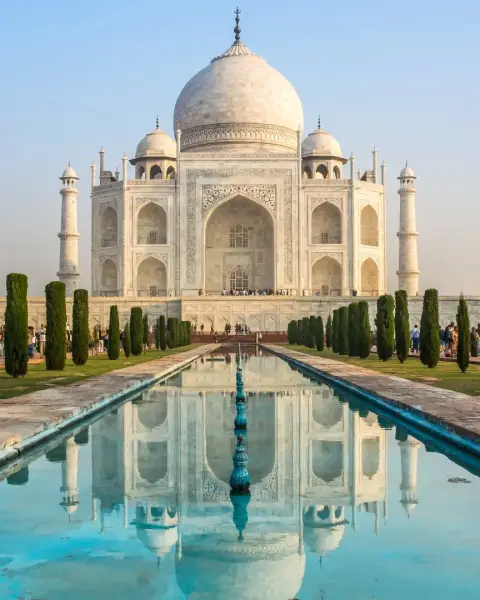
Shah Jahan commissioned the Taj Mahal in 1632 as a tomb for his wife Mumtaz Mahal, who had died in childbirth; the main complex was finished around 1653. The white marble mausoleum, inlaid with semi-precious stones, sits on the south bank of the Yamuna river with a formal garden, a mosque and a guesthouse building around it. It joined the UNESCO World Heritage List in 1983.
The monument is closed to general visitors on Fridays, when it opens only for prayers at the mosque. On other days it opens around sunrise, and the first hour is the best time for soft light and smaller crowds. Foreign visitors pay a higher fee than Indian citizens, with an extra charge to enter the main mausoleum; buy online to skip the ticket queue. Food, tobacco and large bags are not allowed inside.
Agra Fort and the abandoned Mughal city of Fatehpur Sikri are both close enough to fill a second day.
- Location: Agra, Uttar Pradesh
- Best time: October–March, at sunrise
- Getting there: Express train from Delhi (around 2 hours)
- Entry: Online or gate ticket; closed Fridays
The youngest wonder here suits architecture lovers and photographers best. Come back at sunset to see it from Mehtab Bagh across the river.
 Get the bookingMentor app
Which ancient wonders no longer exist?
Four of the original Seven Wonders of the Ancient World have vanished entirely, which is why they are not ranked above even though they are older than several entries.
The Hanging Gardens of Babylon (traditionally linked to Nebuchadnezzar II, around 600 BCE, in present-day Iraq) have never been located. No archaeological evidence confirms they existed at Babylon, and some historians think the account may describe gardens at Nineveh instead. The ruins of Babylon can be visited, but there is no garden to see.
The Statue of Zeus at Olympia, made by the sculptor Phidias around 435 BCE, was a seated figure about 12 m tall in gold and ivory. It was lost in late antiquity. At Olympia in Greece you can still visit the sanctuary, the temple foundations and the workshop where Phidias built it.
The Colossus of Rhodes, a bronze statue of the sun god Helios completed in the early 3rd century BCE, fell in an earthquake only decades later. The Lighthouse of Alexandria stood for well over a thousand years before earthquakes brought it down; the Citadel of Qaitbay in Alexandria was built on or near its site.
An earlier version of this article listed "Motsahenh tombs" in Egypt. We could find no record of a site by that name, so it has been removed.
How to plan a trip around ancient wonders
Grouping by region saves the most time and money. Türkiye alone covers three entries: Selçuk for the Temple of Artemis and Ephesus, Bodrum for the Mausoleum, and Şanlıurfa for Göbekli Tepe, linked by domestic flights. Egypt and Jordan pair well, with Cairo to Amman a short flight. Rome, Agra and Beijing each work as single-city bases with day trips.
Entry rules for foreigners depend on your passport. Egypt, Jordan, Türkiye, India, China and Peru all have official visa or e-visa portals, and several offer visa on arrival or visa-free entry to some nationalities only. Check the government portal for your passport before booking flights; our visa section and flight search can help with the planning.
- Book the capped sites first. Machu Picchu, the Colosseum underground and Stonehenge sell out in peak months. Lock those tickets before flights and hotels.
- Go at opening time. Giza, Petra and the Taj Mahal are cooler and quieter in the first hour. Midday is both hot and crowded.
- Compare bundled passes. The Jordan Pass and Rome's combined Colosseum ticket can cost less than buying entries one by one.
- Carry your passport. Several sites, including parts of the Great Wall and Machu Picchu, tie tickets to ID and check it at the gate.
- Pack for walking. Petra, Machu Picchu and the Great Wall involve steep steps. Good shoes matter more than any other item.
- Mind local closures. The Taj Mahal shuts to tourists on Fridays and many sites change hours in Ramadan or national holidays.
Compare routes to Cairo, Rome, Delhi, Amman and Lima, then add a hotel near the site you want to see at opening time. Search flights
Planning a trip to Jordan? Read our Jordan travel guide or search flights.
 Umrah packages








{{item.get_author.first_name}} {{item.get_author.last_name}}
{{item.comment_txt}}
{{item_reply.get_author.first_name}} {{item_reply.get_author.last_name}}
@ {{item_reply.reply_to}}, {{item_reply.reply_txt}}