
Bangladesh has 25 camping sites worth the trip, from island beaches such as Saint Martin's and Nijhum Dwip to forest parks in Sylhet and Chattogram, lakes in the hill districts and fully equipped basecamps on the edge of Dhaka. If you live in or near the capital, The Base Camp Bangladesh in Gazipur, NeoCampers in Savar and the Meghna riverbank at Araihazar are the closest options. For a lake view, Kaptai, Mohamaya, Mayabini and the lakeside sites at Rema-Kalenga all take campers.
This guide is part of our wider guide to the best places to visit in Bangladesh.
Before you plan a Bandarban trip: Nafakhum is still off-limits to tourists. The administrative travel ban imposed in late 2022 has not been lifted as of this update, and tourists may travel only as far as Tindu. A tourist went missing at Nafakhum in November 2025 after entering the area without registering or hiring a guide, despite the active ban. Tindu, Boga Lake, Debotakhum and Keokradong reopened in 2025 after security operations eased, but all require a registered local guide and check-post registration. None of this is optional, and ignoring it causes more serious incidents in the area than the terrain does.
Most "best camping sites in Bangladesh" lists treat every site on the map as equally available. They aren't. Some of the best-known spots sit inside a travel restriction zone that changes by the month with security conditions in the Chittagong Hill Tracts, and getting this wrong has put tourists in real danger. This guide groups the sites by the kind of trip they suit (coastal islands, hill-tract trekking, forest and lake parks, organized basecamps) and states any permit or restriction in the entry itself.
How this was checked: access and permit status for the Bandarban hill-tract sites was verified against district administration notices and news coverage current as of June 2026. Restrictions in this region can change within months, so treat any "open" status here as accurate as of this update and confirm again closer to your travel date, ideally with a registered local guide or the Bandarban district tourism office.
All 25 camping sites at a glance
Click a site name to jump to its entry. A dash means the post has no confirmed detail for that column.
| # | Site | District | Type | Tents for hire? | Best season | Status |
|---|---|---|---|---|---|---|
| 1 | Saint Martin's Island | Cox's Bazar | Beach (island) | Not confirmed | 1 Nov 2026 – 15 Mar 2027 tourist window | Open, seasonal rules |
| 2 | Nijhum Dwip | Noakhali | Beach (island) | Bring your own | October–April | Open |
| 3 | Sonadia Island | Cox's Bazar | Beach (island) | Bring your own | Winter | Open |
| 4 | Monpura Island | Bhola | Beach (island) | Through organised group trips | Winter | Open |
| 5 | Kutubdia Island | Cox's Bazar | Beach (island) | Not confirmed | October–April | Open |
| 6 | Sandwip | Chattogram | Riverbank (island) | Not confirmed | October–April | Open |
| 7 | Char Kukri Mukri | Bhola | Beach (island) | Not confirmed | Winter | Open |
| 8 | Bashbaria Beach | Chattogram | Beach | Yes, 600–1000 BDT package | Check before you go | Open |
| 9 | Tindu | Bandarban | Hill | No, bring all gear | Check before you go | Permit |
| 10 | Nafakhum | Bandarban | Hill (waterfall) | Not confirmed | Check before you go | Banned |
| 11 | Debotakhum | Bandarban | Hill (gorge pool) | Kayaks for hire | Full-moon nights | Permit |
| 12 | Mirinja Valley | Bandarban | Hill | Yes, at resorts | Monsoon and early winter (mist) | Open |
| 13 | Hazarikhil Sanctuary | Chattogram | Forest | Yes, 400 Taka for two | Check before you go | Open |
| 14 | Khadimnagar National Park | Sylhet | Forest | Yes, 500 / 800 Taka | Check before you go | Open |
| 15 | Rema-Kalenga Sanctuary | Habiganj | Forest and lake | Yes | Check before you go | Open |
| 16 | Satchari National Park | Habiganj | Forest | Not confirmed | Check before you go | Check reports |
| 17 | Baroiyadhala National Park | Chattogram | Forest, waterfall and lake | Yes | Falls strongest July–October | Open |
| 18 | Sohosrodhara Waterfall | Chattogram | Forest (waterfall) | Yes | Cooler months | Open |
| 19 | Kaptai Lake | Rangamati | Lake | Yes, resort packages | All year | Open |
| 20 | Mohamaya Lake | Chattogram | Lake | Booked for a fee, 4–30 people | Check before you go | Confirm policy |
| 21 | Mayabini Lake | Khagrachari | Lake | Not confirmed | Check before you go | Open |
| 22 | Araihazar | Narayanganj | Riverbank | Not confirmed | Check before you go | Open |
| 23 | The Base Camp Bangladesh | Gazipur | Basecamp | Yes, all gear included | Check before you go | Open |
| 24 | NeoCampers | Dhaka (Savar) | Basecamp | Yes, safari tents | November–February | Open |
| 25 | Nazimgarh Tent Camp | Sylhet | Basecamp | Yes, packages | Dry season | Open |
Camping sites near Dhaka
The Base Camp Bangladesh in Gazipur, NeoCampers in Savar and the Meghna riverbank at Araihazar in Narayanganj are the three sites on this list close enough to Dhaka for a one-night trip. The first two sell overnight packages, so you bring little or nothing; at Araihazar you bring your own gear.
- The Base Camp Bangladesh, Gazipur: in Safipur Bazaar, Madhabpur, near Dhaka. Packages include the full overnight setup, so you bring nothing. Good for families.
- NeoCampers, Savar: roughly 24 km north-west of central Dhaka. Safari tents, crafts, campfires and BBQ, booked in advance as a package.
- Araihazar, Narayanganj: sandy banks of the Meghna near the capital, with date palm orchards and ferry crossings. Bring your own gear.
 Exclusive holiday package offers
Camping sites with a lake in Bangladesh
To pitch by the water in Bangladesh, choose Kaptai Lake in Rangamati, Mohamaya Lake in Mirsharai, Mayabini Lake in Khagrachari, the lakeside sites at Rema-Kalenga in Habiganj, Baroiyadhala National Park in Sitakunda or Boga Lake in Bandarban. Kaptai resorts sell tent packages all year, and Boga Lake needs a registered guide.
- Kaptai Lake, Rangamati: the largest artificial lake in South Asia; resorts sell tent packages with food, and you can camp there all year.
- Mohamaya Lake, Mirsharai: booked camping for groups of 4 to 30, with kayaking and swimming.
- Mayabini Lake, Khagrachari: a 15-acre lake about 30 minutes from Khagrachari town.
- Rema-Kalenga, Habiganj: designated lakeside camping sites inside the sanctuary, with tents for hire.
- Baroiyadhala National Park, Sitakunda: Sahasradhara Lake and Bawa Chhora are the park's best-known camping spots.
- Boga Lake, Bandarban: reopened in 2025, but only with a registered guide and checkpoint registration.
Current access status in the Bandarban hill tracts
The coastal and forest-park sites on this list carry no travel restrictions. The hill-tract sites around Bandarban do, and their status has changed more than once in the past three years. This is where things stood as of this update.
| Site | Status | Requirement |
|---|---|---|
| Tindu | Open, permit required | Registered guide + checkpoint registration |
| Boga Lake | Open, permit required | Registered guide + checkpoint registration |
| Debotakhum | Open, permit required | Local guide recommended, check current rules |
| Keokradong | Open, permit required | Reopened Oct 2025, follow security guidance on arrival |
| Nafakhum | Banned, do not enter | Active administrative ban; access point only as far as Tindu |
| Mirinja Valley | Generally open | Resort-based, less affected by hill-tract restrictions |
| All other sites on this list | No restrictions | Standard local rules only |
This table reflects information current as of June 2026. Bandarban restrictions have shifted several times since 2022 in response to security operations. Confirm the current status with a registered guide, your accommodation or the district tourism office before you finalise hill-tract plans, especially for anything beyond Tindu.
Which type of camping trip suits you?
A night on a remote island, a trek in Bandarban, a lake or forest park with rental gear and an organized basecamp near Dhaka are four different trips. Pick by category as well as by photos, or you may arrive on an island with city-trip expectations, or at a Dhaka basecamp expecting solitude.
- Coastal and island (beach and sandbar camping): Saint Martin's, Nijhum Dwip, Sonadia, Monpura, Kutubdia, Sandwip, Char Kukri Mukri. Best October to April. Facilities are minimal; bring your own gear unless you stay near a resort.
- Hill tract (Bandarban trekking): Tindu, Boga Lake, Debotakhum, Mirinja Valley. Most sites need a permit and a guide. Check access status at the planning stage and again before you book transport.
- Forest and lake (national park and reservoir camping): Hazarikhil, Khadimnagar, Rema-Kalenga, Satchari, Baroiyadhala, Kaptai Lake, Mohamaya Lake, Mayabini Lake. Gear rental is usually available on site, which makes these the easiest for beginners.
- Organized basecamp (near Dhaka, all gear included): The Base Camp Bangladesh (Gazipur), NeoCampers (Savar), Araihazar, Nazimgarh Tent Camp. Best for first-timers, families and anyone without equipment.
 Umrah packages from Dhaka
Coastal and island camping sites
Saint Martin's Island

Saint Martin is the most sought-after destination for travelers in Bangladesh, a coral island where the waves break on the reef and a full-moon night draws people out onto the sand. Camping, though, depends on the current rules.
As of October 2026, Saint Martin's is open to tourists only from 1 November 2026 to 15 March 2027 (Prothom Alo):
- Day trips only in November.
- Overnight stays in December and January. For February to mid-March, check the latest Department of Environment notice before booking.
- An average cap of 3,500 visitors a day.
- A Tk 100 conservation fee.
- Night lights, noise and barbecues on the beach are banned.
Within those rules, a night on the island is quiet and safe. With the lights off on a clear night, the stars are the main show.
- Location: Cox’s Bazar
- Best activities: Snorkelling, moonlit walks.
Nijhum Dwip

Nijhum Island, in Hatia Upazila of Noakhali District, is a sandbar that rose out of the Bay of Bengal. It has a deer sanctuary and is considered the second-largest mangrove forest in Bangladesh. Any day between October and April works for camping, and nights are quiet whether the moon is full or new.
Much of the island is protected. Nijhum Dwip National Park was declared on 8 April 2001 and covers about 3,865 hectares of forest land. Its mangroves hold a herd of roughly 5,000 chital (spotted deer), and thousands of migratory birds arrive in winter. Walk the forest edge early in the morning to see both.
- Location: Hatiya, Noakhali
- Best activities: Stargazing, nature walks.
Sonadia Island

Sonadia covers about 9 square kilometres in Maheshkhali Upazila, Cox's Bazar. People camp here for the empty beach, the mangrove creeks and the migratory birds that gather on the mudflats in winter. There is almost nothing on the island. A campfire and a simple barbecue on the sand are the evening's entertainment.
The island lies about 15 km north-west of Cox's Bazar town, separated from Maheshkhali by a canal. Bring your own water and food, and arrange the boat from Maheshkhali or Cox's Bazar before you go.
BirdLife International lists Sonadia as an Important Bird Area for wintering waders, including the spoon-billed sandpiper. Olive ridley and green turtles nest on its beaches, so keep fires and lights well back from the shoreline.
- Location: Maheshkhali, Cox’s Bazar
- Best activities: Beach BBQs, birdwatching.
Monpura Island

Winter is the best time for Monpura, a remote island in Bhola District. With rivers and sea on every side, it has open views of both sunrise and sunset, much like Kuakata. The island has a deer sanctuary, Monpura Landing Station and the Chowdhury Project.
Monpura is an upazila of about 373 square kilometres with roughly 90,000 residents (2022 census), bordered by Hatiya to the east and the Bay of Bengal to the south. Facilities are basic, so most campers join an organised group trip that handles the launch, tents and meals. If you go independently, carry water, food and a power bank, and ask residents before choosing a riverside pitch: tides reach well inland.
- Location: Bhola
- Best activities: Wildlife photography, riverside camping.
Kutubdia Island

Kutubdia is an island upazila of Cox’s Bazar covering 216 square kilometres. It has Bangladesh's largest wind power plant, a quiet beach, salt farms, a lighthouse and the shrine of Kutub Awliya. Campers come for the empty coastline and the island's reputation for safety.
The lighthouse is a 35 m metal tower first lit in 2004. It replaced a British-era masonry tower from 1846.
- Location: Cox’s Bazar
- Best activities: Visiting salt farms, exploring local culture.
Sandwip

Sandwip is an island upazila of Chattogram where the Meghna meets the sea. Expect wide green fields, sandbars rising in the river, welcoming residents and several historic sites. For camping, head to the western riverside at Rahmatpur, where the bank is open and quiet.
The upazila, which also includes Urir Char, covers about 762 square kilometres and has some 327,000 residents.
- Location: Meghna River Estuary
- Best activities: Riverside camping, exploring Rahmatpur.
Char Kukri Mukri, Bhola

Char Kukri Mukri lies about 120 kilometres from Bhola district, where the Meghna meets the Bay of Bengal. It is known as one of Bangladesh's largest wildlife sanctuaries. A sandy stretch called Balur Dhum has a beach feel similar to Cox’s Bazar or Kuakata, clean and quiet, with clear views of sunrise and sunset. Winter is the time to camp.
The island is low-lying and much of it floods at high tide, so pitch on raised ground.
- Location: Meghna Estuary, Bhola
- Best activities: Sunrise views, nature trails.
Bashbaria Beach, Chattogram

Stay for the sunset. Bashbaria, in Sitakunda Upazila of Chattogram, has rows of casuarina trees, new green grassland and picnic spots, and its campsites come with tents and the basics already set up.
A package of 600 to 1000 BDT gets you a tent, evening snacks, a barbecue dinner and khichuri in the morning. Confirm the current price with the operator before you go, and check tide times, since parts of the beach flood at high water.
- Location: Sitakunda, Chattogram
- Best activities: BBQs, night gatherings.
Hill-tract camping sites in Bandarban
Tindu

Tindu, in Thanchi Upazila of Bandarban District, is often called the "Land of Paradise" of Bangladesh: clouds, river, hills and waterfalls in one place. Most campers spend the night on the bank of the Shankha River. Facilities are limited, so bring all your equipment.
Tindu sits on the Sangu River about three hours by boat upstream from Thanchi. It is currently the furthest point tourists may travel on this route, as covered in the access table above. The UK Foreign Office advises against all but essential travel to Bandarban, Rangamati and Khagrachari, which can affect travel insurance for foreign visitors.
- Location: Thanchi, Bandarban
- Best activities: Camping by the Sangu River, hiking.
Nafakhum, Bandarban
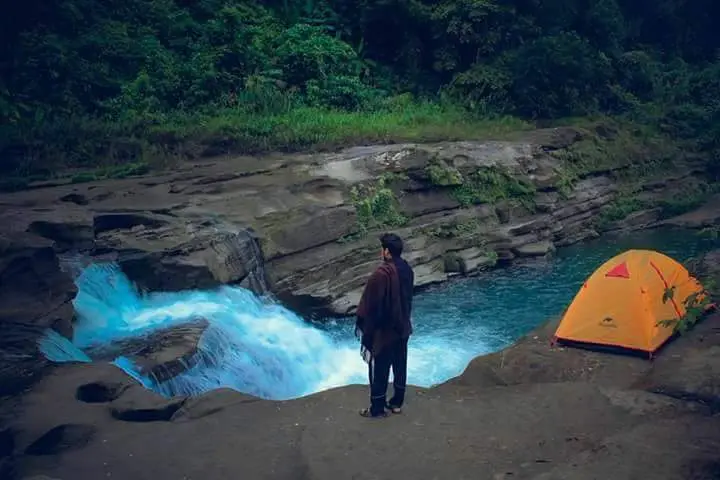
Nafakhum, in Remakri Union of Thanchi Upazila, is one of the largest waterfalls in Bangladesh and is often called the Niagara of Bengal. The falls lie on the Remakri River, a tributary of the Sangu, and the river drops about 7 to 9 metres. In sunlight the spray throws up rainbows. When access is permitted, a visit requires a guide and all your own camping gear.
Access as of October 2026: the administrative ban on Nafakhum remains in force, and tourists may go only as far as Tindu (bdnews24, August 2026). Do not plan to camp here until the ban is lifted.
- Location: Bandarban
- Best activities: Exploring trails, photography.
Debotakhum

The banks of Tarasa Khali in Shilbandha Marma Para, Rowangchhari upazila, lead to Devtakhum, a deep pool between steep hill walls. Campers time their trip for a full-moon night, and kayaks can be hired to paddle through the narrow gorge.
Debotakhum reopened in 2025. Like the other hill-tract sites, it requires a registered local guide and check-post registration, as set out in the access table above. Confirm the status shortly before you leave, because Bandarban rules have changed several times since 2022. The UK Foreign Office also advises against all but essential travel to Bandarban, which may affect insurance cover for foreign visitors.
- Location: Bandarban
- Best activities: Stargazing, night photography.
Mirinja Valley, Lama

Several resort cottages in Mirinja Valley rent tents on their grounds. The reason to come is waking above the clouds: on monsoon and early-winter mornings, mist fills the valley below.
Book with a resort in advance. Tent pitches are limited, the road up from Lama is slow, and Bandarban access rules can change at short notice, so confirm that tent stays are running before you travel.
- Location: Lama, Bandarban
- Best activities: Trekking, exploring local culture.
Forest, waterfall and lake camping sites
Hazarikhil Wildlife Sanctuary, Chattogram
 Chattogram" width="720" height="540" />
No gear is no excuse here. Hazarikhil Wildlife Sanctuary in Fatikchhari, Chattogram, rents camping equipment, and the authorities will help even if you bring your own.
- Two-person tent: 400 Taka.
- Guide, recommended for safety: 500 Taka extra.
- Contact: 01816 061600.
The sanctuary was set up in 2010 and covers about 2,908 hectares of the Ramgarh-Sitakunda forests, some 45 km north of Chattogram port. Some 216 bird species have been recorded, along with capped langurs, western hoolock gibbons and the near-threatened Himalayan serow.
- Location: Fatikchhari, Chattogram
- Best activities: Trekking, wildlife spotting.
Khadimnagar National Park, Sylhet

Khadimnagar, in Sadar Upazila of Sylhet District, is a tropical evergreen forest loud with birds and cicadas, with waterfalls and tea gardens nearby. The Sylhet Forest Department manages the park and runs the camping.
- Tent for two: 500 Taka. Tent for three: 800 Taka.
- Family accommodation is also available.
- Contact: 01737 853713.
The park lies about 13 km east of Sylhet town. It was declared on 13 April 2006, covers about 679 hectares, and has 26 mammal and 25 bird species on record.
- Location: Sylhet
- Best activities: Birdwatching, guided tours.
Rema-Kalenga Wildlife Sanctuary, Habiganj

Rema-Kalenga is the largest natural forest in Bangladesh after the Sundarbans: old hill forest with primates and birds. The lakeside inside the park has designated camping sites where tents can be hired, so you need not carry your own.
The sanctuary was established in 1982, covers about 1,796 hectares beside the Tripura border and lies some 130 km north-east of Dhaka. Surveys have recorded 167 bird and 37 mammal species. Bring binoculars and stay with a guide on the forest trails.
- Location: Chunarughat, Habiganj
- Best activities: Lake camping, wildlife exploration.
Satchari National Park, Habiganj

Satchari, in Chunarughat Upazila of Habiganj District (Sylhet Division), covers nearly 243 hectares and was formerly the Raghunandan Hill Reserve Forest. It has deep-forest trekking, tree-top activities and a designated campsite, and draws eco-tourists for its dense forest and wildlife.
The park was established in 2005 and is about 130 km from Dhaka. It is home to the critically endangered western hoolock gibbon, best heard calling in the early morning. Our access table marks Satchari "check reports", so look for recent news before you go.
- Location: Habiganj
- Best activities: Exploring flora and fauna.
Baroiyadhala National Park

Baroiyadhala, in Sitakunda Upazila of Chattogram, has several waterfalls, including Khaiyachhara and Napittachhara. Bawa Chhora and Sahasradhara Lake are its best-known camping spots, and all the equipment you need is available. Trails lead from the camping areas to the falls, which run strongest from July to October.
The park was declared on 6 April 2010 and covers about 2,934 hectares on the east side of the Dhaka to Chattogram highway. The trails cross streams, so wear shoes with grip.
- Location: Sitakunda, Chattogram
- Best activities: Trekking, birdwatching.
Sohosrodhara Waterfall

Sohosrodhara Waterfall is inside Sitakunda Ecopark, in the evergreen Chandranath Reserve forest at Sitakunda. Camping equipment can be rented at the base of the falls. Many Bangladeshi waterfalls shrink to a trickle in winter; Sohosrodhara keeps flowing, which makes it a good cool-season choice.
The eco park, set up in 2001 as the country's first, lies beside the Dhaka to Chattogram highway near Muradpur.
- Location: Sitakunda, Chattogram
- Best activities: Waterfall exploration, hiking.
Kaptai Lake, Rangamati
 Rangamati" width="720" height="405" />
Kaptai Lake in Rangamati district is the largest artificial lake in South Asia, with green hills running down to the water on every side. You can camp on its shores at any time of year. Several resorts and cottages have their own camping sites and sell packages that include food and a tent, so you need bring nothing.
The lake was formed by the Kaptai Dam on the Karnaphuli River, completed in the early 1960s, and covers about 688 square kilometres. Its creation displaced around 100,000 people and flooded the old Chakma royal palace.
- Location: Rangamati
- Best activities: Boating, exploring local villages.
Mohamaya Lake, Chattogram

Mahamaya Lake in Mirsharai, Chattogram, is one of Bangladesh's artificial lakes, roughly heart-shaped. Camping is booked by paying a set fee to the authorities, and a group must have at least 4 and no more than 30 people. Swimming and kayaking are also on offer.
If you kayak or swim, wear a life jacket and stay near the shore. The camping policy can change, so confirm it before you travel.
- Location: Mirsharai, Chattogram
- Best activities: Group camping, water sports.
Mayabini Lake

Mayabini Lake Tourism Center in Panchhari Upazila, Khagrachari, was built around a 15-acre lake inside 40 acres of rolling hills. It is a 30-minute drive from Khagrachari town, which takes some of the worry out of security. The water is clear and calm, hills close in on every side, and the open sky is good for stargazing.
Panchhari is one of Khagrachari's nine upazilas, with large Chakma and Tripura communities. The hill districts can see sudden security restrictions, so check local conditions with the tourism centre or your guide before traveling.
- Location: Khagrachari
- Best activities: Fishing, nature walks.
Organized basecamps and riverside camping
The Base Camp Bangladesh, Gazipur
 Bangladesh – Gazipur" width="720" height="480" />
The Base Camp Bangladesh is an outdoor activity centre in Safipur Bazaar, Madhabpur, Gazipur District, near Dhaka. Alongside its activities it offers camping, campfires and BBQ parties. The big advantage at Basecamp Adventures is that you bring nothing: camping packages include the full setup for an overnight stay, and it works well for families.
Packages and prices change by season. Contact the camp directly to confirm what is included (tent, bedding, meals and activities), and book early for weekends and public holidays.
- Location: Safipur Bazaar, Madhabpur
- Best activities: Team games, BBQ parties.
NeoCampers

NeoCampers in Savar, Dhaka, is a friendly campsite. Besides physical activities, it offers carpentry, pottery, treasure hunts, birdwatching, campfires and BBQ.
It opened in 2018, set up by the team behind The Base Camp in Gazipur. The two sites split the market. Base Camp leans towards adventure; NeoCampers is built around group living, with guests sleeping in safari tents and spending the day on crafts, shared cooking and slower outdoor activities. Stays of up to several days have been offered, which suits school groups, office teams and families wanting a first night under canvas without carrying gear.
Savar is roughly 24 km north-west of central Dhaka, but traffic on the Dhaka to Aricha highway decides the journey time, so leave early on a Friday morning. Tents and activities are sold as packages and the site has worked on a pre-booking basis, so confirm availability, the current price and which meals are included before setting out. November to February is the best window, when evenings are cool enough for a campfire.
- Location: Savar
- Best activities: Campfires, birdwatching.
Araihazar

Araihazar is a popular camping area near the capital. The sandy banks of the Meghna, date palm orchards and floating ferries give you plenty of places to pitch, from open riverbank to quieter spots inland. The area is known as peaceful and safe, which makes it a sound choice for first-timers as well as experienced campers.
As at any riverside site, ask residents where the bank is stable, keep the tent well above the water line, and check the river level after rain.
- Location: Narayanganj
- Best activities: Ferry rides, sunrise photography.
Nazimgarh Tent Camp, Sylhet

Nazimgarh Tent Camp offers trekking, kayaking and boat tours, with modern facilities available for a fee. Choose it if you want a tent without carrying one, with tea gardens and forest close by.
Tent stays and activities are sold as packages, so confirm what is included and the current rate with the operator before booking. Sylhet's wettest months bring sudden rain and high rivers; kayaking and boat trips are more comfortable in the dry season, when the water is calmer and clearer.
- Location: Sylhet
- Best activities: Kayaking, trekking.
How to choose the right camping site
Where you pitch matters as much as which park you pick. A good spot means comfort and safety; a poor one can turn a good plan into a long night. Check these points:
- Safety first. Avoid riverbanks, unstable slopes and spots under large, weak trees. In Bangladesh most camping risks come from weather and terrain, so choose ground that feels secure.
- Weather. The dry season (November to April) is the reliable window. The monsoon brings unpredictable rain and flooding. Always check the forecast before heading out.
- The ground. Look for flat, dry, slightly raised ground. Uneven, rocky or muddy surfaces hurt both your sleep and the tent's stability.
- Water. Camp near a water source but not right beside it. Too close means more humidity, more insects and a flood risk.
- Wind. Beaches and hilltops catch strong wind. Use trees or a small rise as a break.
- Access. Make sure you can reach the site with your equipment. Remote spots need proper planning and experience.
- Privacy and security. Total isolation is rarely wise. For most travelers, a quiet but known location is the right balance.
- Signal and help. Check for at least basic mobile coverage, and know where the nearest settlement or help point is.
- Your purpose. Rest, adventure and photography each call for a different kind of site.
Camping tips that work in Bangladesh
Bangladesh switches between coastal sand, hill-tract forest and lakeside ground, often within one trip. The ten habits below come up again and again among people who camp here regularly, and most cost nothing beyond a few minutes of planning.
Plan your route and share it before you leave
The Chittagong Hill Tracts and the Sundarbans carry real risk from terrain and limited access as well as from wildlife. Tell someone outside your group exactly where you are going and when you expect to be back.
Foreign visitors have one more check. The UK Foreign Office advises against all but essential travel to Rangamati, Khagrachari and Bandarban, and traveling against that advice can invalidate travel insurance. Read your own government's advice and your policy wording before booking a hill-tract site.
- Share your route with someone you trust before departure
- Check current local conditions and restrictions for your specific site
- Note known environmental risks for the area
- Save emergency contact numbers offline on your phone
Check the weather 24–48 hours before you leave
Sylhet's weather turns fast, and sudden rain has spoiled more trips than any wildlife on this list. Make the forecast check part of packing.
The Bangladesh Meteorological Department divides the year into winter (December to February), a hot pre-monsoon (March to May), the monsoon (June to September) and a short post-monsoon autumn. Violent "nor'wester" thunderstorms hit from March to May, and Sylhet is the wettest part of the country, so a clear morning there says little about the night.
- Check forecasts 24–48 hours before departure
- Skip the trip if a storm alert is active for your destination
- Stick to the dry season, November through April, for the most reliable conditions
Bring a power bank
Most camping sites in Bangladesh have no electricity. A high-capacity power bank or solar charger keeps your phone, GPS and camera running, and that matters most for navigation and for calling for help.
Size it to the trip. A 10,000 mAh unit gives most phones two full charges, enough for one night; a 20,000 mAh unit covers two or three nights, or a phone plus a headlamp. Charge everything the night before and pack a cable for every device; a missing cable is the most common reason a charged bank goes unused. On islands such as Nijhum Dwip and in the Bandarban hills the signal comes and goes, and phones drain fast hunting for a network. Use airplane mode when you can and download offline maps before leaving town. A small solar panel only helps on clear dry-season days; in cloudy monsoon weeks it barely charges.
Start the fire before the humidity wins
Humid air makes campfires harder to light here than in drier climates. Dry leaves, paper and small twigs are reliable starters when everything else is damp.
Carry your own starter in a sealed bag, such as cotton balls with a little petroleum jelly or commercial fire cubes, plus a lighter and waterproof matches. Ask the site manager or forest office whether fires are allowed: some protected areas and turtle-nesting beaches restrict them, and Saint Martin's bans barbecues on the beach. Keep water or sand nearby and douse the ashes fully before you sleep.
- Gather dry material before sunset, while it is still easy to find
- Keep the fire contained and follow local rules where they exist
- Never leave a fire unattended
Cook less at camp, prepare more at home
Cooking from scratch at a remote site eats time you would rather spend outdoors. Rice dishes, pasta and dry food that need little preparation cut that time without cutting the meal.
Heat and humidity spoil cooked food quickly. Eat anything perishable on the first evening and rely on dry staples such as chira (flattened rice), muri, biscuits, noodles and dates after that. Carry drinking water or a reliable filter, because many islands and forest sites have no safe supply, and take all rubbish back out with you.
- Prepare simple, low-effort meals before you leave
- Store food in reusable containers
- Pack only the cooking equipment the meal needs
Sleep well, or the next day suffers
A bad night on hard ground ruins the morning after. A foam mat or inflatable mattress with a sleeping bag suited to the season solves most of it.
Winter, December to February, is the main camping season, and nights in the north and the hills can be colder than visitors expect, so a light sleeping bag or blanket earns its space. In warmer months a breathable tent with good mesh panels matters more than insulation, and a bed net helps if you sleep in the open.
- Use a foam mat or inflatable mattress under your sleeping bag
- Match the sleeping bag's warmth rating to the season
- Avoid setting up directly on hard or uneven ground
Sort your gear by category before you pack
Digging through one big bag for a torch at night wastes time. Mesh or compartment bags, sorted by category, fix that before it starts.
A simple system: one dry bag for sleeping gear and spare clothes, one for food and cooking, and a small pouch for documents, cash, medicines and a headlamp that stays on your body. Waterproof bags are worth the money on boat trips to Nijhum Dwip, Sonadia or Monpura, where spray and rain soak anything in an ordinary backpack.
- Use mesh or compartment bags to split up your gear
- Keep food, clothing and tools in separate sections
- Keep frequently used items near the top, where you can reach them
Plan for insects
Forest areas such as the Sundarbans bring heavy insect pressure, especially after dusk. Repellent, candles and the right clothing cover most of it.
Insects are also a health issue. The US CDC reports malaria transmission in the hill-tract districts, Chattogram, Cox's Bazar and the Sylhet division districts, among others. It recommends a repellent with at least 20% DEET, permethrin on clothing and tents (never on skin) and a bed net when sleeping outdoors. Ask a travel doctor about malaria tablets and the Japanese encephalitis vaccine before a camping trip.
- Apply a natural or standard insect repellent before sunset
- Bring citronella candles for the campsite
- Wear clothing that covers your skin during peak insect hours
Pack gear that does two jobs
Every multi-purpose item saves space and weight. A tarp is both shelter and ground cover. A sleeping bag doubles as a blanket. One multi-tool replaces half a dozen.
A few pairings that work in Bangladesh: a sarong or gamchha (the light cotton towel sold in every bazaar) dries fast and serves as towel, sunshade, pillow cover and modest wrap for village visits. A headlamp frees both hands for cooking and pitching in the dark. A light rain jacket also blocks the wind on an evening boat ride, and a pot with a lid doubles as bowl and kettle. Trekking poles can hold up a tarp. Keep the pack light enough to carry over a muddy trail or onto a small boat, because many sites, from the hill tracts to the islands, end with a walk or a wade.
Carry an emergency kit, even for one night
The trip that needs an emergency kit is rarely the one where you expected it. Keep one packed and ready so you are not assembling it before every trip.
A practical kit for Bangladesh: plasters and sterile dressings, antiseptic, oral rehydration salts, paracetamol, an antihistamine for insect bites, any prescription medicine, insect repellent, tweezers for thorns and leeches, a whistle, a small torch and a foil emergency blanket. Add water purification tablets or a filter for sites without a safe supply. Carry a paper card with your blood group, allergies and an emergency contact, plus a copy of your ID or passport. Many camping sites are hours from a hospital, so know the nearest upazila health complex and how to reach it, and save the national emergency number 999 in your phone.
- Basic first-aid supplies
- A multi-tool or knife
- A flashlight or headlamp
- Any medications you take regularly
Read the ground before you pitch
Ground near rivers and hills can change within hours of rain upstream. Five minutes looking over the site catches most of the problems that would otherwise appear at 2 AM.
About 80% of Bangladesh's rain falls in the monsoon, and on islands and estuary chars high tide can cover low ground. Ask residents how far the water reaches before you choose a pitch, and move higher if heavy rain sets in overnight.
- Choose ground that is flat, dry and slightly raised
- Stay out of flood-prone areas and away from unstable slopes
- Avoid spots under dead branches or loose rock
Permits and safety in the hill tracts
The Bandarban hill tracts (Ruma, Thanchi, Rowangchhari, Alikadam) run under different rules from the rest of Bangladesh's camping sites, tied to security conditions. A travel ban first imposed in October 2022 in response to militant activity was lifted in stages, site by site, through 2025, and the conditions attached to each reopening are not optional.
The three standing conditions for approved Bandarban zones:
- Tourists may visit only officially approved locations, based on the current security situation.
- Travel must be arranged through a registered district or upazila-level tourist guide.
- All visitors must register their details at designated checkpoints or tourist information centres before entering.
The November 2025 incident at Nafakhum shows why. A 17-member group entered a banned area without registering or hiring a guide. The area has no mobile coverage, so when a member went missing while swimming, the others could not call for help and had to travel back out to file a report.
Foreign nationals face one more layer: a special permit, usually arranged through a travel agency in Dhaka, Chittagong or Bandarban town, on top of the guide and registration rules that apply to everyone.
Planning a trip to Bangladesh? Read our Bangladesh travel guide, compare hotels in Bangladesh, browse tours or search flights.
Choosing your first camping trip in Bangladesh
Bangladesh has camping for most tastes, from the mangroves of Nijhum Dwip to the still water of Mayabini Lake. For a first trip, pick a site with tents for hire, such as Rema-Kalenga, Nazimgarh or a Kaptai resort, and go between November and February, when the weather is dry and cool. Check local rules before you set off, especially for islands like Saint Martin's, and carry out everything you bring in.
Have a camping spot you think belongs on this list? Tell us in the comments.
Attention: Every tourist destination is a national treasure. Do nothing that harms the place, and encourage others to do the same. Looking after it is our shared responsibility.
Caution: Hotel, resort, transport and other costs change over time, so details in this guide may not match current prices. Verify before you plan your trip. Contact numbers for hotels, resorts, transport and other services are included from various sources for convenience; verify them before making any payment. This travel guide is not responsible for any financial loss or problem that may arise.
 AI trip planner











{{item.get_author.first_name}} {{item.get_author.last_name}}
{{item.comment_txt}}
{{item_reply.get_author.first_name}} {{item_reply.get_author.last_name}}
@ {{item_reply.reply_to}}, {{item_reply.reply_txt}}