

Hallstatt, Austria and Zermatt, Switzerland top most lists for photogenic setting, Hallstatt a lakeside UNESCO village since 1997, Zermatt a car-free village beneath the 4,478-meter Matterhorn. Cortina d'Ampezzo, Italy co-hosted the Milano Cortina 2026 Winter Olympics this past February, its second Games since 1956. Switzerland's towns run most expensive; Slovenia's Bled and Poland's Zakopane deliver comparable scenery for considerably less.
A town's elevation rarely makes it into "best mountain towns in Europe" guides, even though it's the single fact that explains almost everything else about the place: why Zermatt bans cars entirely, why St. Moritz can run horse races on a frozen lake every February, why Davos gets close to 300 sunny days a year. Most lists skip straight past facts like that to the same 4 adjectives rotated across 20 towns, mild temperatures, blooming flowers, fewer crowds, applied identically whether the town sits in Austria, Norway, or Montenegro. That formula tells you nothing about what actually separates 1 town from the next.
This guide runs 25 towns instead, each anchored to something specific: an exact elevation, a named cable car or cog railway, a UNESCO listing year, plus a real where-to-stay recommendation and a card of genuine things to do, filled in for every single entry. Cortina d'Ampezzo carries the most current update on this list. It co-hosted the Winter Olympics this past February, and the venues are still fresh for anyone visiting in 2026.
5 townsAustrian Alps:
From a UNESCO lake village to a 2-time Olympic host city, Austria's mountain towns pair genuine alpine scenery with real cultural weight.
Hallstatt:
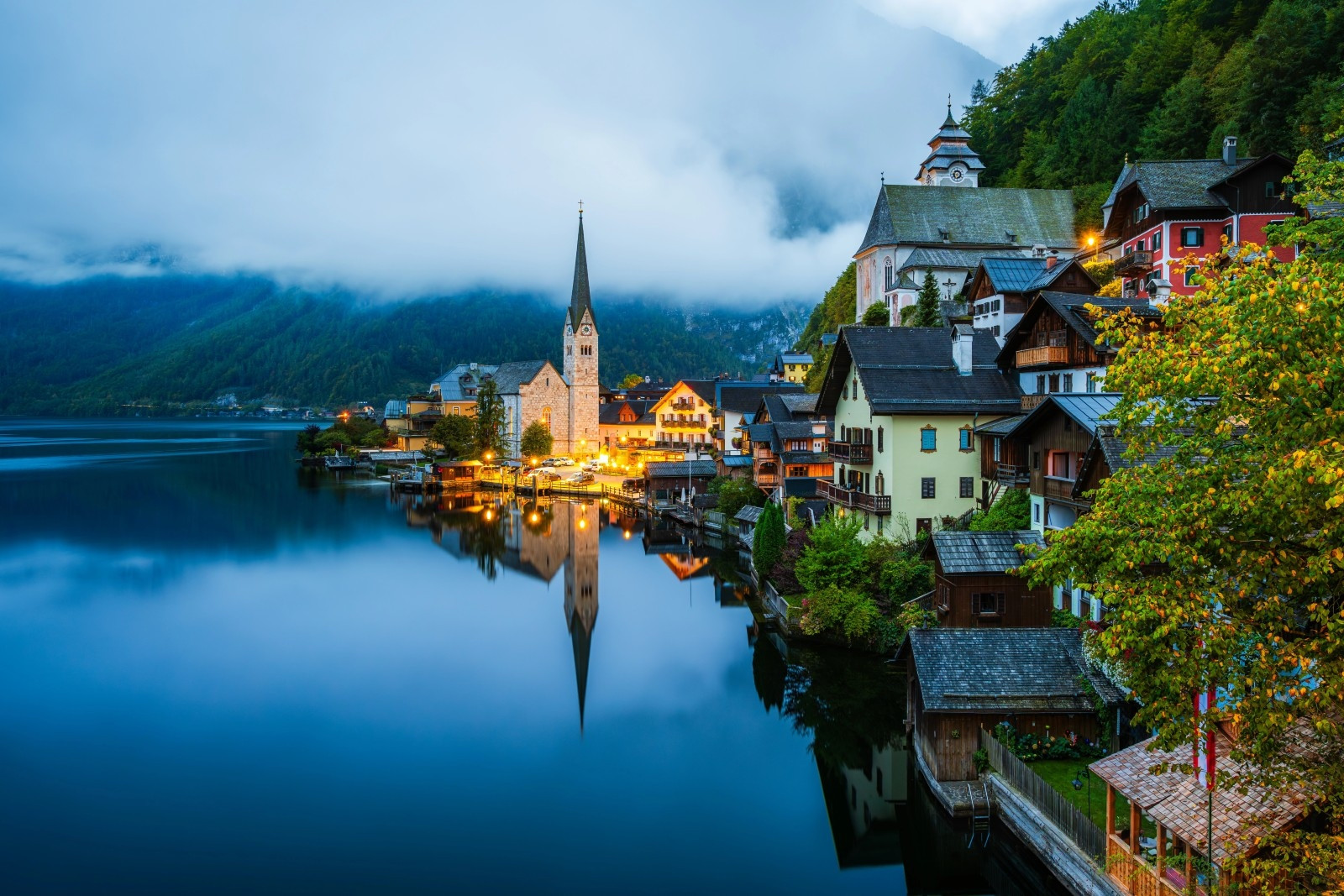
A lakeside village of roughly 800 people wedged between Lake Hallstatt and the Dachstein massif, part of a UNESCO World Heritage cultural landscape since 1997. The nearby salt mine dates back around 7,000 years, among the oldest in the world, and the town's popularity got so intense that a full-scale replica was built in Huizhou, China in 2012. The historic center sits on a narrow shelf of land between the lake and the mountainside, so most streets run on foot only, connected by a short funicular up to the salt mine and skywalk viewpoint above the rooftops. The town's small cemetery still practices a centuries-old bone-house tradition due to limited burial space on the narrow lakeside shelf.
🏠 Where to stay in Hallstatt
Book inside the historic lakeside center if you want to walk everywhere; rooms here are small and sell out fast in summer. Guesthouses in nearby Obertraun or Gosaumühle run cheaper and connect to Hallstatt by a short train or boat ride.
🗺️ Things to do in Hallstatt
Hallstatt Skywalk
A cliffside viewing platform above the rooftops, reached by funicular from the town center.
Hallstatt Salt Mine
Guided tours through one of the world's oldest working salt mines, including a wooden miners' slide.
Lake Hallstatt boat ride
A short crossing gives the classic postcard view of the town from the water.
Hallstatt Beinhaus (Bone House)
A small chapel holding centuries of hand-painted skulls, a genuinely unusual local tradition.
Innsbruck:
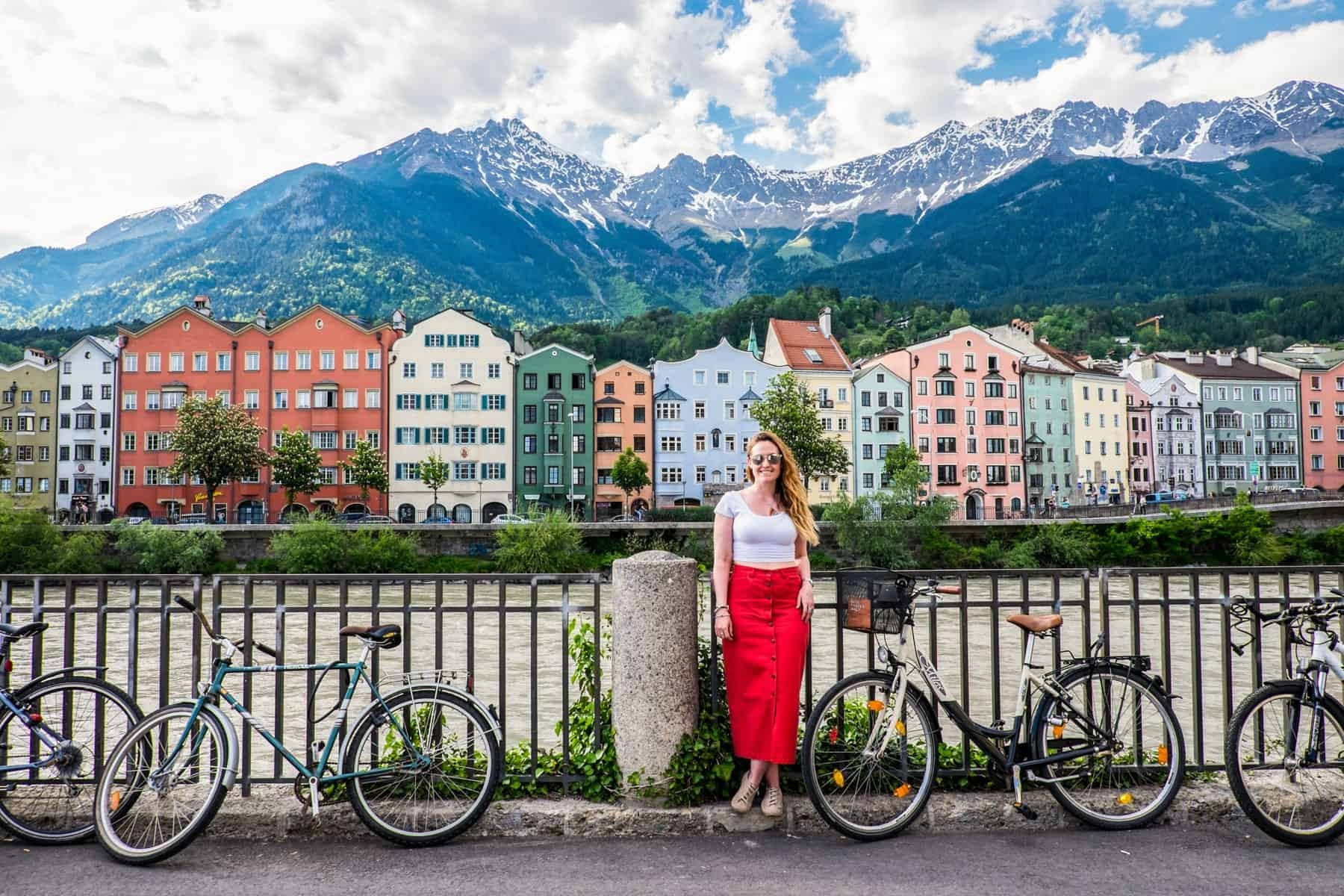
The Tyrolean capital hosted the Winter Olympics twice, in 1964 and 1976, and the Nordkette cable car still lifts visitors from the city center to 2,256 meters in about 20 minutes, one of the fastest urban-to-alpine transitions in Europe. The Golden Roof (Goldenes Dachl), 2,657 gilded copper tiles installed in 1500, anchors the compact Old Town below. Innsbruck functions as a genuine city with a university, a real local population, and year-round transit, not just a resort built around tourism, which gives it a different feel from most other entries on this list. Ambras Castle, built in the 16th century on the city's edge, holds one of Europe's oldest collections of armor and Renaissance curiosities.
🏠 Where to stay in Innsbruck
Stay in the Old Town (Altstadt) for walking access to the Golden Roof and the Nordkette cable car base station. The area around the main train station runs cheaper and still connects easily by tram.
🗺️ Things to do in Innsbruck
Nordkette cable car
Rises from the city center to alpine terrain above 2,200 meters in under half an hour.
Golden Roof (Goldenes Dachl)
2,657 gilded tiles built in 1500, the historic centerpiece of the Old Town.
Swarovski Crystal Worlds
A crystal-themed museum and garden a short train ride outside the city.
Bergisel Ski Jump
An Olympic ski jump with a viewing platform and rooftop café over the city.
Salzburg:
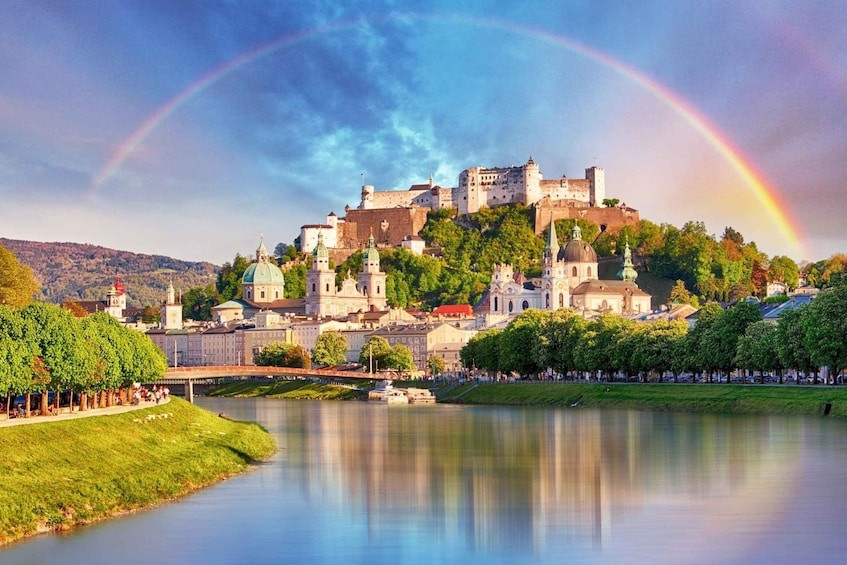
Mozart's birthplace and a UNESCO World Heritage Old Town since 1996, anchored by Hohensalzburg Fortress, built starting in 1077 and among the largest fully preserved medieval castles in Europe. The Sound of Music was filmed across several of the city's real locations, and the annual Salzburg Festival, running since 1920, still draws the summer's biggest crowds. The city sits at the edge of the Alps, not deep inside them, which makes it a practical combination stop: genuine mountain scenery visible from the fortress walls, paired with a walkable historic center that doesn't require a car or cable car to enjoy.
🏠 Where to stay in Salzburg
The Altstadt (Old Town) puts every major sight within walking distance but runs at a premium. Neustadt, across the river, offers similar walkability at a lower price point.
🗺️ Things to do in Salzburg
Hohensalzburg Fortress
An 11th-century fortress reachable by funicular, with panoramic city and Alpine views.
Mirabell Palace and Gardens
Baroque gardens featured in The Sound of Music, free to walk through.
Getreidegasse
The historic shopping street where Mozart was born, lined with narrow wrought-iron shop signs.
Salzburg Cathedral
A baroque cathedral rebuilt after 1598, at the center of the Old Town's main square.
Zell am See:
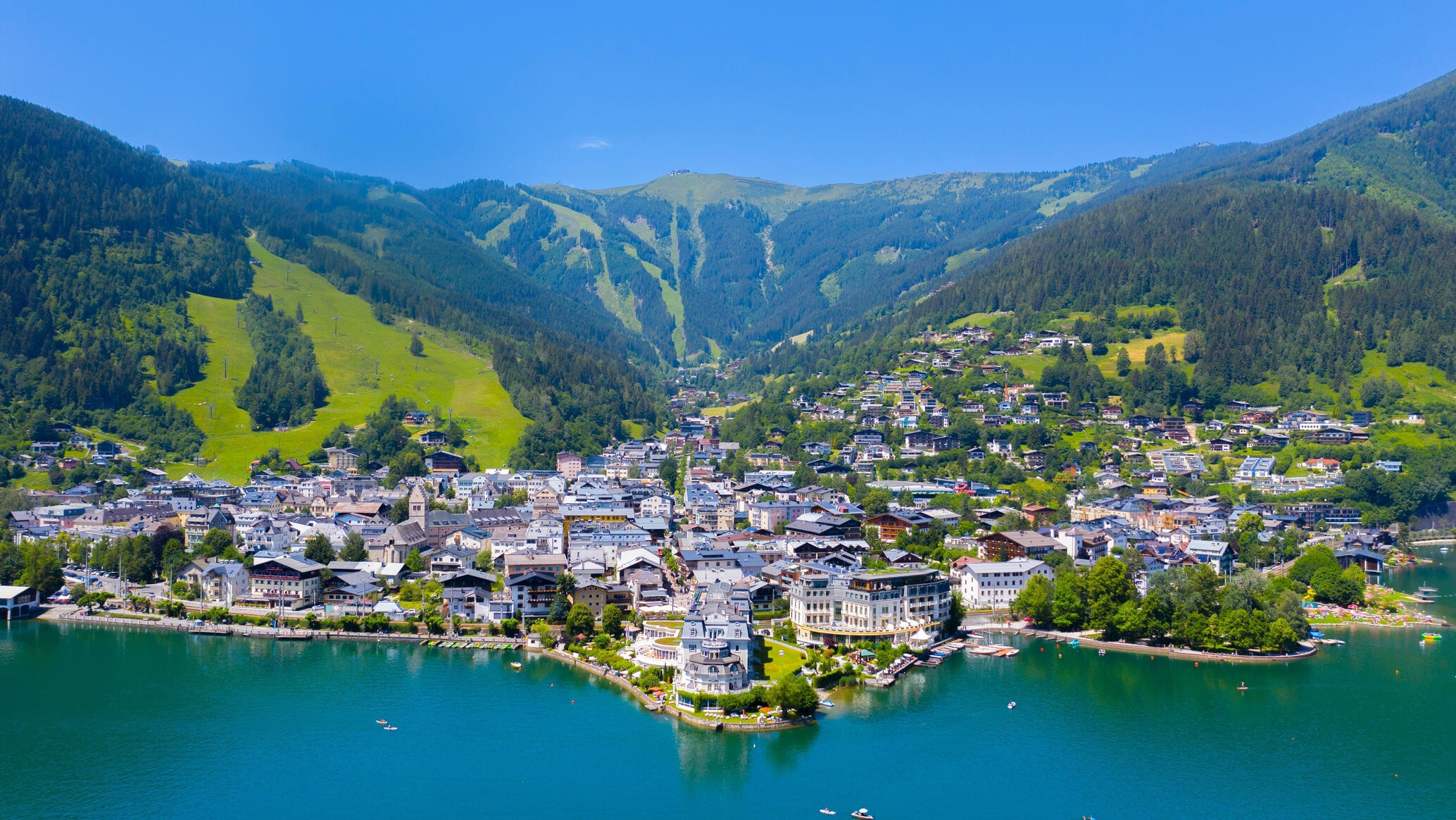
A lake town paired with the Kitzsteinhorn glacier (3,203 meters) a short drive away, one of the few places in Austria offering skiing on real glacier snow into early summer. Lake Zell itself stays warm enough for swimming in July and August, giving Zell am See a genuine dual-season identity most Alpine towns don't have. The train station connects directly to Salzburg and Innsbruck, making it a practical stop on a wider Austrian rail itinerary. The town center sits directly on the lakeshore, small enough to walk end to end in 15 minutes, with the Schmittenhöhe peak rising on the opposite side for a second ski and hiking area beyond the glacier.
🏠 Where to stay in Zell am See
Lakefront guesthouses in the town center put you within walking distance of both the lake promenade and the cable car base stations. Rates drop noticeably a few streets back from the water.
🗺️ Things to do in Zell am See
Kitzsteinhorn glacier
Cable cars reach glacier terrain above 3,000 meters, skiable into early summer.
Lake Zell promenade
A flat lakeside walking and cycling path circling the town.
Schmittenhöhe cable car
A second peak opposite the glacier, with hiking trails and a summit restaurant.
Sigmund Thun Klamm gorge
A wooden walkway through a dramatic river gorge just outside town.
7 townsSwiss Alps:
Switzerland's mountain towns run the most expensive of any region on this list, and the infrastructure, rail access, cable cars, cog railways, largely explains why.
Zermatt:
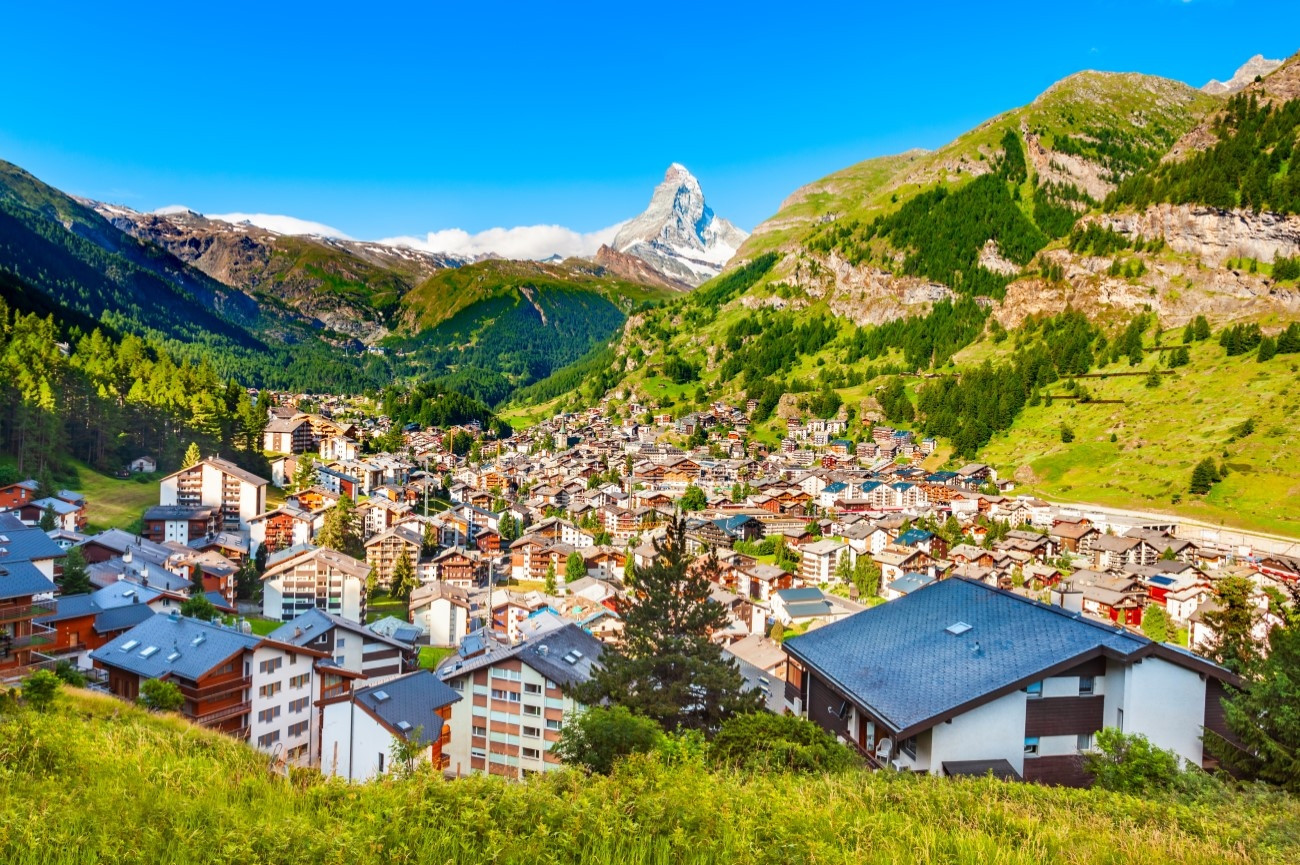
A fully car-free village (only electric taxis and hotel shuttles operate) directly beneath the Matterhorn, at 4,478 meters one of the most recognizable peaks on Earth. The Gornergrat cog railway, opened in 1898, climbs to 3,089 meters for what's widely considered the single best Matterhorn viewpoint anywhere. Visitors arrive by train to Täsch, then transfer to a short shuttle train into the car-free village itself, a genuinely different arrival experience from driving straight into most other Alpine resorts. Peak-season accommodation should be booked several months ahead, since the village's fixed size limits how much lodging supply can ever expand. Skiing here crosses the border into Italy via the Matterhorn Glacier Paradise lift system, Europe's highest cable car station.
🏠 Where to stay in Zermatt
Central Zermatt puts you closest to the main lifts but commands the highest rates in Switzerland. The Winkelmatten neighborhood, a short walk from the center, runs quieter and noticeably cheaper.
🗺️ Things to do in Zermatt
Gornergrat Railway
A cog railway climbing to 3,089 meters for the classic Matterhorn panorama.
Matterhorn Glacier Paradise
Europe's highest cable car station, with glacier skiing and an ice cave.
Five Lakes Walk (5-Seenweg)
A moderate hiking loop connecting 5 alpine lakes with Matterhorn reflections.
Zermatlantis / Matterhorn Museum
An underground museum covering the village's mountaineering history.
Sunnegga funicular
A quick underground funicular to a sunny viewpoint and small lake.
Bahnhofstrasse
The car-free main street lined with shops, chalets, and mountain-view cafés.
Lucerne:
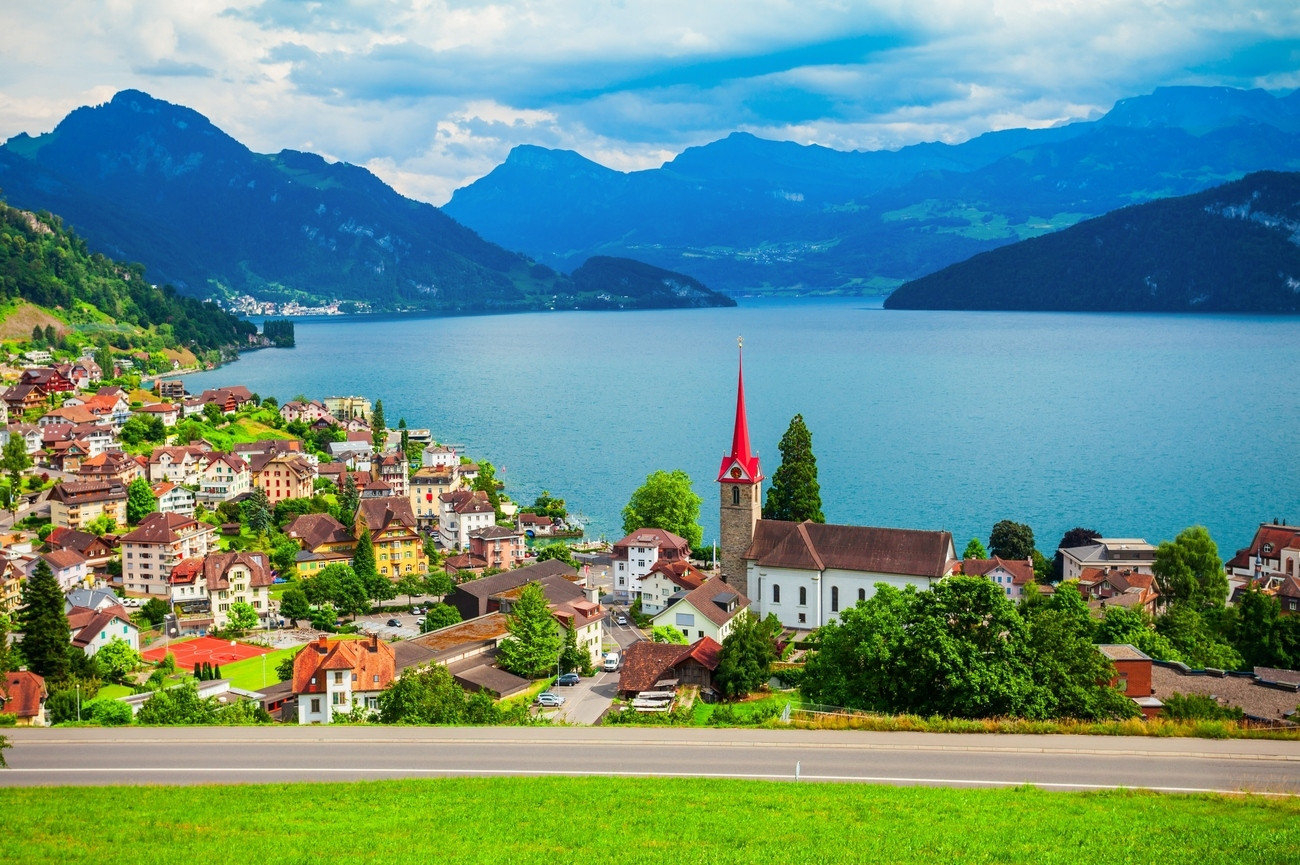
The Chapel Bridge (Kapellbrücke), built in 1333, is the oldest wooden bridge in Europe still standing, crossing the Reuss River in the city's compact old town. Mount Pilatus, reached by the world's steepest cog railway (gradient up to 48%), rises directly behind the city, giving Lucerne a genuine lake-and-mountain combination inside a real, walkable urban center. Boat trips across Lake Lucerne connect to smaller lakeside villages, and the KKL Luzern concert hall, built with acoustics regarded among the best in Europe, hosts a regular classical music program alongside the city's more casual lakefront cafés. Nearby Mount Rigi, reached by Europe's oldest mountain railway, opened in 1871, offers a quieter counterpart to the busier Pilatus route.
🏠 Where to stay in Lucerne
The Old Town (Altstadt) near the Chapel Bridge offers the most walkable base. Hotels along the lake promenade cost more but come with direct mountain views from the room.
🗺️ Things to do in Lucerne
Chapel Bridge (Kapellbrücke)
Europe's oldest wooden bridge, decorated with painted panels inside the roof beams.
Mount Pilatus
Reached by the world's steepest cog railway, with panoramic Alpine views from the summit.
Lake Lucerne boat cruise
Scenic lake crossings connecting Lucerne to smaller lakeside towns.
Lion Monument
A rock-carved monument commemorating Swiss Guards, a short walk from the Old Town.
KKL Luzern concert hall
A modern concert venue on the lakefront known for its acoustics and architecture.
Grindelwald:
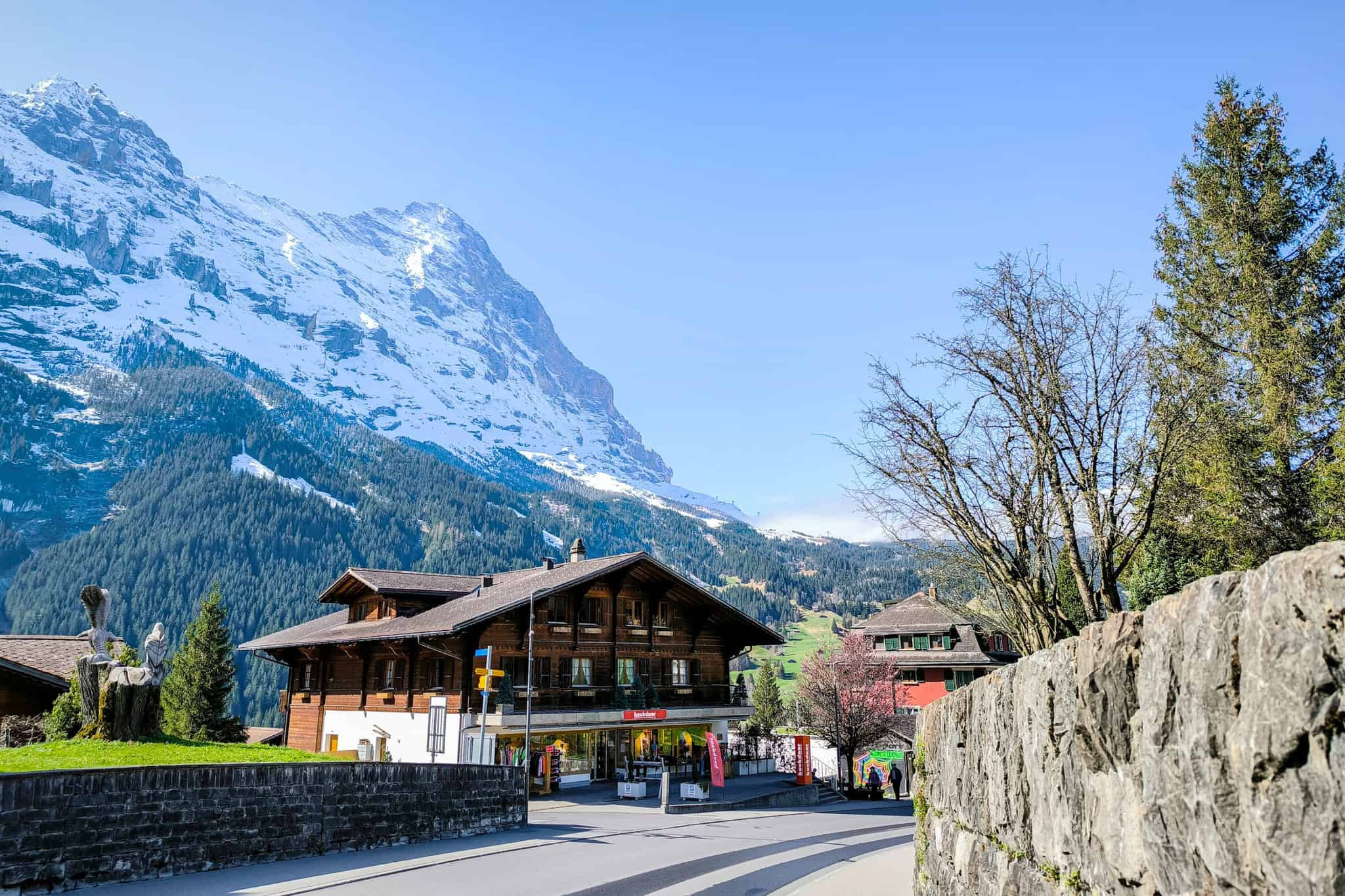
The Eiger's north face (3,967 meters), 1 of the most famous and historically dangerous climbing walls in the world, looms directly over the village. Grindelwald is the standard base for reaching the Jungfraujoch, "Top of Europe," the highest train station on the continent at 3,454 meters, and the Eiger Express gondola, opened in 2020, cut the journey time from the valley considerably. Summer brings some of the region's most photographed hiking trails directly beneath the north face, while winter opens 2 separate ski areas, First and Kleine Scheidegg-Männlichen, both accessible without a car. Local dairy farms still graze cattle on the valley's lower slopes through summer, visible from most of the village's main hiking trails.
🏠 Where to stay in Grindelwald
The village center offers the shortest walk to the main gondola stations. Grund, a lower satellite hamlet, runs cheaper and connects by a short local train.
🗺️ Things to do in Grindelwald
Jungfraujoch (Top of Europe)
Europe's highest railway station at 3,454 meters, with an ice palace and glacier views.
Eiger Trail
A dramatic hiking path directly beneath the Eiger's north face.
First Cliff Walk
A suspended walkway and zipline circuit on the First ridge above the village.
Männlichen cable car
Connects to one of the region's most scenic ridge-line hiking routes.
St. Moritz:
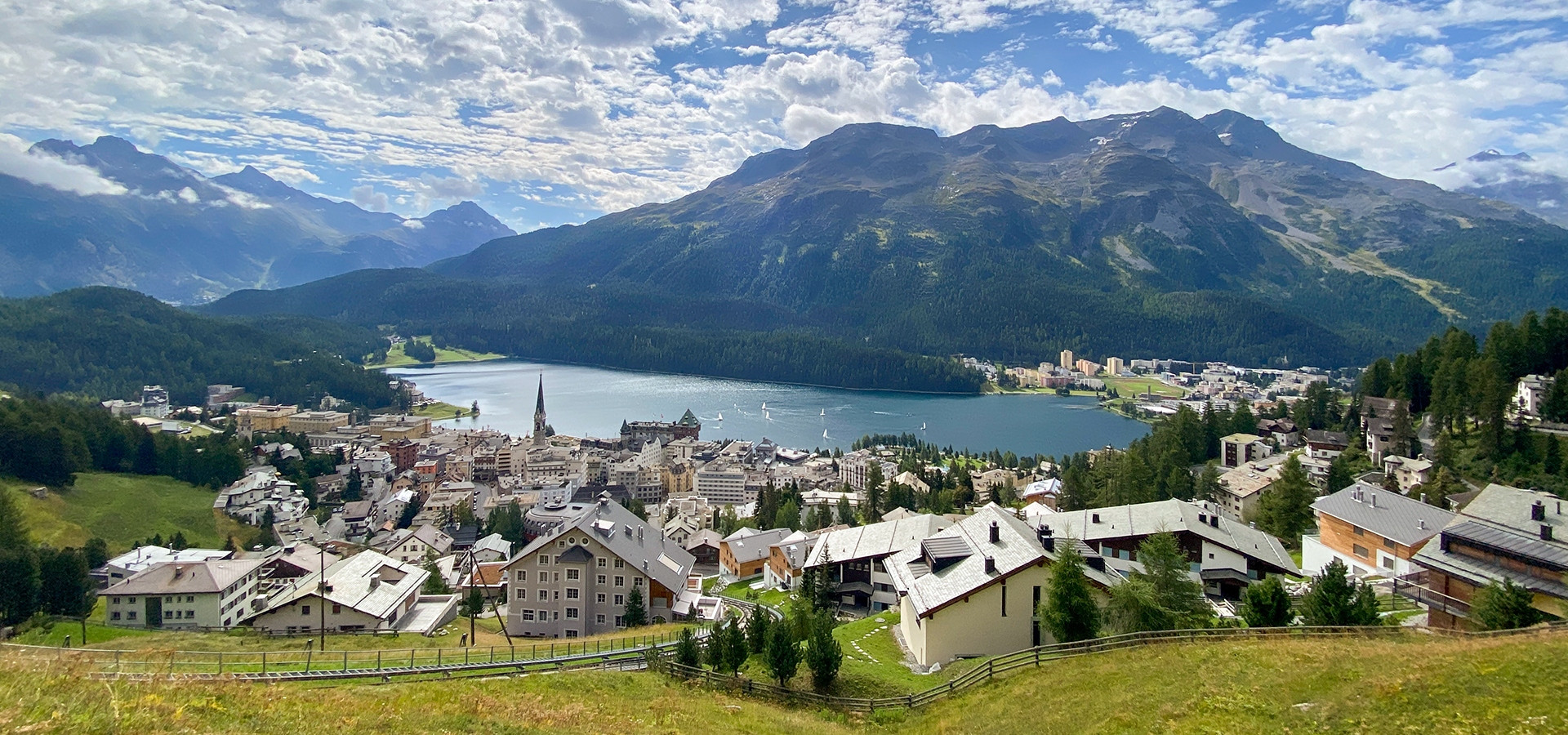
St. Moritz hosted the Winter Olympics twice (1928 and 1948) and has run the Cresta Run, a natural ice skeleton and bobsled track, since 1884. Every February, the White Turf horse races run directly on the frozen surface of Lake St. Moritz, a genuinely unusual venue that exists nowhere else at this scale. The town splits into 2 distinct halves: St. Moritz Dorf, the upper village with luxury hotels and shops, and St. Moritz Bad, the lower spa district by the lake, connected by a short funicular and walking paths. The wider Engadin Valley holds several other lakes linked by flat walking and cycling routes, popular with visitors even outside the main winter season.
🏠 Where to stay in St. Moritz
St. Moritz Dorf sits closest to the shops and the lake promenade at the highest prices in the region. St. Moritz Bad, a short walk or funicular ride below, runs noticeably cheaper with similar lake access.
🗺️ Things to do in St. Moritz
Cresta Run
A natural ice skeleton and bobsled track operating since 1884, open to spectators and thrill-seekers.
Lake St. Moritz
Hosts the frozen-lake White Turf horse races and Snow Polo World Cup each February.
Muottas Muragl funicular
A historic funicular to a panoramic viewpoint over the Engadin lakes.
Segantini Museum
A small museum dedicated to painter Giovanni Segantini's Alpine landscapes.
Interlaken:
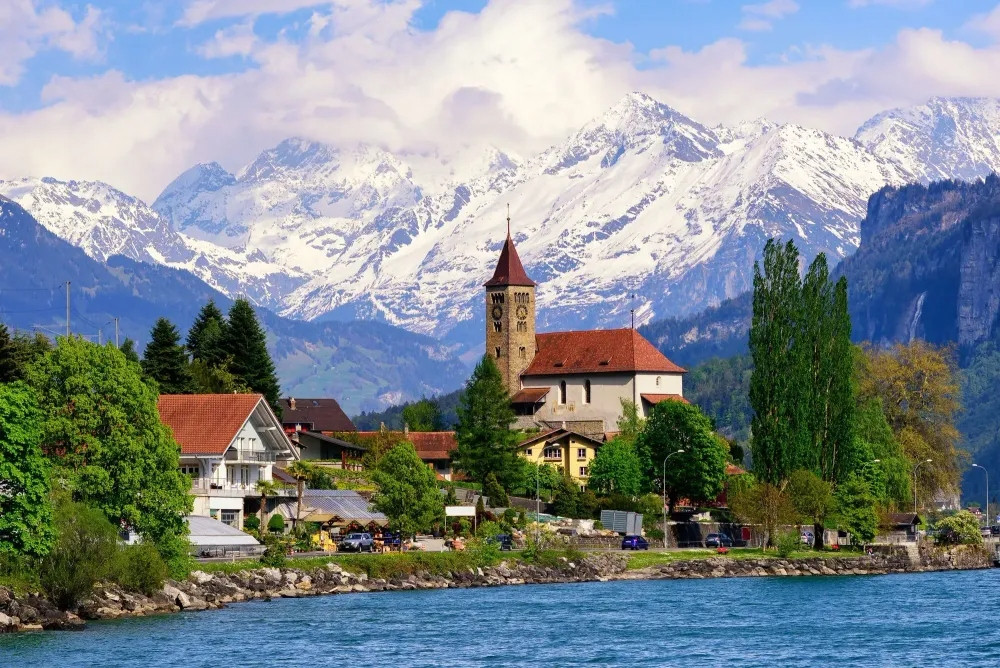
The name means "between lakes" in German, and it's literal: Interlaken sits directly between Lake Thun and Lake Brienz, with the Jungfrau massif visible up the valley. It's the adventure-sports hub of the region, paragliding, canyoning, and skydiving all operate from here, and it functions as the practical transport gateway to Grindelwald and the wider Jungfrau region. The town itself stays compact and low-rise, with both lakes reachable on foot from the central Höheweg promenade, and its position at the base of the valley makes it the natural overnight base for day trips deeper into the mountains. Its central position also makes it the standard overnight stop for travelers connecting onward to Zermatt or Lucerne by train.
🏠 Where to stay in Interlaken
The central Höheweg area puts you between both train stations and close to the adventure-sports booking offices. Budget hostels cluster near the West station, a short walk from the lake.
🗺️ Things to do in Interlaken
Harder Kulm viewpoint
A funicular-accessed lookout with views over both lakes and the Jungfrau massif.
Paragliding over the valley
Tandem flights launching from nearby peaks, landing in the town center.
Lake Brienz boat cruise
A scenic lake crossing to the turquoise-blue Brienz waters.
St. Beatus Caves
Illuminated limestone caves and waterfalls a short bus ride from town.
Davos:
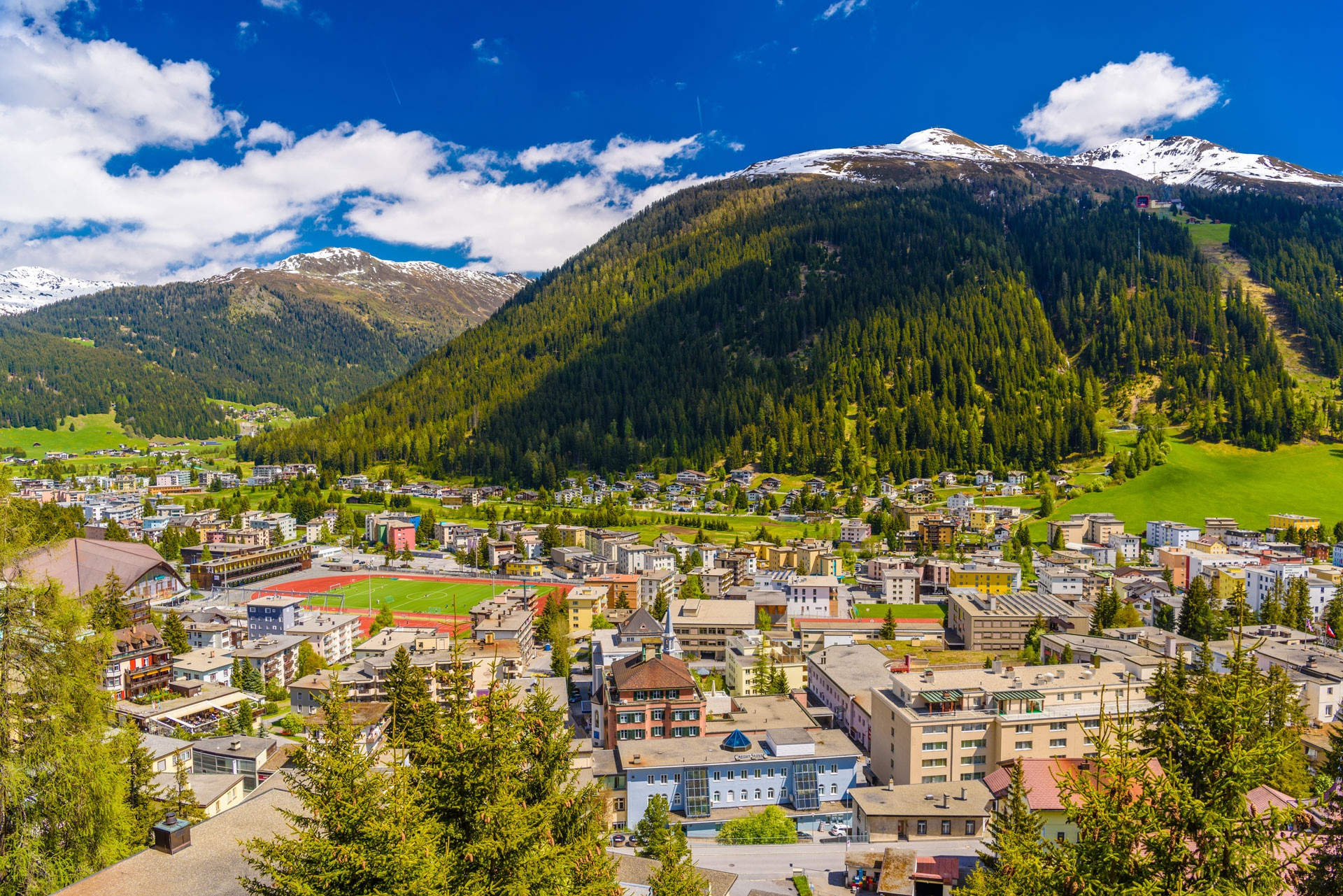
At 1,560 meters, Davos is one of the highest towns in Europe, and it's best known internationally for hosting the World Economic Forum every January since 1971, when world leaders and business figures descend on a town of under 11,000 residents. Beyond the conference, Davos runs one of the largest connected ski areas in the region across 6 mountains, and its high altitude and dry climate historically made it a destination for tuberculosis treatment in the late 19th century, the same clean-air reputation that now draws hikers and cyclists in summer. Its dry climate and roughly 300 days of annual sunshine originally attracted tuberculosis patients before drawing skiers and hikers instead.
🏠 Where to stay in Davos
Davos Platz, the main village center, sits closest to the largest lift stations and the conference center. Davos Dorf, a short train stop away, runs quieter and slightly cheaper.
🗺️ Things to do in Davos
Jakobshorn
A mountain known for freestyle skiing and snowboarding terrain parks in winter.
Lake Davos
A flat lakeside path popular for walking, jogging, and ice skating in winter.
Schatzalp funicular
A historic funicular to a plateau with hiking trails and mountain views.
Kirchner Museum Davos
A museum dedicated to Expressionist painter Ernst Ludwig Kirchner, who lived nearby.
4 townsFrench Alps:
From the birthplace of the Winter Olympics to a canal-lined lake town, France's Alpine towns split cleanly between serious mountaineering and genuine relaxation.
Chamonix:
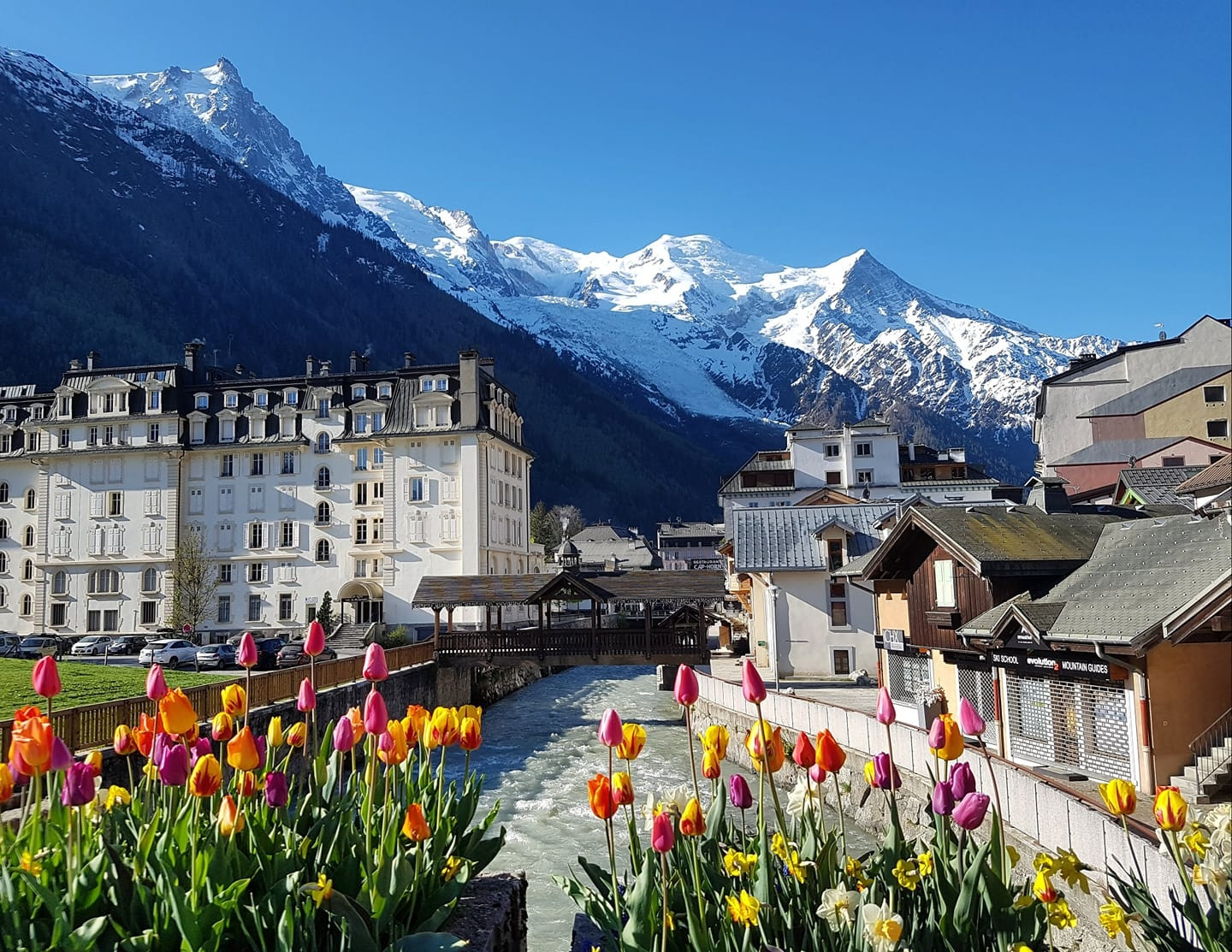
Chamonix hosted the first-ever Winter Olympics in 1924 and has stayed Europe's mountaineering capital since. Mont Blanc, at 4,808 meters the highest peak in Western Europe, sits directly above the town, and the Aiguille du Midi cable car climbs to 3,842 meters, one of the highest cable car ascents on the continent, in around 20 minutes from the valley floor. The town retains a genuine, lived-in feel despite its fame, with a year-round population running actual businesses, not functioning purely as a seasonal resort shell, and the surrounding trails connect into the multi-day Tour du Mont Blanc circuit, a route that takes most hikers 7 to 11 days to complete in full.
🏠 Where to stay in Chamonix
Central Chamonix puts you closest to the Aiguille du Midi cable car and the main train station. Les Praz and Argentière, satellite villages a short bus ride away, offer quieter, cheaper alternatives.
🗺️ Things to do in Chamonix
Aiguille du Midi cable car
Climbs to 3,842 meters, including a glass viewing platform called the Step into the Void.
Mer de Glace glacier
France's largest glacier, reached by a historic cog railway and ice cave.
Tour du Mont Blanc
A multi-day hiking circuit around the Mont Blanc massif, doable in shorter day sections.
Planpraz cable car
A quicker, lower-altitude alternative with strong Mont Blanc views and hiking access.
Annecy:
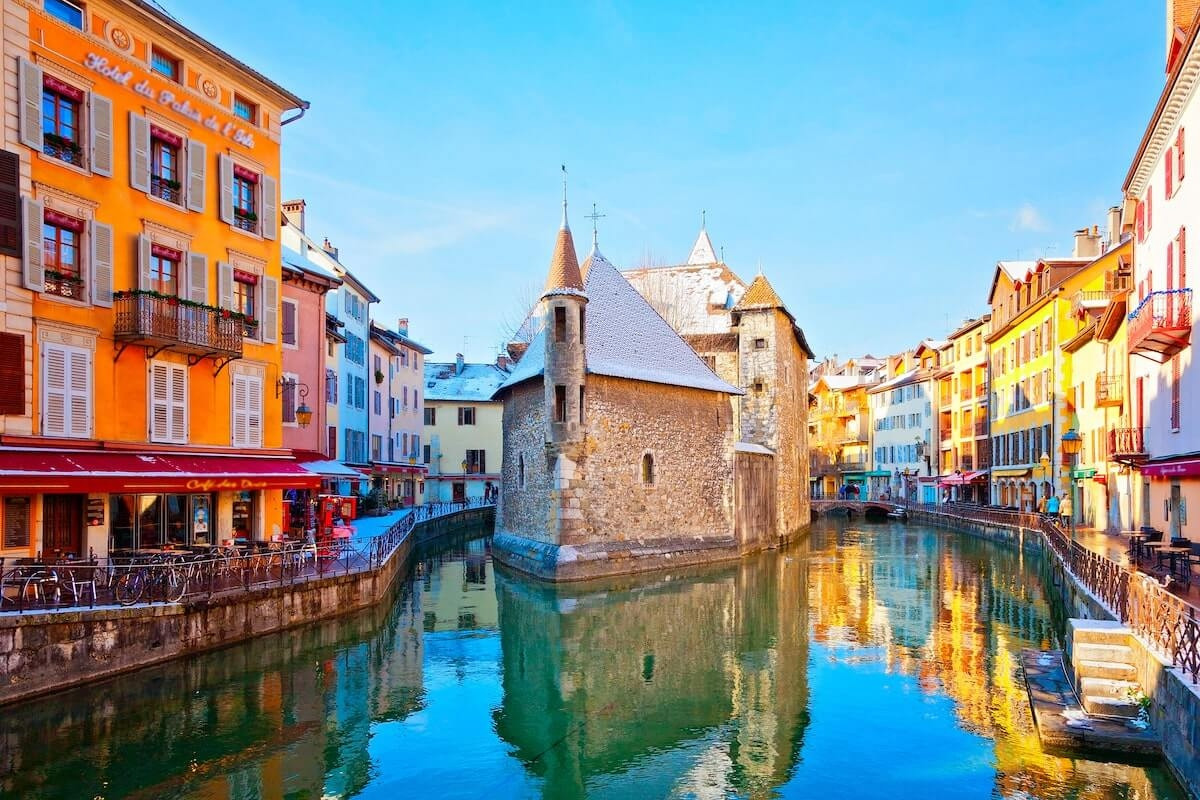
Called the "Venice of the Alps" for the canals running through its old town, Annecy sits on Lake Annecy, regularly ranked among the cleanest lakes in Europe. The combination of mountain backdrop, canal-side architecture, and swimmable water gives it a genuinely different character from the ski-focused towns elsewhere on this list. The old town's Palais de l'Isle, a former prison built on a small island in the canal, dates to the 12th century, and a paved lakeside path circles much of the lake for cycling, making Annecy one of the more relaxed bases on this entire guide. The town's Thursday, Friday, and Sunday markets draw locals and visitors alike for fresh regional produce and cheese.
🏠 Where to stay in Annecy
The old town (Vieille Ville) puts you inside the canal district within walking distance of the lake. Neighborhoods along the lakeshore south of the center offer quieter, more residential lodging with direct water access.
🗺️ Things to do in Annecy
Palais de l'Isle
A 12th-century former prison built on a small island in the town's canal.
Lake Annecy cycling path
A paved route circling much of the lake, rentable by the hour.
Château d'Annecy
A former residence of the Counts of Geneva, now a local history museum.
Lake Annecy swimming beaches
Several public beaches with clean, swimmable water through summer.
Les Deux Alpes:
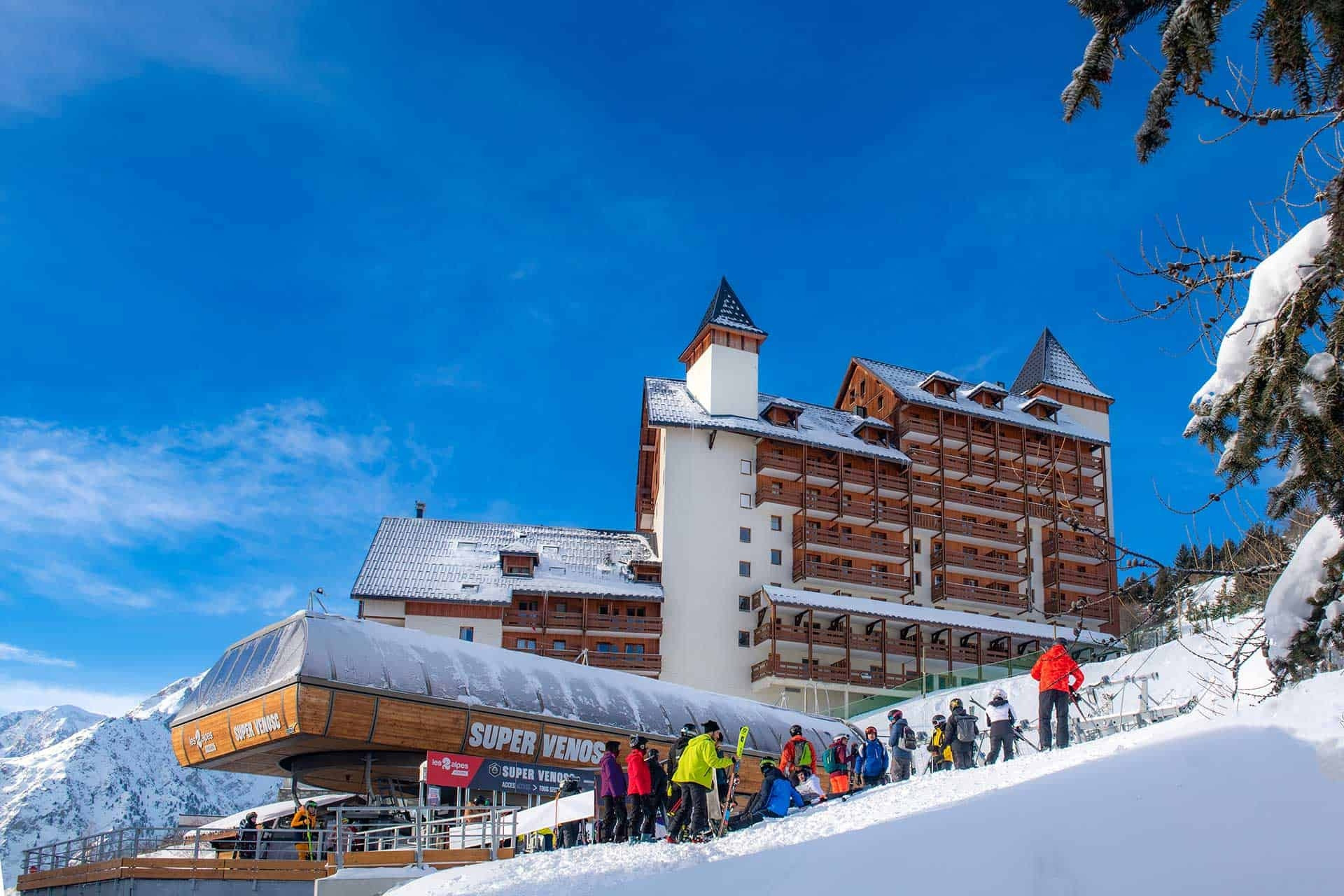
One of the highest ski resorts in Europe, with glacier skiing available up to 3,600 meters, which keeps the slopes open into summer months when most Alpine resorts have shut down entirely. The Venosc cable car connects the resort to the valley village below, giving summer visitors mountain access without needing snow at all. The resort was purpose-built for skiing, not grown from an older village, which means less historic architecture than towns like Chamonix or Annecy, but a layout genuinely optimized for direct slope access from most accommodation. A zipline strung between the resort and the neighboring village of Mont-de-Lans ranks among the longest in Europe.
🏠 Where to stay in Les Deux Alpes
Ski-in, ski-out apartments near the main lift stations cost the most but save real time each day. The lower village and nearby Venosc offer a quieter, more traditional alternative a short cable car ride away.
🗺️ Things to do in Les Deux Alpes
Glacier skiing on the Dôme
Summer skiing at up to 3,600 meters, rare among European resorts.
Venosc cable car
Connects the resort to the older valley village below.
La Meije viewpoint
A dramatic peak visible from the resort's upper lift stations.
Diable au Coeur mountain restaurant
A slopeside restaurant reachable only by ski, gondola, or hike.
Chambéry:
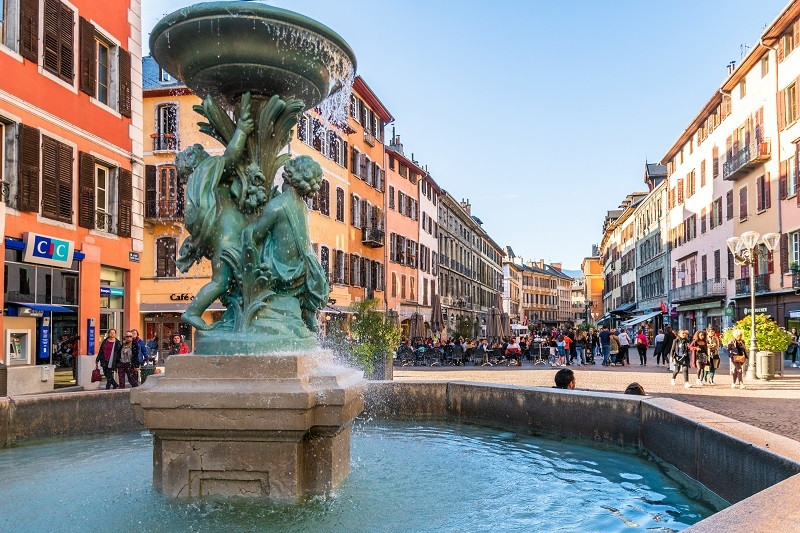
Chambéry served as the historic capital of the Duchy of Savoy for centuries before the region joined France in 1860, and the Château des Ducs de Savoie still anchors the old town today. The Fontaine des Éléphants, built in 1838 to honor a local benefactor who made his fortune in India, remains the city's most photographed landmark, with its 4 larger-than-life elephant sculptures. Chambéry sits at the meeting point of several Alpine valleys, which makes it a practical, less touristy base for exploring the wider Savoie region without the crowds of the bigger-name resort towns. Rail connections make it a practical hour's link to both Annecy and the larger ski resorts of the Tarentaise valley.
🏠 Where to stay in Chambéry
The old town streets around Place Saint-Léger put every major sight within a short walk. Chambéry has considerably lower accommodation rates than the ski resorts further into the mountains, a genuine advantage for a multi-stop Alps trip.
🗺️ Things to do in Chambéry
Fontaine des Éléphants
A 19th-century fountain with 4 elephant sculptures, the city's signature landmark.
Château des Ducs de Savoie
The former ducal residence, now partly used for regional administration and tours.
Les Charmettes
Jean-Jacques Rousseau's former countryside home, now a small museum.
Old town walking streets
Colorful pedestrian lanes lined with cafés, starting at Place Saint-Léger.
3 townsItalian Dolomites:
Home to the Winter Olympics' second host city and a UNESCO mountain range recognized since 2009.
Cortina d'Ampezzo:
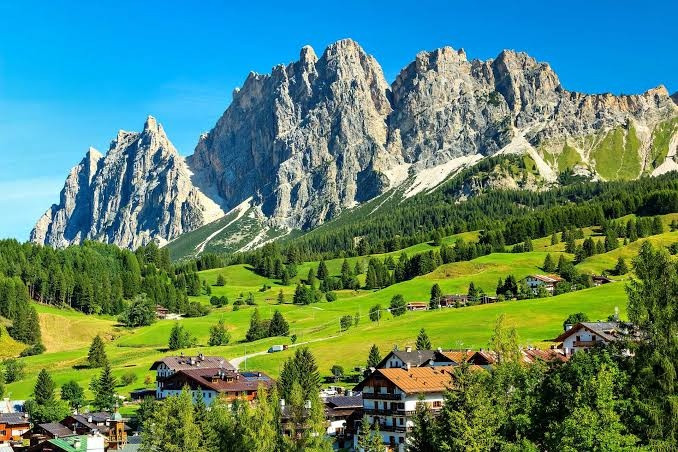
Cortina co-hosted the Milano Cortina 2026 Winter Olympics (February 6-22, 2026) alongside Milan, its second time hosting after the original 1956 Games, and the town's alpine skiing, bobsled, and curling venues are still fresh from the event. The Dolomites themselves have held UNESCO World Heritage status since 2009, and the town sits at 1,220 meters, ringed by the Tofane and Cinque Torri peaks. Known as the "Queen of the Dolomites," Cortina pairs genuine ski-resort infrastructure with a level of boutique shopping and dining that few other mountain towns on this list can match. Sunset light on the surrounding peaks, locally called enrosadira, turns the rock a distinct pink and orange on most clear evenings.
🏠 Where to stay in Cortina d'Ampezzo
Central Cortina, around Corso Italia, puts you closest to the shops and the Olympic venues at the highest prices. Outlying hamlets like Pocol offer mountain views and lower rates a short drive from the center.
🗺️ Things to do in Cortina d'Ampezzo
Olympia delle Tofane ski run
The historic race slope used in both the 1956 and 2026 Olympics.
Cinque Torri
5 distinctive rock towers with hiking trails and open-air WWI trench museums.
Lake Sorapis hike
A demanding day hike to a striking turquoise glacial lake.
Corso Italia
Cortina's pedestrian main street, lined with boutiques and cafés.
Val Gardena:
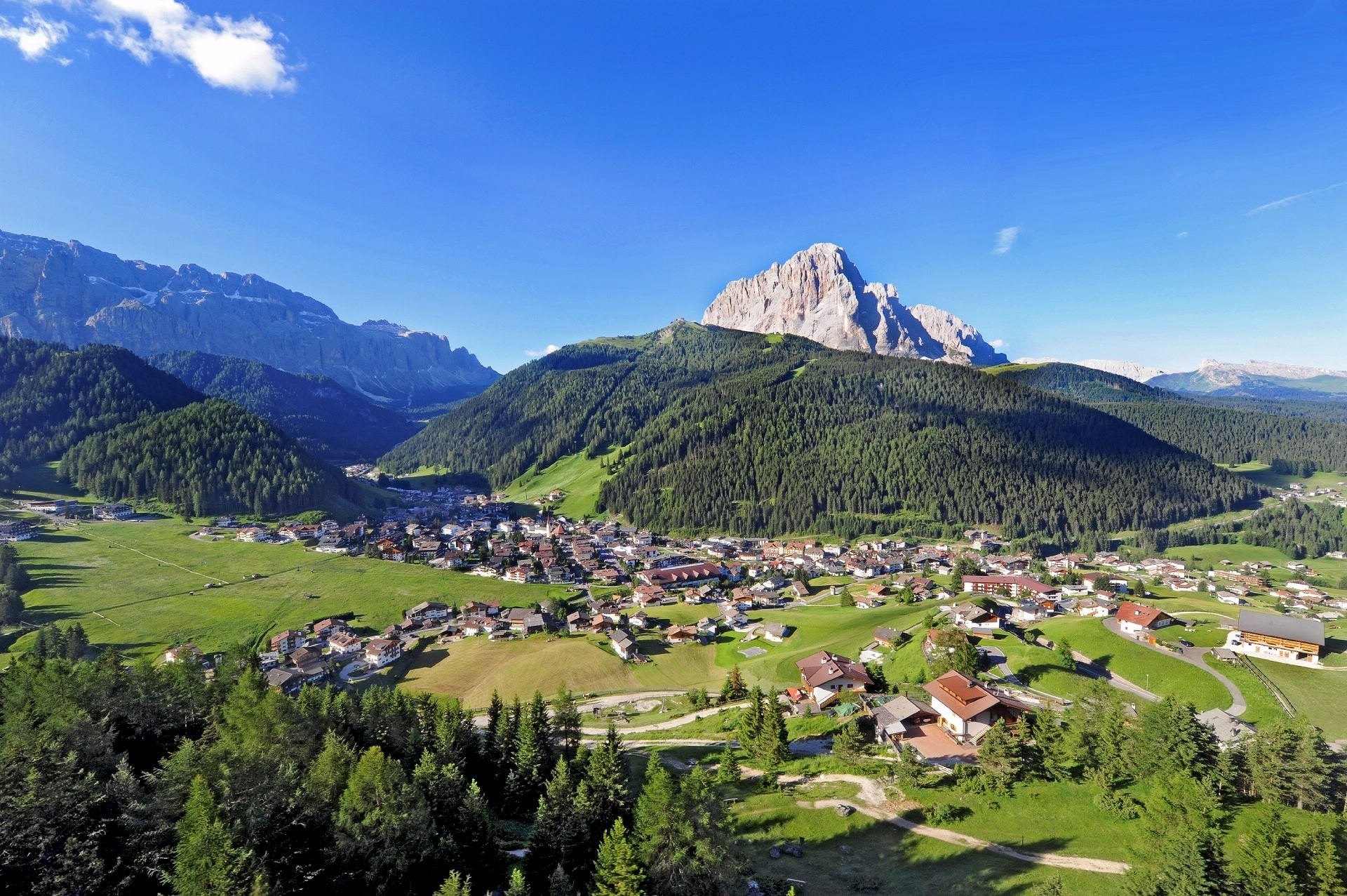
Val Gardena forms part of the Sella Ronda, a 40-kilometer ski circuit looping through 4 valleys, and it's 1 of the few places in Italy where Ladin, a distinct Romance language predating both Italian and German influence in the region, is still spoken alongside both. Summer swaps skis for over 175 kilometers of marked hiking trails through the same terrain, and the valley's 3 main villages, Ortisei, Santa Cristina, and Selva, each offer a slightly different pace, from Ortisei's larger town center to Selva's closer access to the high peaks. Local woodcarving workshops, a centuries-old regional craft, still operate in several of the valley's smaller villages.
🏠 Where to stay in Val Gardena
Ortisei, the valley's largest village, has the most restaurants and shops within walking distance. Selva sits closest to the Sella Ronda lift network for anyone prioritizing ski or hiking access over town amenities.
🗺️ Things to do in Val Gardena
Sella Ronda circuit
A 40km ski loop through 4 valleys, doable in a single day by lift and piste.
Seceda ridge
A dramatic knife-edge ridgeline reachable by cable car, among the Dolomites' most photographed views.
Ladin culture museums
Small local museums preserving the valley's distinct pre-Roman language and traditions.
Alpe di Siusi
Europe's largest high-altitude alpine meadow, adjoining the valley for hiking and cross-country skiing.
Plan de Corones:
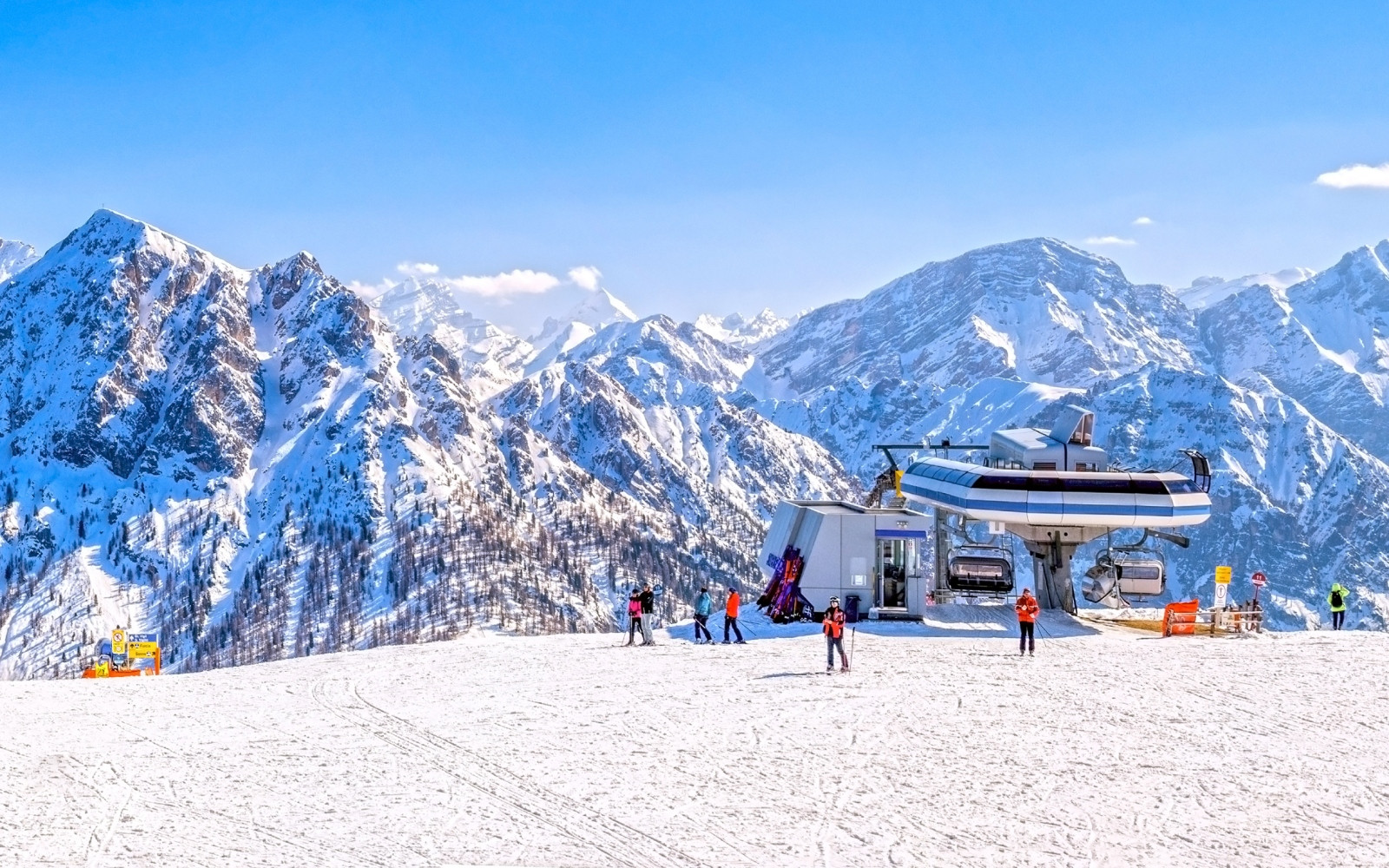
Plan de Corones (Kronplatz) offers around 119 kilometers of ski slopes, among the largest single ski areas in South Tyrol, and its summit holds the Reinhold Messner Mountain Museum, designed by architect Zaha Hadid and built directly into the mountain rock. The museum draws visitors who have no interest in skiing at all, a genuinely rare pull for a ski-resort summit. The mountain rises between 3 South Tyrolean valleys, giving skiers access to 3 distinct base areas and giving hikers a genuine choice of starting village depending on where they're staying. A separate summit installation, the Lumen Museum of Mountain Photography, opened in 2018 inside a former military bunker.
🏠 Where to stay in Plan de Corones
Base villages like Bruneck (Brunico) at the foot of the mountain offer the most amenities and transit connections. Smaller hamlets closer to the lift stations save commute time but offer fewer dining options.
🗺️ Things to do in Plan de Corones
Reinhold Messner Mountain Museum (MMM Corones)
A Zaha Hadid-designed museum built into the summit rock.
Kronplatz cable car
Rises to the summit from 3 separate valley base stations.
Concert platform (Concert Balcony)
A cliffside viewing platform with panoramic Dolomite views.
Bruneck old town
A well-preserved medieval town center at the base of the mountain.
3 townsNordic Mountains and Fjords:
Norway and Iceland's mountain terrain runs volcanic and glacial, not classically alpine, a genuinely different geology from the rest of this guide.
Bergen:
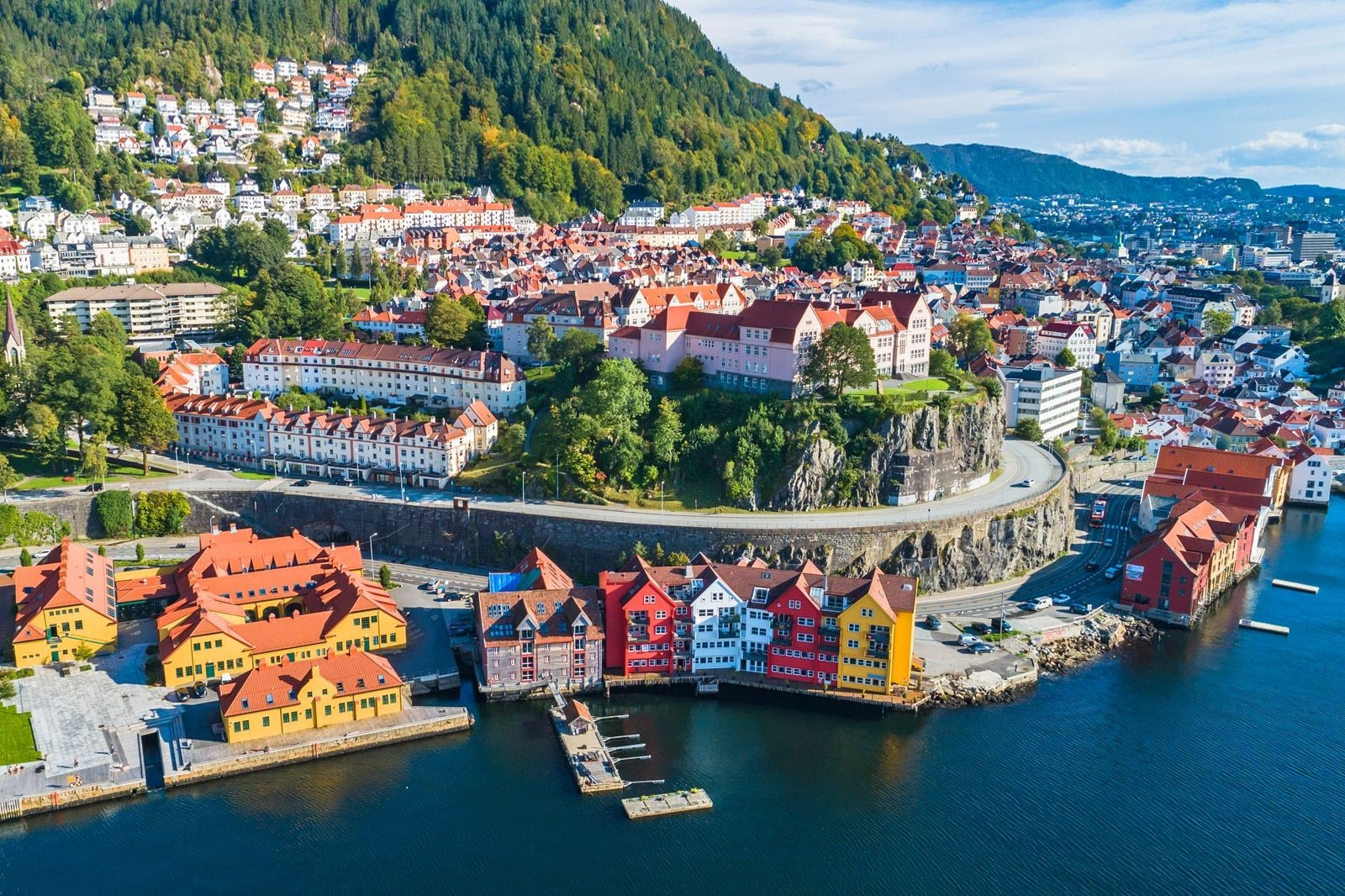
Bryggen, Bergen's row of wooden wharf buildings dating to the 14th century, has held UNESCO World Heritage status since 1979, and the Fløyen funicular lifts visitors from the harbor to a mountaintop viewpoint in about 8 minutes. Bergen also ranks among Europe's rainiest cities, worth planning around, not something to be surprised by. The city functions as the practical gateway to Norway's western fjords, with ferries and scenic train routes departing regularly, and its compact harbor-front layout means most of the historic sights, the fish market, Bryggen, and the funicular base, sit within a 15-minute walk of each other, a detail worth checking against the forecast before planning a multi-day stay.
🏠 Where to stay in Bergen
The harbor area near Bryggen offers the most walkable base for the historic sights. Neighborhoods slightly uphill save money while staying within easy walking distance of the center.
🗺️ Things to do in Bergen
Bryggen wharf
UNESCO-listed 14th-century wooden buildings lining the historic harbor.
Fløyen funicular
Reaches a mountaintop viewpoint over the city and harbor in about 8 minutes.
Bergen Fish Market
A working seafood market with stalls selling fresh and prepared catch.
Fjord cruise departures
Bergen's harbor is the main departure point for scenic western fjord tours.
Olden:
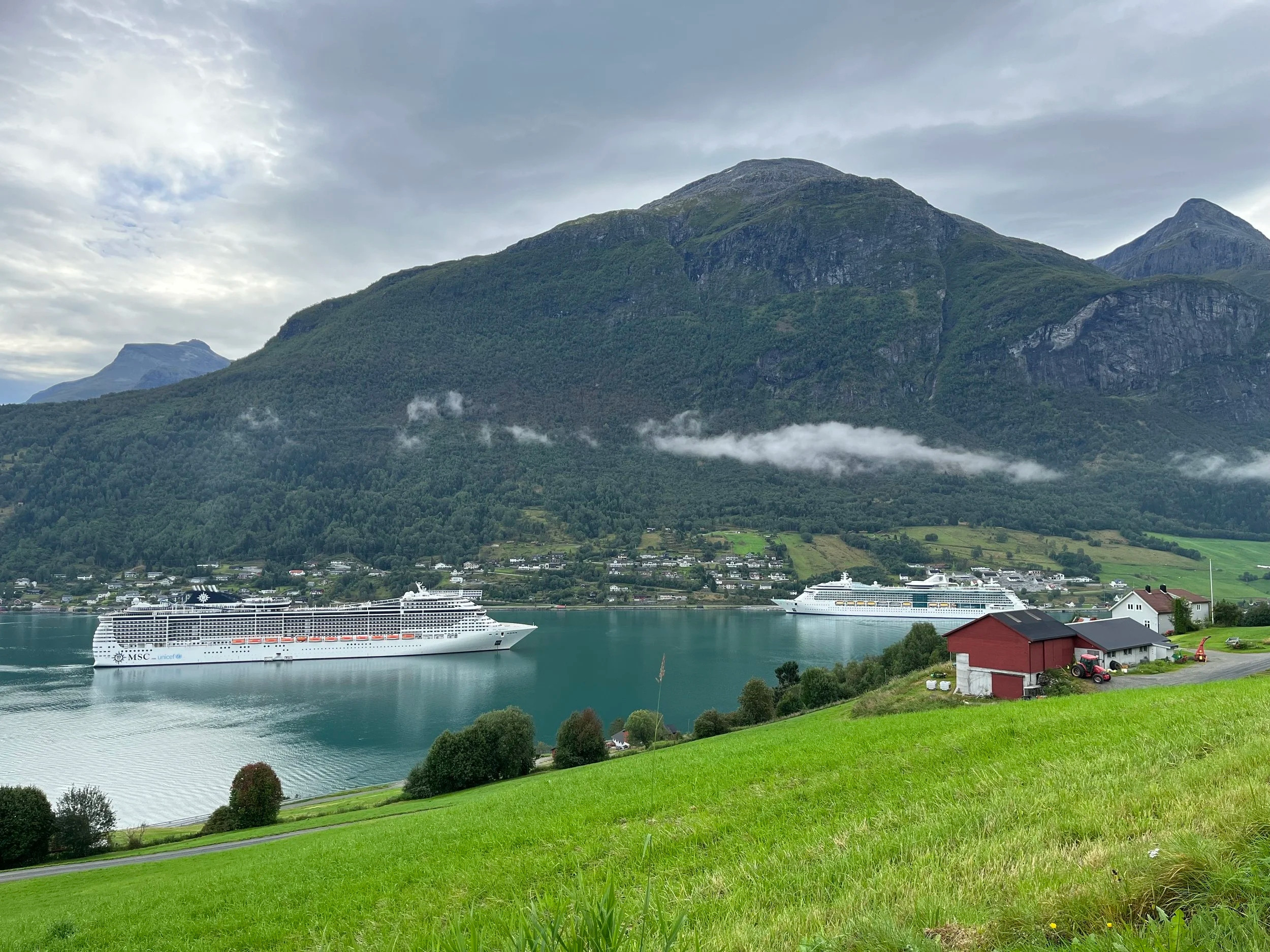
Olden sits an hour from the Briksdalsbreen arm of Jostedalsbreen, mainland Europe's largest glacier, reachable by a combination of short hike and glacier-adapted vehicle. The surrounding national park delivers some of the most dramatic ice-and-fjord scenery in Norway without the crowds of the more famous fjord towns further south. The village itself stays small, built mainly around cruise ship arrivals and glacier tour operators, so most visitors treat it as a day-trip base, not a multi-day stay, though the surrounding valley rewards a longer visit for anyone with the time. Cruise ships stop here regularly through summer, so mornings before midday tend to run considerably quieter than the afternoon.
🏠 Where to stay in Olden
Olden itself has limited lodging options given its small size; guesthouses and farm stays in the surrounding valley offer a genuine local alternative with glacier views from the property.
🗺️ Things to do in Olden
Briksdalsbreen glacier
An accessible glacier arm reached by a short hike or glacier-adapted troll car.
Lovatnet lake
A turquoise glacial lake with hiking and kayaking a short drive from the village.
Jostedalsbreen National Park
Mainland Europe's largest glacier, with multiple access points for guided ice walks.
Kjenndalsbreen glacier arm
A less-visited alternative glacier viewpoint further into the valley.
Vik i Myrdal:
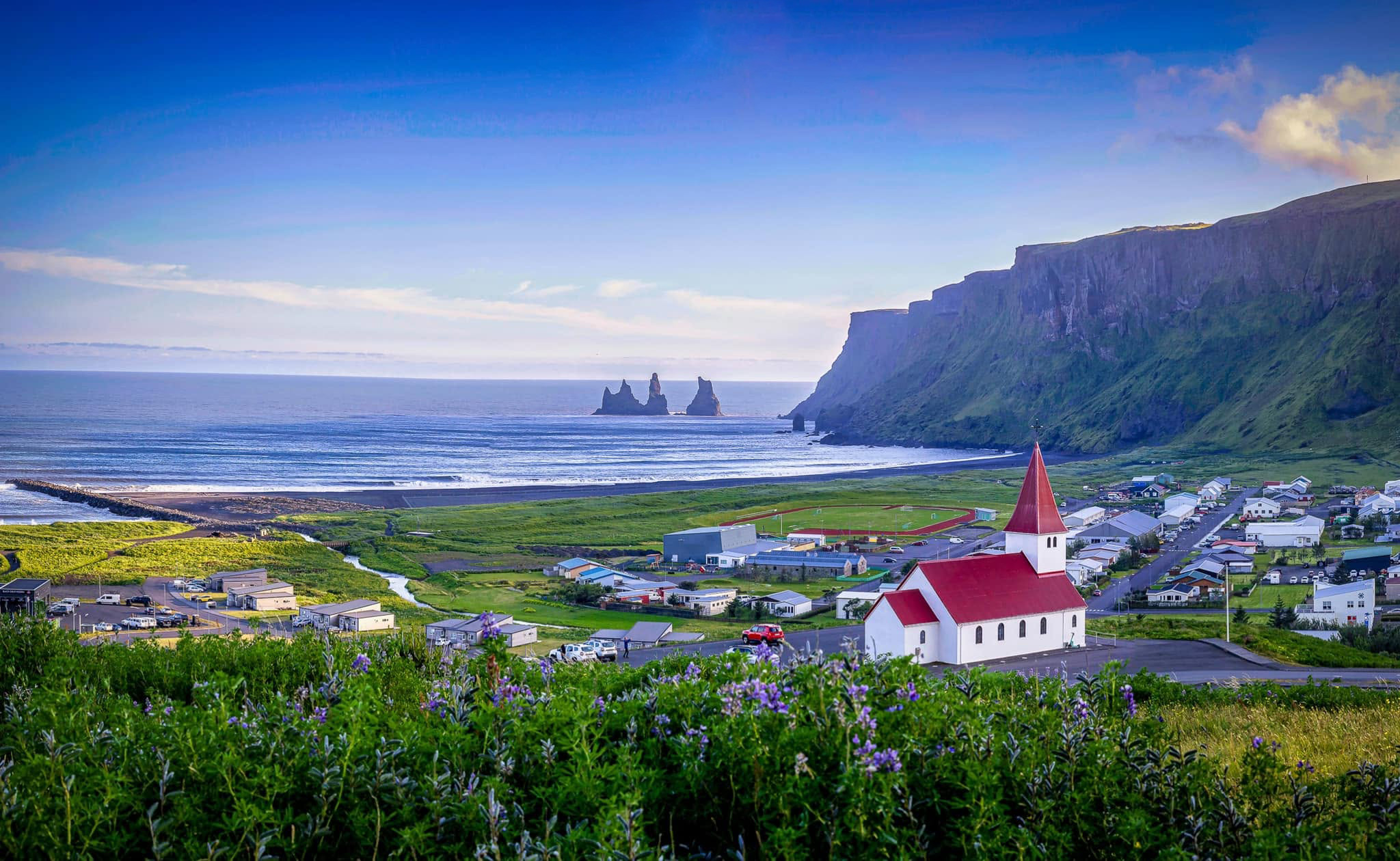
Iceland's southernmost village sits beside Reynisfjara, a black sand beach with hexagonal basalt columns formed by rapidly cooled lava, and the nearby Dyrholaey peninsula hosts nesting puffins through the summer months. The mountain backdrop here is volcanic, not alpine, a genuinely different geology from every other town on this list. The village itself holds only a few hundred residents, functioning mainly as a base for exploring the surrounding coastline, and the black sand beach carries genuine danger from sneaker waves, a detail every visitor should take seriously, not treat as decoration. The Ring Road connects the village directly to Reykjavik, roughly a 2.5-hour drive, making it a common overnight stop on round-island trips.
🏠 Where to stay in Vik i Myrdal
Vik has a small number of guesthouses and 1 larger hotel; book well ahead in summer since options are genuinely limited for a stop this popular on the Ring Road.
🗺️ Things to do in Vik i Myrdal
Reynisfjara black sand beach
Basalt sea stacks and hexagonal columns, with genuine sneaker-wave danger to respect.
Dyrholaey peninsula
A coastal arch and puffin nesting site with panoramic ocean views.
Reyniskirkja church viewpoint
A small white church on a hill overlooking the village and coastline.
Skogafoss and Seljalandsfoss waterfalls
2 major waterfalls a short drive west of the village.
4 townsBalkan and Central Europe:
3 countries and a genuine Nazi-era historical site sit alongside Slovenia's most photographed lake and Montenegro's fjord-like bay.
Bled:
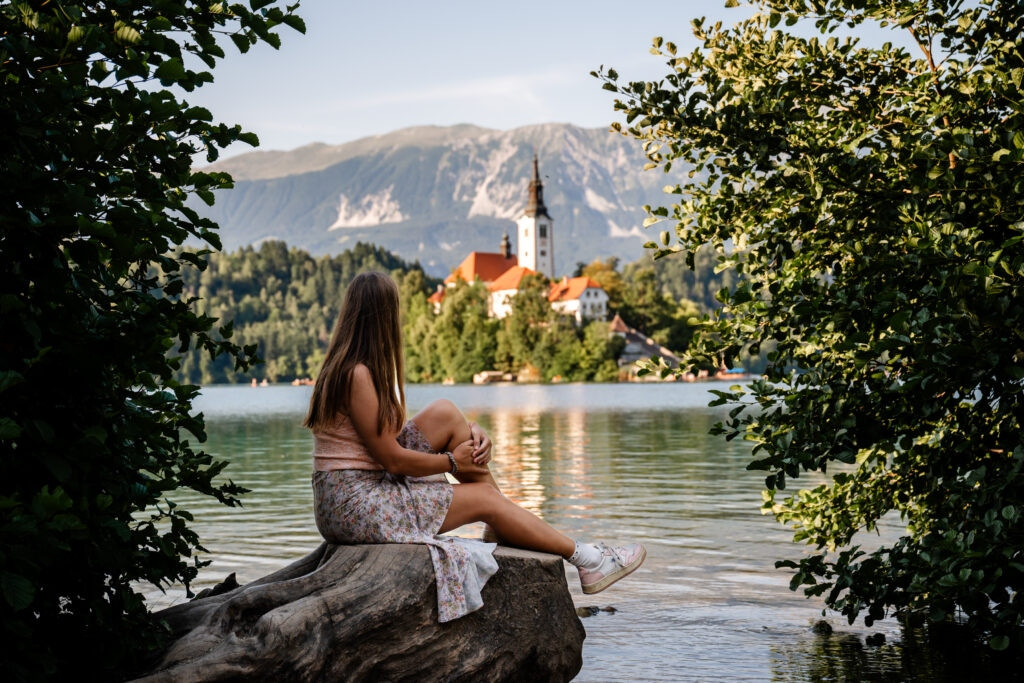
Bled Castle, perched 130 meters above the lake, dates to 1011 and ranks among the oldest castles in Slovenia. The single islet in the middle of Lake Bled, topped with a small church, is reachable only by a traditional wooden pletna boat, rowed by hand, one of the few lake-island approaches in Europe still done this way out of genuine tradition, not staged novelty. The town itself stays small and walkable, circling the lake on a flat path that takes about 90 minutes on foot, with the Julian Alps visible across the water on clear days. Local bakeries sell kremna rezina, a custard cream cake specific to the town, worth trying at a lakeside café.
🏠 Where to stay in Bled
Lakefront hotels put you directly on the water with castle and island views but cost more. Guesthouses a few streets back from the lake, still within a 10-minute walk, run noticeably cheaper.
🗺️ Things to do in Bled
Bled Island church
Reached only by traditional pletna rowing boats from the lakeshore.
Bled Castle
An 11th-century clifftop castle with a small museum and panoramic lake views.
Lake Bled walking path
A flat, roughly 90-minute loop around the entire lake.
Vintgar Gorge
A wooden walkway through a narrow river gorge, a short drive from town.
Kotor:
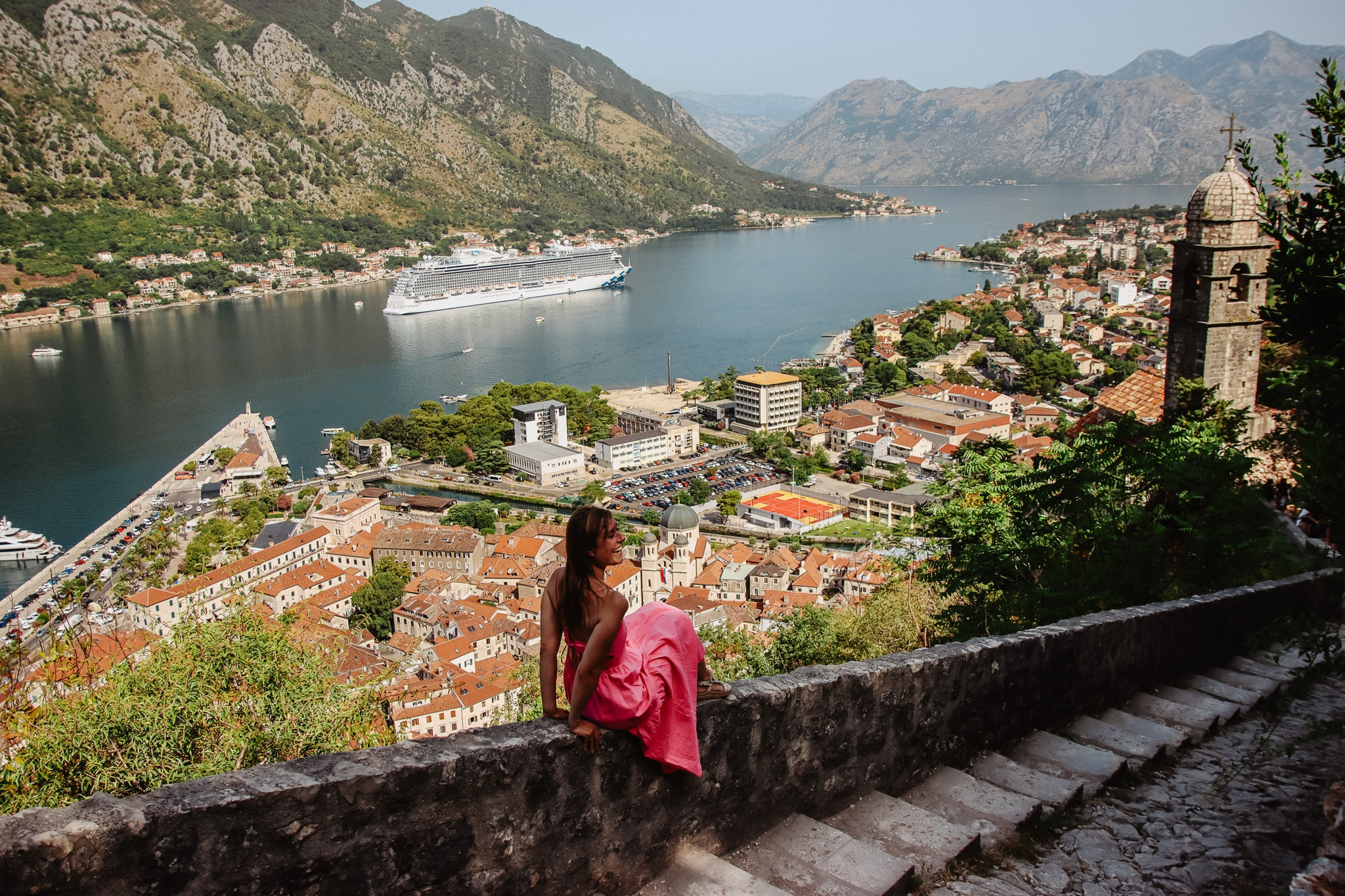
Kotor's Bay, a UNESCO World Heritage site, cuts so deeply into the mountains that it's often mistaken for a fjord, though it's technically a submerged river canyon. The medieval city walls stretch 4.5 kilometers and climb to St. John's Fortress at 260 meters, a genuinely demanding climb rewarded with a view over both the bay and the old town's terracotta rooftops. Cruise ships dock directly in the old town during peak season, which crowds the narrow medieval streets considerably by midday, so an early morning or late afternoon visit avoids the worst of it. Its position along the Adriatic coast also makes it a common stop on Balkan road trips connecting to Dubrovnik further north.
🏠 Where to stay in Kotor
Staying inside the old town walls puts you closest to the fortress climb and the main sights, though rooms here run smaller and pricier. Nearby Dobrota and Perast, along the bay, offer quieter, more residential bases.
🗺️ Things to do in Kotor
St. John's Fortress climb
A steep 4.5km wall circuit to 260 meters, with bay views the whole way up.
Kotor Old Town
A walled medieval center with Venetian architecture and narrow stone streets.
Perast and Our Lady of the Rocks
A nearby village and an artificial islet church reachable by boat.
Bay of Kotor boat tour
Scenic cruises around the fjord-like bay's villages and coastline.
Zakopane:
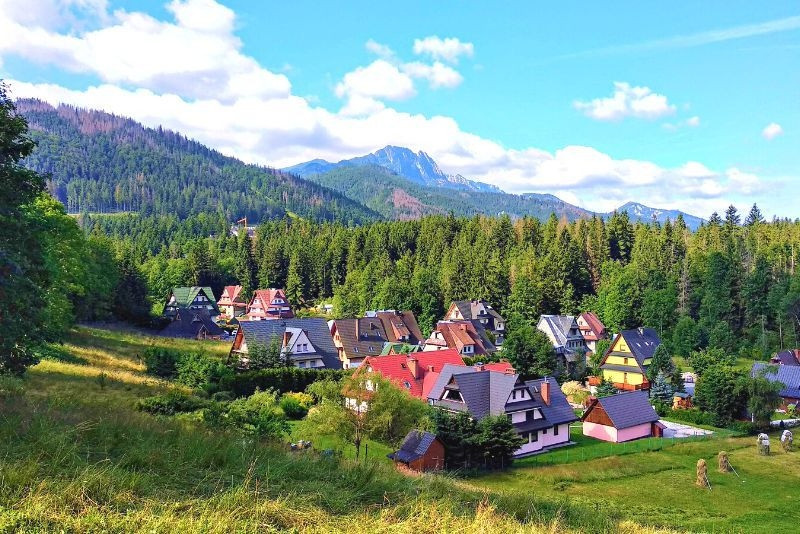
Known as Poland's "winter capital," Zakopane serves as the main gateway to Tatra National Park, and its distinct Podhale wooden architecture, steep shingled roofs and carved facades, developed independently from the more famous Alpine building styles further west. The Gubalowka funicular gives a quick panoramic view over the town and the Tatra range without a hike. Prices here run considerably lower than equivalent Alpine resorts in Switzerland or Austria, which has made Zakopane a genuine budget alternative for skiing and hiking without sacrificing real mountain scenery. Krupowki street stays lively well into the evening with food stalls selling oscypek, a traditional smoked sheep cheese unique to the region.
🏠 Where to stay in Zakopane
Krupówki, the main pedestrian street, puts you closest to restaurants and shops at the highest local prices. Quieter residential streets a short walk away offer the same mountain access for considerably less.
🗺️ Things to do in Zakopane
Gubalowka funicular
A quick ride to a panoramic ridge view over the town and Tatra range.
Morskie Oko lake hike
A popular day hike to one of Poland's most photographed alpine lakes.
Krupówki street
The main pedestrian street, lined with shops, food stalls, and traditional architecture.
Kasprowy Wierch cable car
Rises to a high-altitude ridge on the Slovak border, popular for skiing and hiking.
Berchtesgaden:
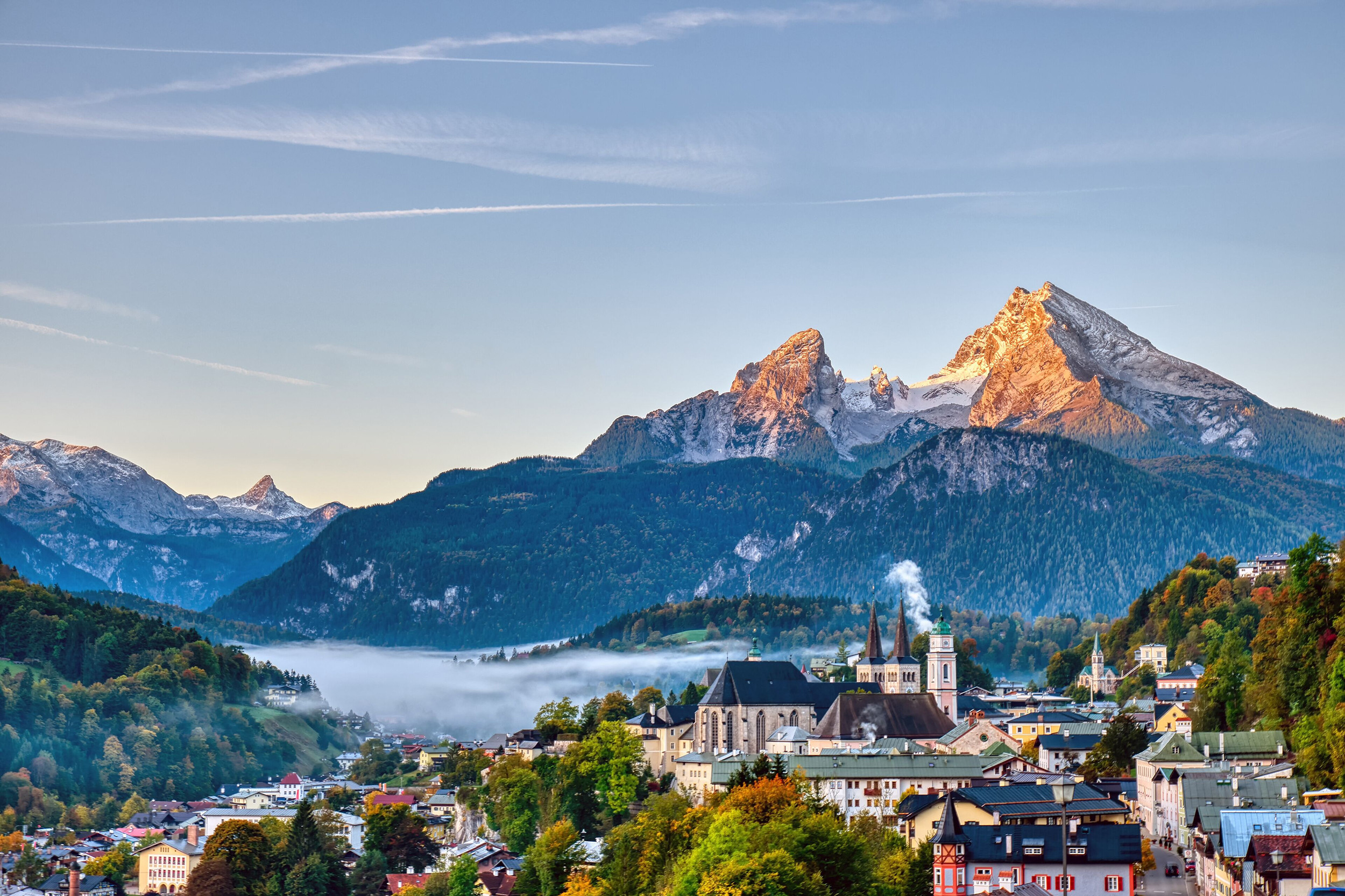
Konigssee, often cited as Germany's cleanest lake, sits inside Berchtesgaden National Park beneath the Watzmann, the country's second-highest peak. The Eagle's Nest (Kehlsteinhaus), built in 1938, sits at 1,834 meters and today functions as a restaurant and viewpoint, its wartime history documented directly at the nearby Dokumentation Obersalzberg museum, not glossed over. Electric boats are the only motorized vessels permitted on Konigssee, keeping the lake genuinely quiet, and a trumpeter traditionally demonstrates the multi-second echo off the surrounding cliffs partway through the standard boat tour. The surrounding national park also protects several easier, family-friendly trails, not just the demanding Watzmann summit routes.
🏠 Where to stay in Berchtesgaden
The town center of Berchtesgaden offers the most lodging variety and train access. Staying closer to Konigssee itself, in Schönau, puts you steps from the boat dock but with fewer dining options in the evening.
🗺️ Things to do in Berchtesgaden
Konigssee electric boat tour
A quiet lake cruise, motorized boats banned, with a famous echo demonstration.
Eagle's Nest (Kehlsteinhaus)
A mountaintop building at 1,834m with a documented, unglossed wartime history.
Dokumentation Obersalzberg museum
A museum examining the region's Nazi-era history in direct detail.
Watzmann hiking trails
Trails around Germany's second-highest peak, ranging from easy lakeside walks to serious climbs.
1 townBavaria's Second Alpine Gateway:
Germany's other major Alpine base, built around the country's highest peak.
Garmisch-Partenkirchen:
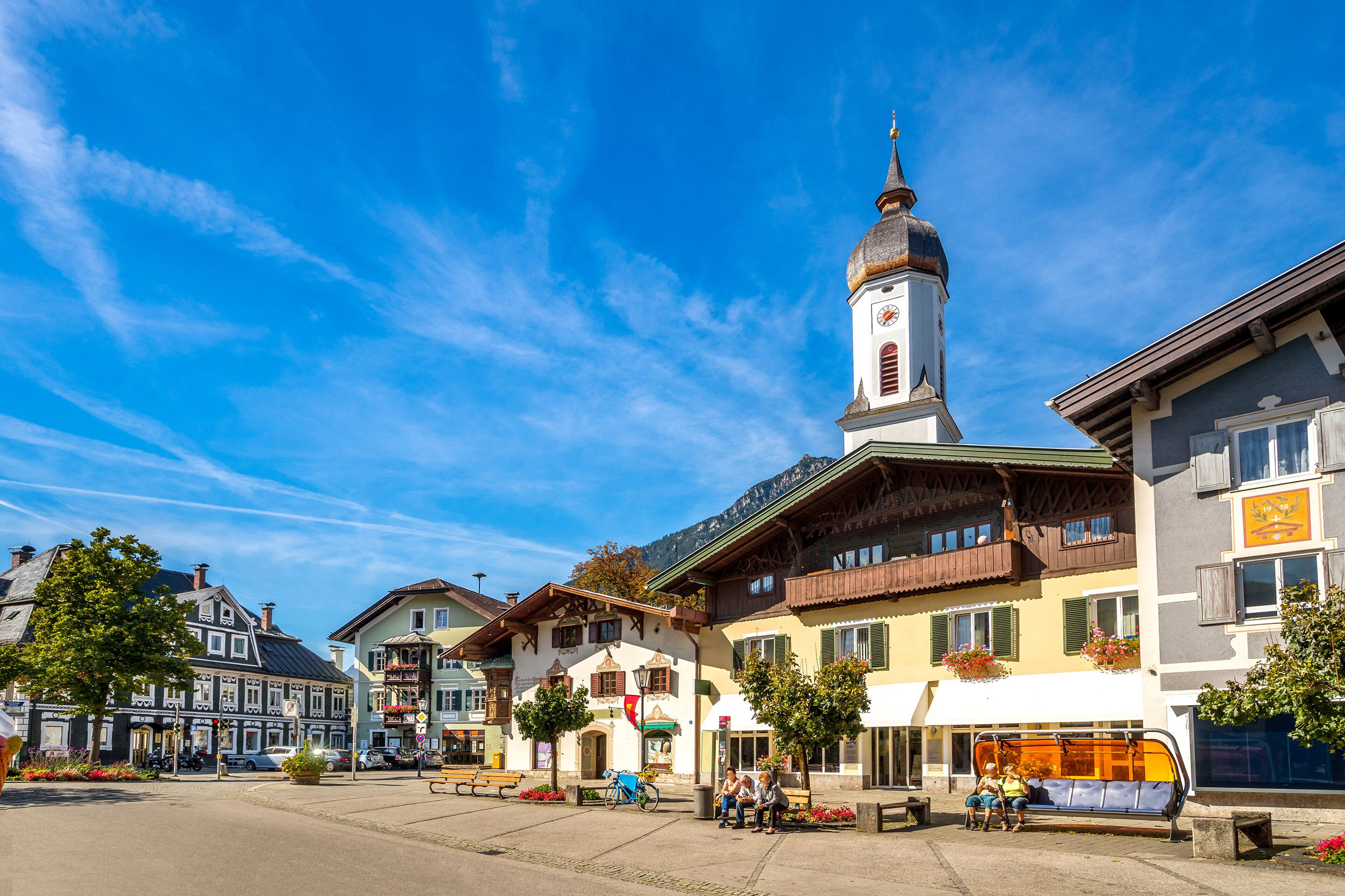
Technically twin towns merged for the 1936 Winter Olympics, Garmisch-Partenkirchen sits at the foot of the Zugspitze, Germany's highest peak at 2,962 meters, reachable by the Bayerische Zugspitzbahn cogwheel train, a route that's run since 1930. The 2 halves retain slightly different characters: Garmisch leans more modern and resort-oriented, while Partenkirchen keeps more traditional Bavarian architecture along its older streets. The Partnachklamm gorge, a dramatic river-carved canyon accessible by a short walk from town, adds a genuinely different landscape to the standard peak-and-valley scenery most Alpine towns offer. The original 1936 Olympic ski jump still hosts an annual New Year's ski jumping event, drawing large crowds each January.
🏠 Where to stay in Garmisch-Partenkirchen
Partenkirchen's older streets offer more traditional Bavarian guesthouses at moderate prices. Garmisch, closer to the Zugspitze train station, suits visitors prioritizing quick mountain access over historic character.
🗺️ Things to do in Garmisch-Partenkirchen
Zugspitze cogwheel train
Climbs to Germany's highest peak via a route running since 1930.
Partnachklamm gorge
A dramatic river canyon reachable by a short walk, with a carved rock walkway.
Olympic Ski Stadium
The original 1936 Winter Olympics venue, still used for events today.
Partenkirchen old town
Traditional Bavarian architecture along the district's older pedestrian streets.





{{item.get_author.first_name}} {{item.get_author.last_name}}
Level 7
5 Photos
36 Reviews
{{item.comment_txt}}
{{item_reply.get_author.first_name}} {{item_reply.get_author.last_name}}
@ {{item_reply.reply_to}}, {{item_reply.reply_txt}}