

The New 7 Wonders (Great Wall of China, Petra, Christ the Redeemer, Machu Picchu, Chichen Itza, the Colosseum, and the Taj Mahal) came from a 2007 public vote. The ancient Seven Wonders are a separate, much older list, and only 1 of them, the Great Pyramid of Giza, still stands. The Taj Mahal's construction started in 1632, not the 1500s. The Colosseum finished in 80 AD, under Titus, not 72 AD under Vespasian, who died before it was complete.
Becoming a world wonder isn't easy. When the New7Wonders Foundation closed its global vote in 2007, only 7 monuments made the final cut, chosen from over 200 nominated sites and more than 100 million votes cast worldwide. That's the New 7 Wonders of the World, and it's a completely separate list from the ancient Seven Wonders, something most articles online get wrong without realizing it. The phrase "New Seven Wonders of the World" gets bolded next to monuments that were never part of that 2007 vote, the Great Pyramid of Giza especially. Giza isn't officially one of the 7 winners. It's the sole survivor of the ancient list, given honorary status alongside them, a distinction worth getting right if you actually want to understand what these lists mean.
From the rock-cut facades of Petra and the cloud-forest ruins of Machu Picchu to the sheer scale of the Great Wall of China and the marble symmetry of the Taj Mahal, the New 7 Wonders span 6 continents and roughly 4,000 years of human building. This guide keeps both lists straight: the New 7 first, then the ancient Seven Wonders that inspired the whole idea, of which only Giza still stands. Real construction dates, corrected where older articles get them wrong, and what's actually left to see at each site today.
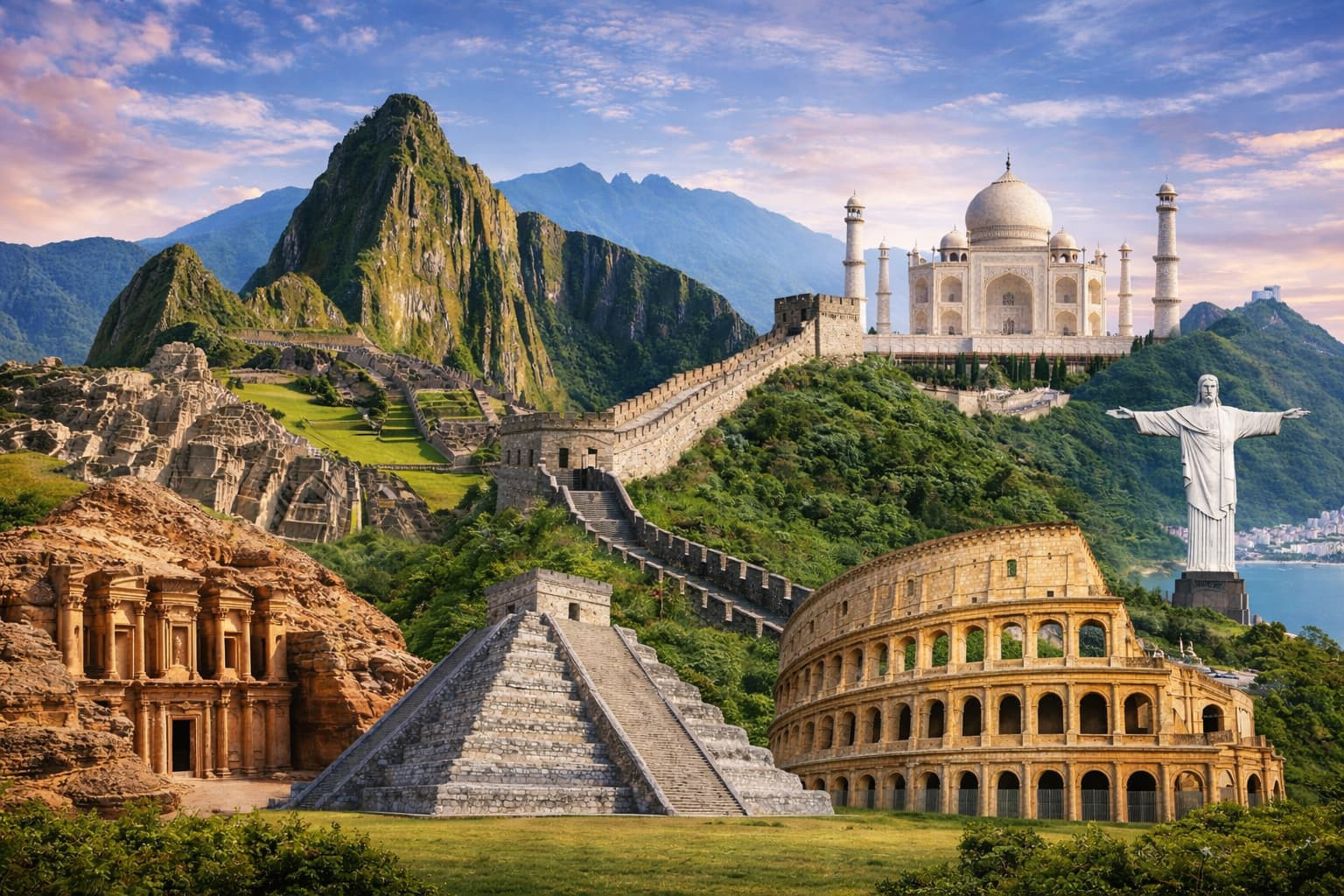
New 7 Wonders vs. the Ancient Seven Wonders:
Swiss filmmaker Bernard Weber founded the New7Wonders Foundation specifically because 6 of the 7 ancient wonders no longer exist. The foundation ran a global public vote, collecting more than 100 million votes before announcing the winners in Lisbon on July 7, 2007: the Great Wall of China, Petra, Christ the Redeemer, Machu Picchu, Chichen Itza, the Colosseum, and the Taj Mahal. The Great Pyramid of Giza, the only ancient wonder still standing, received honorary status separate from the vote itself, which is why it appears in both lists below without technically being one of the 7 winners.
The New 7 Wonders of the World:
Great Wall of China:
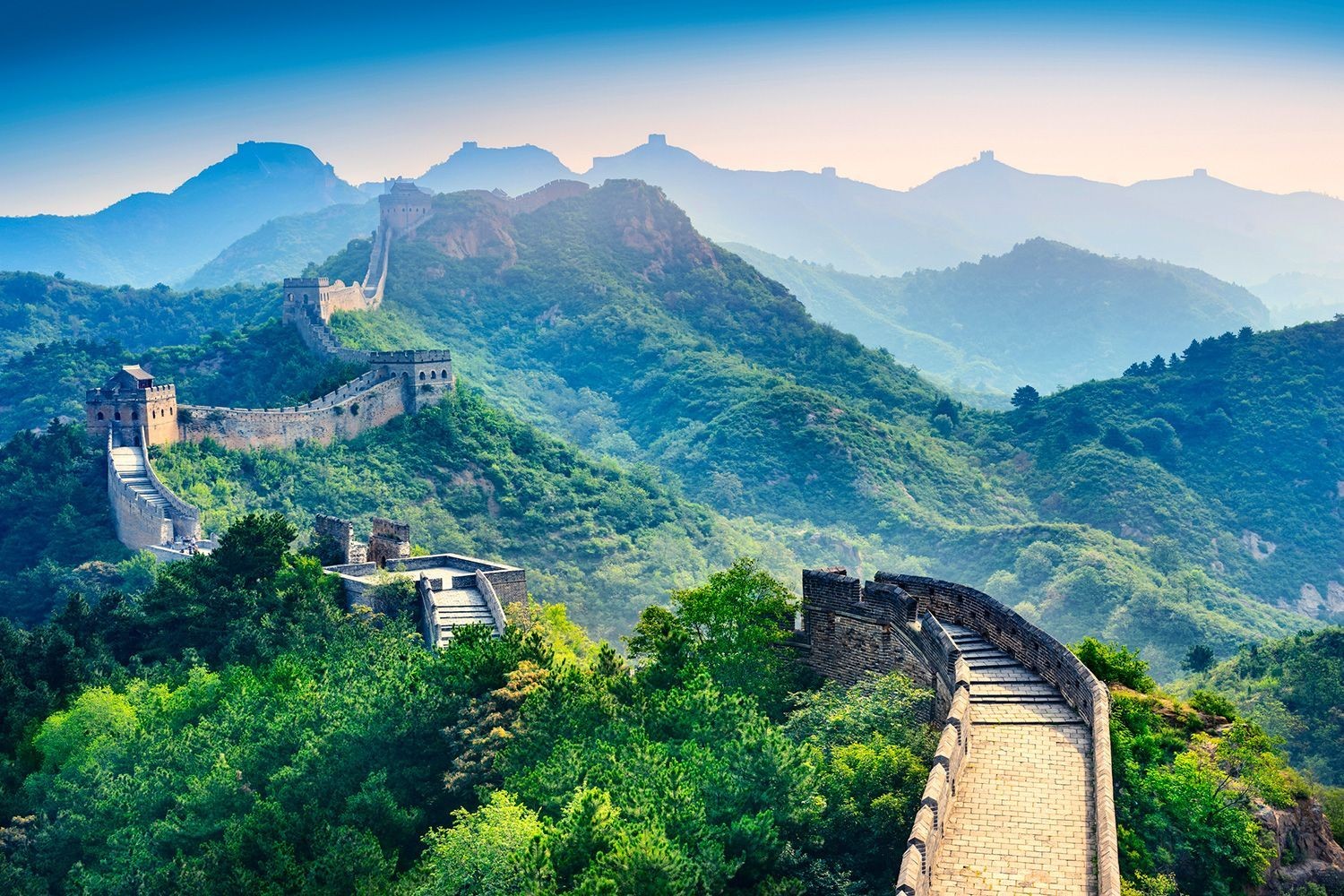
The Great Wall isn't a single continuous structure. It's a network of walls and fortifications built, rebuilt, and extended by different Chinese dynasties over roughly 2,000 years, with the earliest sections dating to around the 7th century BC, when several individual states built defensive walls that later got connected. The sections most visitors actually walk today, Badaling and Mutianyu near Beijing, were built or substantially rebuilt during the Ming Dynasty (1368-1644), considerably later than the wall's earliest origins. Mutianyu runs less crowded than Badaling and includes a cable car and a toboggan ride down. Jiankou, a wilder, unrestored section, appeals to serious hikers willing to skip the paved paths entirely.
Highlights
- Stretches an estimated 21,000+ km across multiple wall systems, not one continuous line
- Jiankou's unrestored, steep sections draw serious hikers away from paved tourist paths
- Watchtowers were used for both defense and long-distance smoke signaling between garrisons
The best time to visit the Great Wall of China:
The best time to visit the Great Wall of China is between March and May or September and November when temperatures are pleasant and crowds are fewer. Extreme athletes won't want to miss the 26.2-mile Great Wall Marathon, held in May each year and considered one of the world's most unique marathon courses. Weekends tend to be busier, so pick a weekday to visit and avoid the crowds.
Nearby attractions in the Great Wall of China:
Forbidden City
Beijing's imperial palace complex, a UNESCO World Heritage site with grand halls and courtyards from China's dynastic past.
Summer Palace
A royal garden and palace complex built around Kunming Lake, a short drive from central Beijing.
Temple of Heaven
An imperial complex where emperors once performed sacrificial ceremonies, centered on the Hall of Prayer for Good Harvests.
Ming Tombs
The burial site of 13 Ming Dynasty emperors, set at the foot of the Tianshou Mountains.
Petra, Jordan:

Petra served as the capital of the Nabataean Kingdom starting around the 4th century BC, a trading civilization that controlled key caravan routes across the Arabian desert and carved much of the city directly into pink and red sandstone cliffs. The Treasury (Al-Khazneh), the facade most visitors recognize, functioned as a royal tomb, reached only after walking through the Siq, a narrow, kilometer-long gorge that opens suddenly onto the carved facade. The Monastery (Ad Deir), a similar but larger rock-cut structure, sits at the top of an 800-step climb and draws far fewer visitors than the Treasury simply because of the walk involved. Petra by Night, a candlelit evening walk through the Siq to the illuminated Treasury, runs several nights a week.
Highlights
- The Nabataeans built a sophisticated water channel and dam system to survive in a desert climate
- Most of the city's facades are carved directly into rock, not built from separate blocks
- Petra by Night lights the Siq and Treasury with over 1,500 candles several evenings a week
The best time to visit Petra:
The best time to visit Petra is between March and May or September and November, when desert temperatures stay comfortable for the walk through the Siq. Petra by Night, an evening walk to the candlelit Treasury, runs several times a week year-round, and a cooler evening in these shoulder months makes the hour-long visit far more comfortable. Arrive right at opening time to reach the Treasury before the tour groups do.
Nearby attractions in Petra:
The Siq
The narrow, kilometer-long gorge serving as Petra's main entrance, opening suddenly onto the Treasury's facade.
Wadi Rum
A dramatic desert valley nearby, known for jeep tours, hiking, and sandboarding across its dunes.
Little Petra (Siq al-Barid)
A smaller, quieter Nabataean site a short distance from the main complex.
The High Place of Sacrifice
A summit reached by a steep staircase, once used for religious ceremonies, with panoramic views over Petra.
Christ the Redeemer, Brazil:
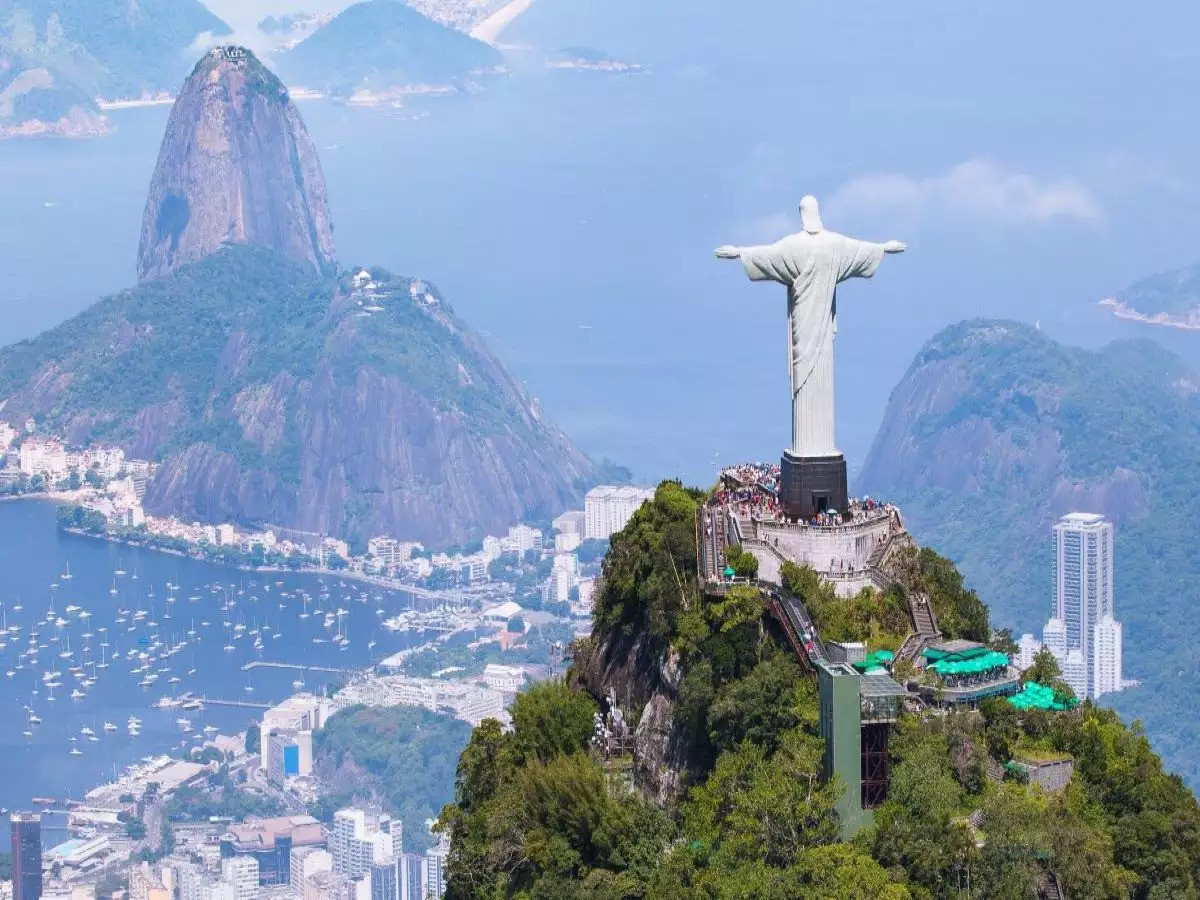
The statue itself stands about 30 meters tall, close to 38 meters including its concrete pedestal, built between 1922 and 1931 with French sculptor Paul Landowski overseeing the design and Brazilian engineer Heitor da Silva Costa managing construction. It sits atop Corcovado Mountain, which rises roughly 700 meters above sea level, a figure that gets mistakenly applied to the statue's own height in plenty of articles that never separate the mountain from the monument standing on it. A cog train through Tijuca National Park, the world's largest urban forest, carries most visitors to the summit, and the panoramic view from the base takes in Sugarloaf Mountain, Copacabana Beach, and Guanabara Bay in a single sweep.
Highlights
- Assembled from reinforced concrete and soapstone tiles, chosen for durability against weather
- Struck by lightning multiple times over the decades; a 2014 strike damaged a finger and the head
- Sits inside Tijuca National Park, the largest urban forest in the world
The best time to visit Christ the Redeemer:
The best time to visit Christ the Redeemer is between December and March, Rio's summer, when skies stay clearest for the panoramic views from Corcovado's summit. Cloud cover rolls in fast at this elevation any time of year, so check the live webcam before heading up if a clear view matters most. Weekday mornings, right after the site opens, offer the shortest lines at the cog train station below.
Nearby attractions in Christ the Redeemer:
Sugarloaf Mountain
Reached by cable car, with panoramic views over Guanabara Bay and the city below.
Copacabana Beach
One of Rio's most famous beaches, a short distance from the mountain's base.
Tijuca National Park
The largest urban forest in the world, surrounding the statue with hiking trails and native wildlife.
Santa Teresa
A bohemian hillside neighborhood known for cobblestone streets and art galleries.
Machu Picchu, Peru:

Built around the mid-1400s under Inca emperor Pachacuti, Machu Picchu functioned as a royal estate, not a hidden refuge, its remote position on a ridge between 2 Andean peaks was likely deliberate architectural statement, not concealment. The site's stonework uses no mortar; blocks were cut precisely enough to fit together without it, a technique that has kept walls standing through repeated regional earthquakes for close to 6 centuries. Huayna Picchu, the steep peak visible in most classic photos of the site, requires a separate ticket with limited daily entries, and those slots sell out weeks ahead in high season. The Inca Trail, a multi-day hike ending at the Sun Gate, requires a permit booked months in advance, since Peru caps daily trail numbers to limit erosion.
Highlights
- Never found by Spanish conquistadors, unlike most other major Inca sites
- American historian Hiram Bingham brought international attention to the site in 1911, though local farmers already knew of it
- Terraced agricultural fields on the site's edges prevented erosion and allowed crop cultivation on steep slopes
The best time to visit Machu Picchu:
The best time to visit Machu Picchu is between April and October, the dry season, when trails stay clear and mountain views go uninterrupted by clouds. Permits for the Inca Trail and Huayna Picchu both sell out months ahead during these peak months, so book as early as possible if either is on your list. May and June offer the same dry conditions with noticeably fewer visitors than the July-August rush.
Nearby attractions in Machu Picchu:
Huayna Picchu
The steep peak seen in classic photos of the site, requiring a separate, limited-entry ticket.
The Sun Gate (Inti Punku)
The Inca Trail's original entrance point, offering a framed view of Machu Picchu from above.
Aguas Calientes
The gateway town below the ruins, with natural hot springs and a small archaeological museum.
Inca Bridge
A rope-and-log bridge built into a cliffside, a short walk from the main site.
Chichen Itza, Mexico:
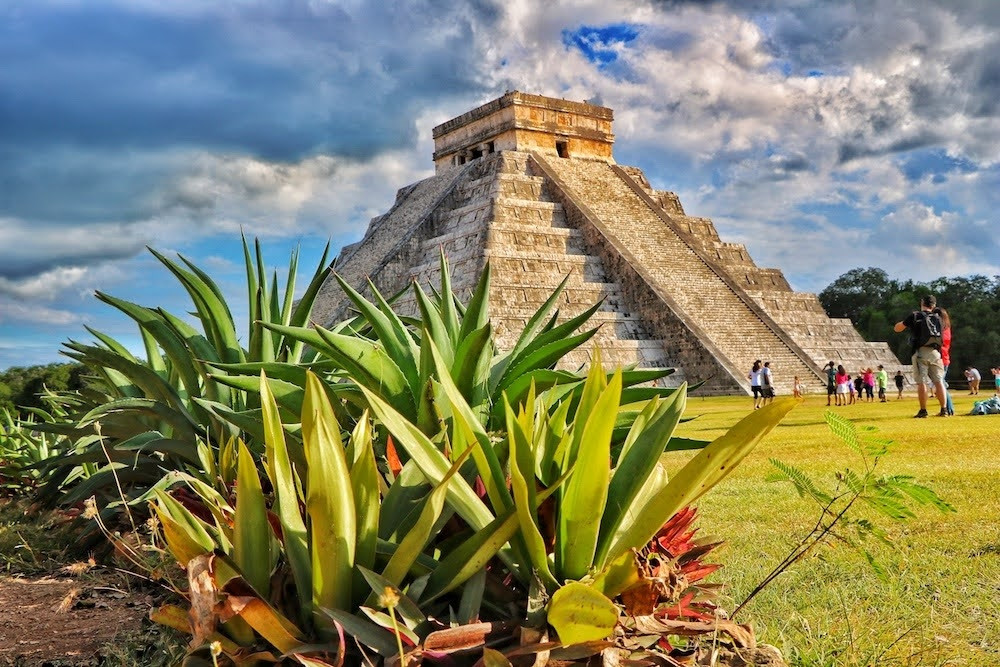
Chichen Itza grew into a major Maya political and religious center between roughly 600 and 1200 AD, with El Castillo, the stepped pyramid dedicated to the feathered serpent god Kukulkan, as its defining structure. The pyramid's design tracks the solar calendar directly: 91 steps on each of 4 sides plus the top platform add up to 365, one for each day of the year. During the spring and autumn equinoxes, the afternoon sun casts a shadow along the northern staircase that shows a serpent descending the pyramid's steps, a deliberate architectural effect that still draws crowds specifically for those 2 dates each year. Climbing the pyramid itself has been prohibited since 2006, following structural damage and safety concerns from decades of tourist foot traffic.
Highlights
- The Great Ball Court is the largest known Mesoamerican ball court, associated with the ritual game Pok-ta-Pok
- A sacred cenote (natural sinkhole) on-site was used for ceremonial offerings, including artifacts recovered by archaeologists
- El Castillo's design produces a genuine acoustic effect, a handclap at its base echoes back sounding like a bird call
The best time to visit Chichen Itza:
The best time to visit Chichen Itza is between December and March, drier and cooler than the Yucatan's summer wet season. The spring and autumn equinoxes, March 20-21 and September 22-23, draw the largest crowds of the year for the famous serpent-shadow effect on El Castillo. Arrive right at opening if visiting during either equinox, since the site fills fast on those 2 dates.
Nearby attractions in Chichen Itza:
Cenote Ik Kil
A natural sinkhole with crystal-clear water a few kilometers from the main site, open for swimming.
Ek Balam
A well-preserved Maya archaeological site about an hour away, known for its Acropolis pyramid and stucco artwork.
Valladolid
A colonial-era town nearby with a historic cathedral and Yucatecan cuisine.
Cenote Yokdzonot
A quieter cenote in a small village setting, less crowded than Ik Kil.
Colosseum, Rome:
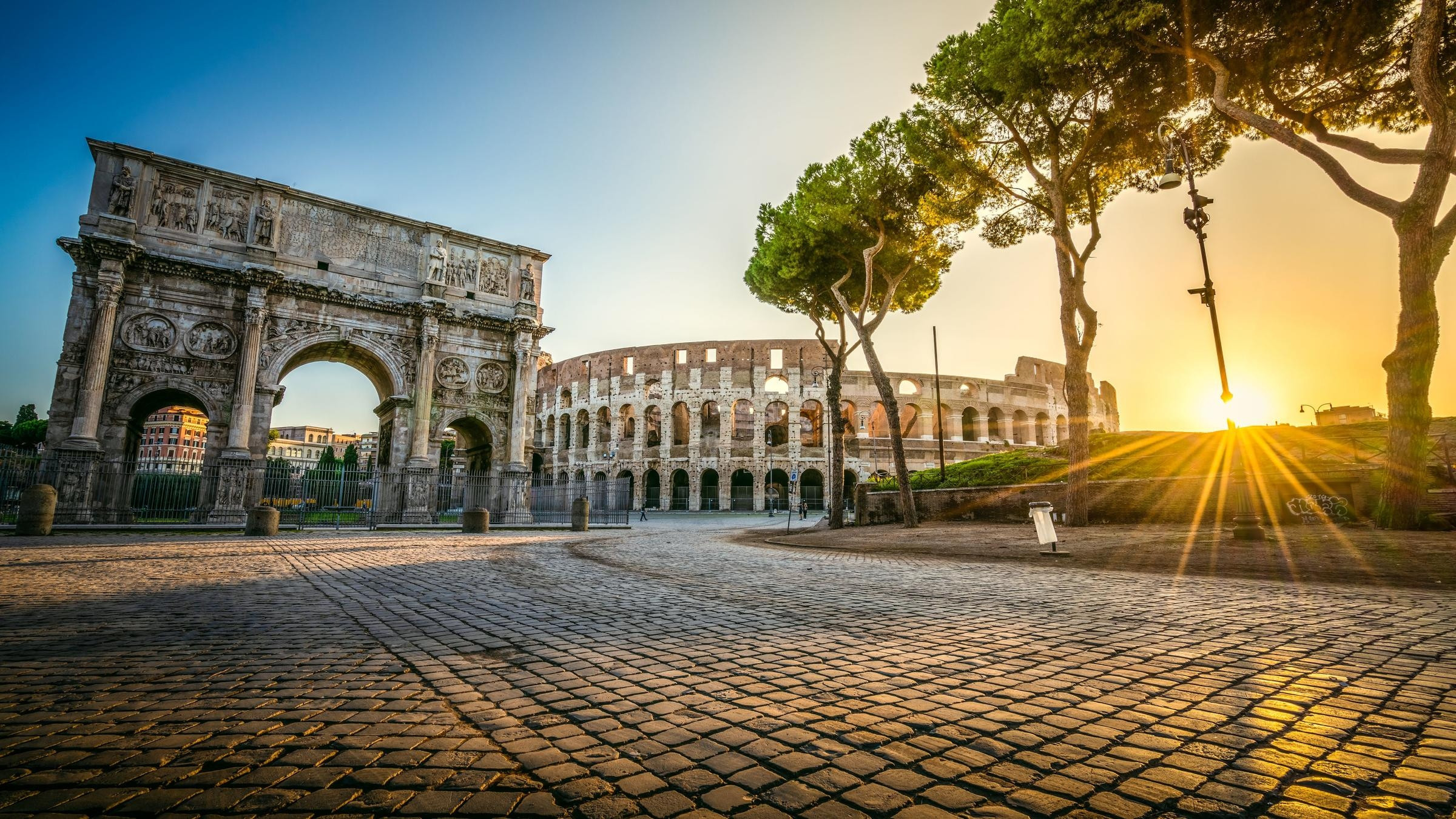
Construction started around 70-72 AD under Emperor Vespasian and finished in 80 AD under his son and successor, Titus, who held the inaugural games that year, roughly 100 days of gladiatorial combat and staged animal hunts. Vespasian died in 79 AD, a year before the amphitheater he commissioned was actually completed. Built primarily from travertine limestone and concrete, it held an estimated 50,000 to 80,000 spectators across 4 levels, with a complex system of underground tunnels (the hypogeum) used to raise animals and performers directly into the arena through trapdoors. The Colosseum draws more than 7 million visitors a year, among the highest attendance figures of any of the 7 wonders, and a combined ticket with the Roman Forum and Palatine Hill covers all 3 sites.
Highlights
- A retractable canvas awning system (the velarium) shaded spectators from the sun
- The hypogeum's underground tunnels raised animals and performers directly into the arena through trapdoors
- Used for centuries after Rome's fall as housing, workshops, and even a quarry for building material
The best time to visit the Colosseum:
The best time to visit the Colosseum is between October and April, avoiding Rome's peak summer heat and the longest ticket lines of the year. Book a timed-entry ticket online in advance regardless of season, since walk-up lines can run over an hour even in the cooler months. Arriving right at opening remains the single best way to beat both the heat and the crowds.
Nearby attractions in the Colosseum:
Roman Forum
The ruins of ancient Rome's political and public center, a short walk from the Colosseum.
Palatine Hill
One of Rome's 7 hills, offering views over the Forum and believed to be the city's original settlement site.
Arch of Constantine
A triumphal arch standing beside the Colosseum, commemorating Emperor Constantine I's victory.
Circus Maximus
The outline of an ancient chariot racing stadium, just south of Palatine Hill.
Taj Mahal, India:

Construction started in 1632 under Mughal emperor Shah Jahan, following the death of his wife Mumtaz Mahal in 1631 during the birth of their 14th child. The main mausoleum was largely finished by the late 1630s, and the full complex, including the surrounding charbagh gardens and main gateway, was completed around 1653, a 20-plus-year project, firmly in the 17th century, not the 1500s as some articles claim. Chief architect Ustad Ahmad Lahori led a workforce reported in the tens of thousands, using white marble that shifts color depending on the light, pink at dawn, white at midday, golden at sunset. Shah Jahan was later deposed by his own son Aurangzeb and imprisoned in nearby Agra Fort, where he reportedly spent his final years watching the Taj Mahal from a window before being buried there himself in 1666.
Highlights
- The marble's semi-precious stone inlay work (pietra dura) uses jade, crystal, and turquoise sourced from across Asia
- The complex is intentionally symmetrical, except for Shah Jahan's own tomb, added off-center beside his wife's
- Declared a UNESCO World Heritage Site in 1983
The best time to visit the Taj Mahal:
The best time to visit the Taj Mahal is between November and March, when Agra's temperatures stay mild and the skies stay clear enough for genuinely sharp photos of the white marble. Sunrise entry gives the softest light on the monument and the smallest crowds of the entire day, since most tour groups arrive closer to mid-morning. The complex closes to general visitors on Fridays, worth checking before planning a trip around a specific date.
Nearby attractions in the Taj Mahal:
Agra Fort
A UNESCO-listed Mughal fortress where Shah Jahan spent his final years, with views of the Taj Mahal from within its walls.
Fatehpur Sikri
A former Mughal capital about 40 km away, known for its red sandstone architecture.
Mehtab Bagh
A garden across the Yamuna River, offering one of the best sunset views of the monument.
Tomb of Itimad-ud-Daulah
Sometimes called the "Baby Taj," a smaller, intricately carved tomb that predates the Taj Mahal.
The Ancient Seven Wonders of the World:
This list predates the 2007 vote by more than 2,000 years, compiled by Greek and Hellenistic writers describing structures across the classical world. Only 1 still stands.
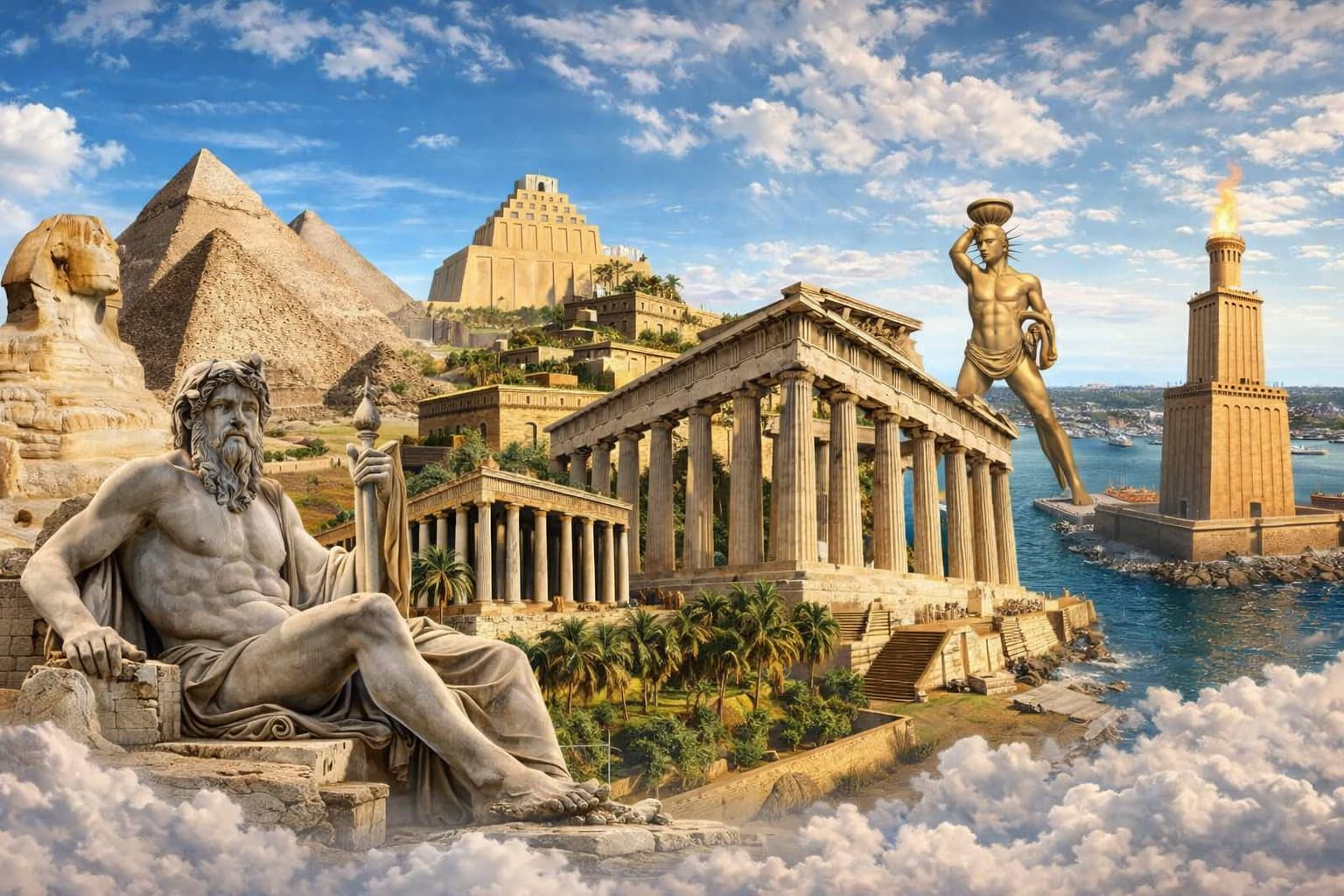
Great Pyramid of Giza (Honorary 8th Wonder):
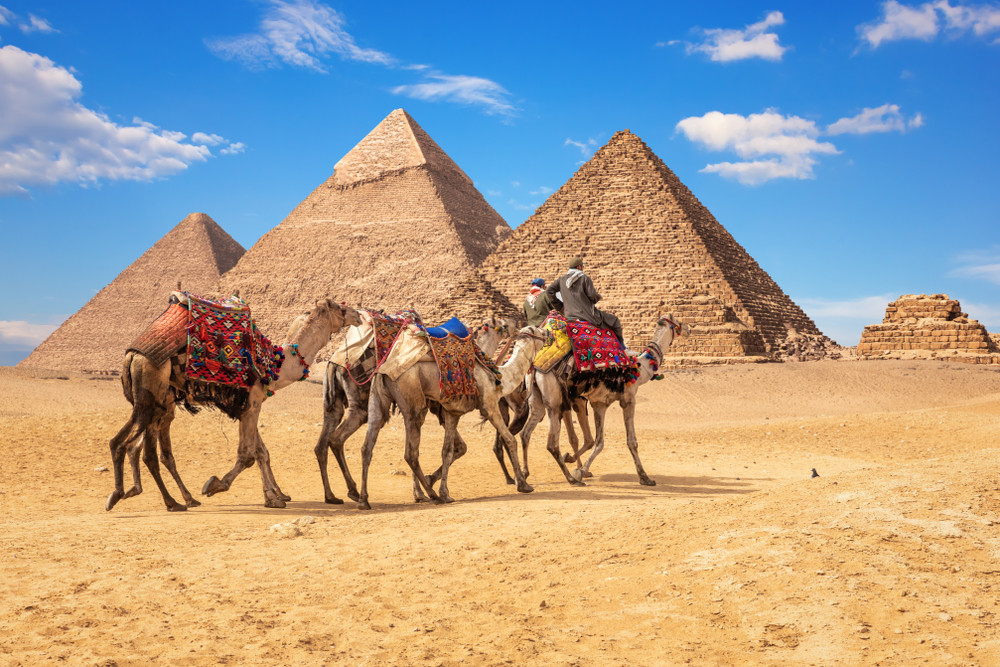
Built around 2560 BC as a tomb for Pharaoh Khufu, the Great Pyramid is the only ancient wonder still standing, and the New7Wonders Foundation gave it honorary status in 2007, not a spot in the actual public vote, since organizers judged it unfair to make a monument that had already survived 4,500 years compete against 6 that no longer existed. The pyramid's base measures roughly 230 meters per side, and it stood 146.5 meters tall originally (closer to 138 meters today, having lost some of its smooth outer limestone casing over the centuries). It held the record for the world's tallest human-made structure for roughly 3,800 years, until Lincoln Cathedral's spire surpassed it in the 14th century AD. The Solar Boat Museum nearby displays a full-sized wooden vessel buried beside the pyramid, reconstructed from more than 1,200 individual pieces.
Highlights
- Built from roughly 2.3 million limestone blocks, some weighing several tons each
- Aligned to true north with remarkable precision, off by only a fraction of a degree
- Part of a larger complex including the Pyramids of Khafre and Menkaure and the Great Sphinx
The best time to visit the Great Pyramid of Giza:
The best time to visit the Great Pyramid of Giza is between September and April, avoiding Egypt's peak summer heat, which can climb past 40°C at the plateau with little shade available. The Sound and Light Show runs most evenings year-round, narrating the pyramids' history against a colorful illuminated backdrop. Arrive before 8am to explore the plateau before both the heat and the tour buses build up.
Nearby attractions in the Great Pyramid of Giza:
Great Sphinx of Giza
A limestone statue with a human head and lion's body, standing adjacent to the pyramid complex.
Pyramid of Khafre
The middle pyramid of the Giza complex, slightly smaller than the Great Pyramid but still retaining some original casing stone near its peak.
Solar Boat Museum
Houses a reconstructed wooden vessel buried beside the pyramid for Khufu's afterlife journey.
Saqqara
An extensive necropolis south of Giza, home to the Step Pyramid of Djoser, Egypt's oldest pyramid.
Hanging Gardens of Babylon:
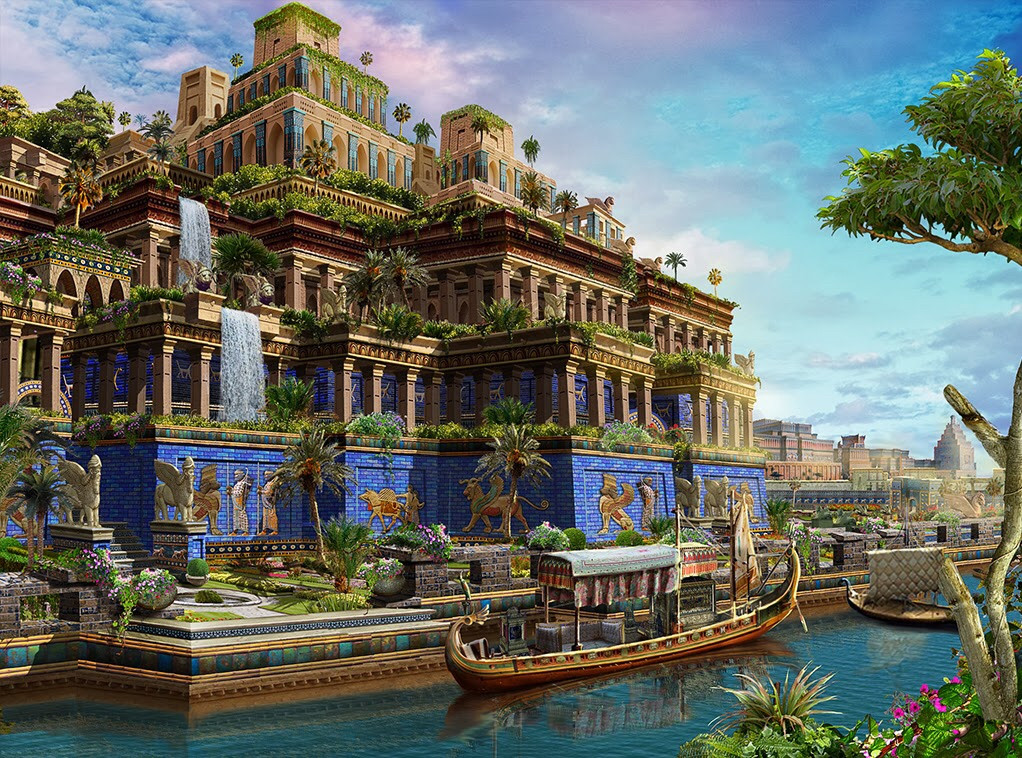
Ancient writers describe the Hanging Gardens as a series of tiered, terraced plantings built around 600 BC, commissioned by King Nebuchadnezzar II reportedly to please his wife Amytis, who missed the green mountains of her homeland amid Babylon's flat terrain. No archaeological evidence of the gardens has ever been confirmed at Babylon itself, and some historians argue the gardens may actually describe a real structure in Nineveh, roughly 500 kilometers away, built by the Assyrian king Sennacherib, a theory that would make the entire Babylon association a historical mix-up carried forward by ancient authors writing centuries after the fact. No physical remains exist to visit today, only the Ishtar Gate reconstruction and the broader Babylon archaeological site nearby.
Highlights
- Ancient accounts describe a chain pump system raising water from the Euphrates to irrigate terraced levels
- The only ancient wonder whose existence is genuinely disputed among historians
- Greek historian Herodotus, writing extensively about Babylon, never mentioned the gardens at all
The best time to visit the Hanging Gardens' believed site:
The best time to visit the Hanging Gardens' believed site is between October and November, avoiding Iraq's harshest summer heat for exploring the open-air Babylon ruins. Little shade exists across the archaeological site, so an early morning visit is worth planning regardless of the season. Confirm current travel advisories for the region before booking, since access and safety conditions can change.
Nearby attractions in the Hanging Gardens of Babylon:
Ishtar Gate (reconstruction)
A reconstructed entrance gate to ancient Babylon, decorated with glazed brick reliefs of mythical creatures.
Babylon archaeological site
The ruins of the ancient city itself, including remnants of its walls, palaces, and temples.
Euphrates riverbank
The river that ran through ancient Babylon, central to every historical theory about the gardens' irrigation.
Temple of Artemis at Ephesus:
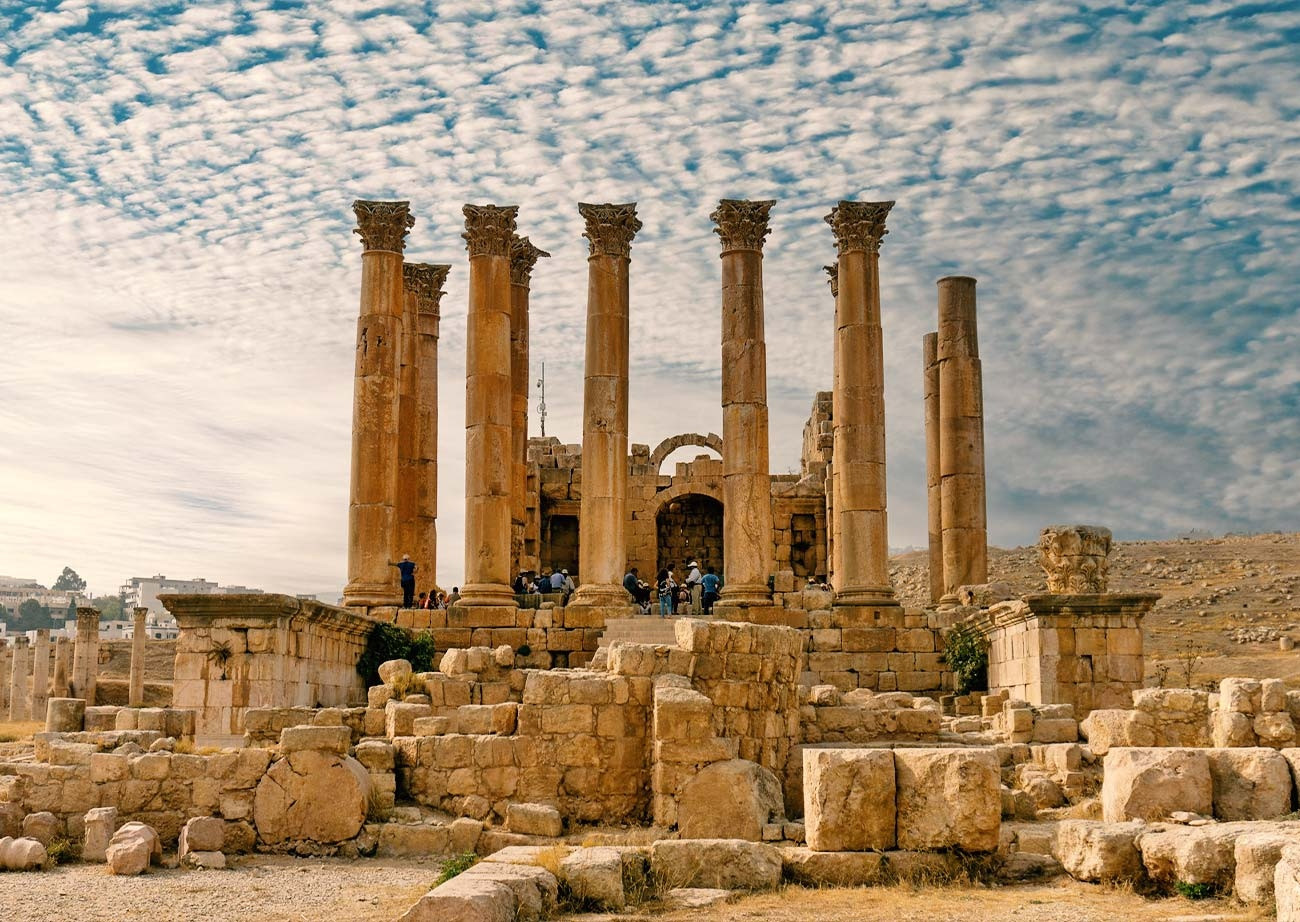
Rebuilt multiple times after floods and fires, the version of the Temple of Artemis counted among the ancient wonders was completed around 550 BC, funded partly by the Lydian king Croesus, and later burned deliberately in 356 BC by a man named Herostratus, who reportedly wanted his name remembered through the act of destruction, giving rise to the term "herostratic fame" for exactly that kind of infamy-seeking. A rebuilt version stood until the 3rd century AD, when Gothic invaders destroyed it during a raid. Today, a single reconstructed column marks the site among scattered foundation stones, considerably less to see than the nearby, far better-preserved ruins of ancient Ephesus itself, including the Library of Celsus.
Highlights
- At roughly 4 times the size of the Parthenon, it ranked among the largest buildings in the ancient Greek world
- Legend holds it burned the same night Alexander the Great was born, in 356 BC
- Funded partly by Lydian king Croesus, whose name is the source of the phrase "rich as Croesus"
The best time to visit the Temple of Artemis:
The best time to visit the Temple of Artemis is between April and May or September and mid-November, avoiding both summer heat and winter rain along Turkey's Aegean coast. The single standing column marking the site takes only a few minutes to see, so most visitors pair it with a longer stop at the much larger Ephesus ruins nearby. Early morning visits to Ephesus itself help beat both the heat and the cruise-ship crowds that arrive by midday.
Nearby attractions in the Temple of Artemis:
Ephesus ancient city
A well-preserved Roman-era city nearby, including the Library of Celsus and the Great Theater.
Terrace Houses
The preserved residences of wealthy Ephesian citizens, offering a direct look at Roman-era daily life.
Basilica of St. John
Ruins believed to mark the burial site of St. John the Apostle, in nearby Selçuk.
Ephesus Archaeological Museum
Houses artifacts excavated from the temple and surrounding sites, in the town of Selçuk.
Statue of Zeus at Olympia:
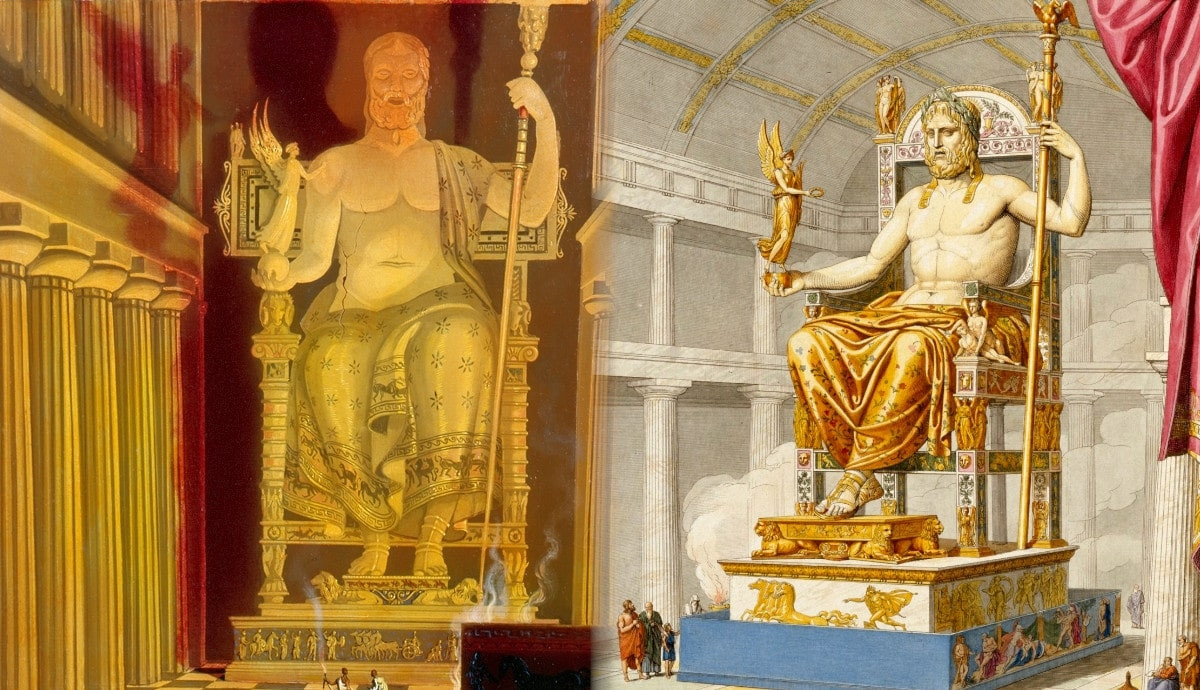
Sculpted by Phidias, one of classical Greece's most celebrated sculptors, around 435 BC, the statue stood roughly 12-13 meters tall inside the Temple of Zeus, built from a wooden core layered with ivory for the god's skin and gold for his robes and crown, a technique called chryselephantine sculpture. Ancient writers described worshippers fearing that if Zeus stood up from his throne, his head would break through the temple's roof, a detail meant to convey the statue's overwhelming scale relative to the building housing it. The statue was likely moved to Constantinople at some point in late antiquity and destroyed in a fire there in the 5th century AD, though some ancient accounts instead describe it perishing along with the temple in Olympia itself. Excavated temple ruins and the ancient stadium remain on-site today.
Highlights
- Phidias also sculpted the Athena Parthenos statue inside the Parthenon in Athens
- Roman Emperor Caligula reportedly wanted the statue transported to Rome; the plan was abandoned
- A fire in 462 AD is the most commonly cited cause of its final destruction, though accounts vary
The best time to visit the Statue of Zeus site:
The best time to visit the Statue of Zeus site at Olympia is between mid-April and mid-June or September and mid-October, mild weather for exploring the sanctuary's largely outdoor ruins. Olympia still hosts the Olympic flame lighting ceremony ahead of each modern Games, a rare moment when the ancient site briefly returns to something close to its original purpose. Visit early in the day, since the site offers little shade during the warmer months.
Nearby attractions in the Statue of Zeus at Olympia:
Olympia Archaeological Site
The sanctuary ruins where the statue and temple once stood, alongside ancient athletic buildings.
Temple of Hera
One of the oldest and most important temples in the sanctuary, dedicated to Zeus's wife.
Ancient Olympic Stadium
The site of the original ancient Olympic Games, walkable today along its original track.
Archaeological Museum of Olympia
Houses sculptures and artifacts recovered from the sanctuary and surrounding excavations.
Mausoleum at Halicarnassus:
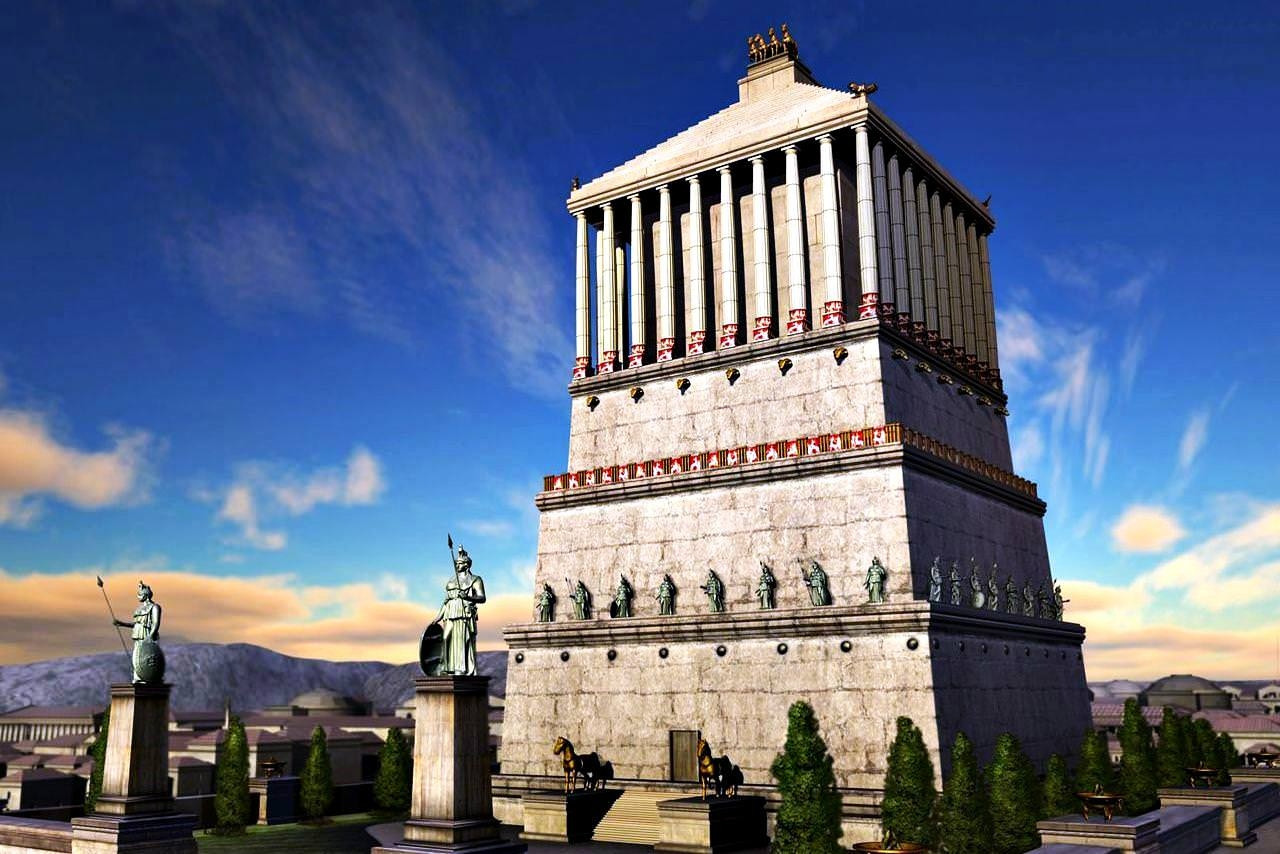
Built between 353 and 350 BC as a tomb for Mausolus, a Persian satrap (regional governor) who ruled Caria from the city of Halicarnassus, the structure gave the English language its word "mausoleum" through his name alone. Standing about 45 meters tall, it combined a stepped pyramid roof with a colonnaded main level and a massive stone chariot sculpture at its peak, built by 4 different Greek sculptors working on separate sides of the monument. A series of earthquakes between the 12th and 15th centuries progressively toppled the structure, and by 1494, Crusader knights were reusing its carved stone blocks to build Bodrum Castle nearby, some of which remain visible in the castle's walls today. Surviving fragments of the original sculptures are held at the British Museum in London.
Highlights
- Mausolus's wife Artemisia II continued the project after his death, reportedly grieving deeply
- The name "mausoleum" entered English and other European languages directly from this structure
- Surviving sculptural fragments were removed to London's British Museum in the 19th century
The best time to visit the Mausoleum at Halicarnassus site:
The best time to visit the Mausoleum at Halicarnassus site is between April and May or October and November, comfortable temperatures for exploring Bodrum's coastal ruins on foot. Bodrum's ancient theater nearby still hosts performances during the summer festival season, though the mausoleum site itself is best seen outside peak summer heat. Pair the visit with Bodrum Castle, a short walk away, to see where much of the mausoleum's original stone ended up.
Nearby attractions in the Mausoleum at Halicarnassus:
Bodrum Castle
A 15th-century fortress built partly from the mausoleum's own reused stone, now home to a museum of underwater archaeology.
Bodrum Amphitheater
A well-preserved Hellenistic-era theater offering views of the city and coastline.
Ancient Halicarnassus
Scattered ruins of the historical city, including old walls and tombs near the mausoleum's original site.
Myndos Gate
One of Halicarnassus's surviving ancient city gates, once central to the city's defense.
Colossus of Rhodes:
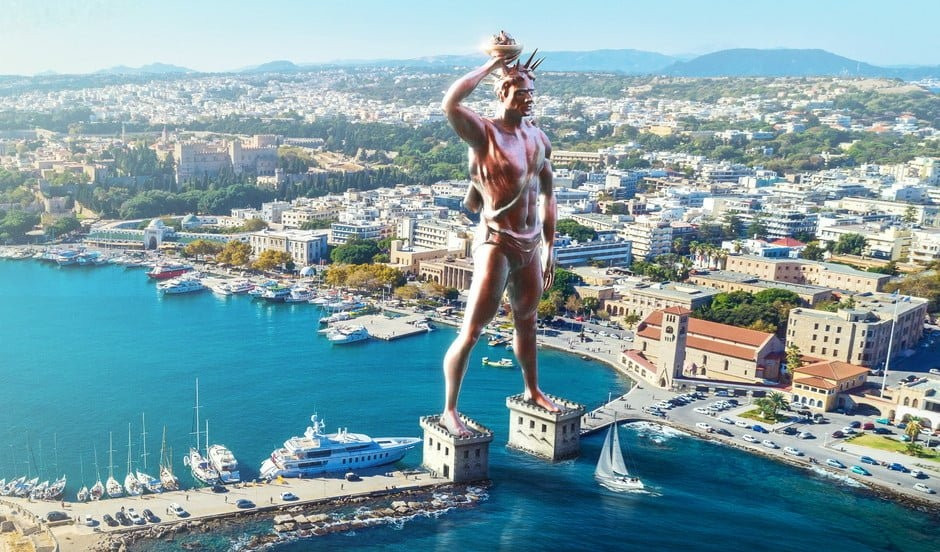
Built in 280 BC to celebrate the island's successful defense against a siege by Antigonid ruler Demetrius I, the Colossus depicted Helios, the Greek sun god, standing an estimated 33 meters tall, roughly comparable to the Statue of Liberty's figure alone, not counting its pedestal. Contrary to a popular image repeated for centuries, the statue almost certainly did not straddle Rhodes' harbor entrance with ships passing beneath its legs. Ancient engineering of the era couldn't support that pose, and the design more likely stood with both feet together on a single pedestal near the harbor. An earthquake toppled it in 226 BC, after only 54 years standing, and the fallen bronze remained on the ground for more than 800 years until an Arab force sold the scrap metal in 654 AD.
Highlights
- Built using melted-down bronze siege equipment abandoned by the defeated attacking army
- An iron and stone framework supported the outer bronze plates, an advanced technique for its era
- The fallen ruins reportedly still drew visitors as a curiosity for centuries after the collapse
The best time to visit the Colossus of Rhodes site:
The best time to visit the Colossus of Rhodes site is between April and May or October and November, mild Aegean weather for walking Rhodes' Old Town and harbor. Mandraki Harbor, the statue's likely former location, stays walkable and uncrowded outside the busy July-August cruise season. Combine the visit with Rhodes Old Town's medieval streets, just a short walk from the harbor itself.
Nearby attractions in the Colossus of Rhodes:
Rhodes Old Town
A UNESCO-listed medieval quarter with the Palace of the Grand Master and old city walls.
Mandraki Harbor
The likely site of the Colossus, marked today by 2 bronze deer statues and 3 windmills.
Rhodes Acropolis
An elevated ancient site with the Temple of Apollo and views across the island.
Lindos
A picturesque village with its own ancient Acropolis, a day trip from Rhodes Town.
Lighthouse of Alexandria:
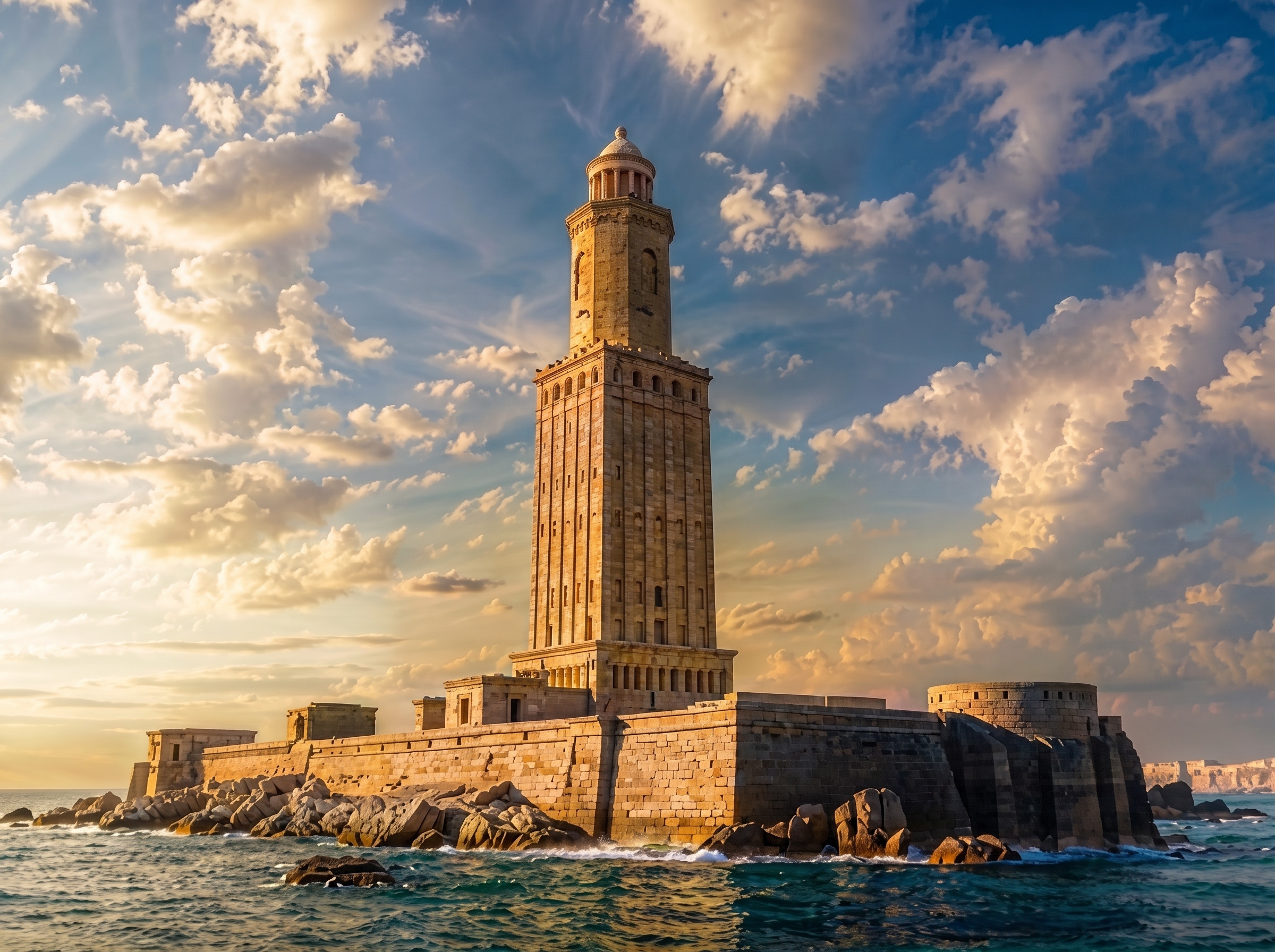
Built between 280 and 247 BC under the Ptolemaic dynasty on the island of Pharos, the lighthouse gave the modern word "pharos" (meaning lighthouse) to several European languages. Standing an estimated 100-120 meters tall, it held the title of tallest human-made structure outside the pyramids for centuries, using a fire and reflective mirror system to project light visible far out into the Mediterranean. A series of earthquakes between the 10th and 14th centuries gradually toppled the structure, with the final collapse recorded around 1323. In 1477, Mamluk sultan Qaitbay built a fortress, the Qaitbay Citadel, on the same site, incorporating some of the lighthouse's own fallen stone blocks into the new fortress's foundation, a structure that still stands today and marks the lighthouse's former location precisely.
Highlights
- Its fire-and-mirror system reportedly projected light visible up to 50 km out at sea
- Commissioned under Ptolemy I and completed under his son Ptolemy II
- Gave rise to "pharos" as the root word for "lighthouse" in French, Italian, Spanish, and Romanian
The best time to visit the Lighthouse of Alexandria site:
The best time to visit the Lighthouse of Alexandria site is between March and April or late September and early November, avoiding both summer heat and winter storms along Egypt's Mediterranean coast. The Qaitbay Citadel, built on the lighthouse's former site, draws heavier local crowds on Fridays and weekends, so a weekday visit runs noticeably quieter. Combine the stop with the nearby Bibliotheca Alexandrina for a fuller day in the city.
Nearby attractions in the Lighthouse of Alexandria:
Qaitbay Citadel
A 15th-century fortress built on the lighthouse's former site, incorporating some of its original stone blocks.
Bibliotheca Alexandrina
A modern library and cultural center reviving the legacy of the ancient Library of Alexandria.
Catacombs of Kom El Shoqafa
An underground Greco-Roman burial site with carvings blending multiple ancient cultures.
Alexandria National Museum
Houses artifacts spanning Alexandria's ancient, Islamic, and modern history.






{{item.get_author.first_name}} {{item.get_author.last_name}}
Level 7
5 Photos
36 Reviews
{{item.comment_txt}}
{{item_reply.get_author.first_name}} {{item_reply.get_author.last_name}}
@ {{item_reply.reply_to}}, {{item_reply.reply_txt}}