


Venue
Tien Du area, Bac Ninh province, Vietnam

Lim Festival guide
Bac Ninh's Lim Festival usually takes the 12th and 13th days of the first lunar month, with the 13th as the main day, though the province fixes its programme only in January. Pairs of singers from twinned villages trade love songs, and listeners drift from one duo to the next. It suits music lovers willing to share the hill with thousands.
The Lim Festival is northern Vietnam's great gathering for quan ho, the call-and-response love songs of Bac Ninh. Pairs of women and pairs of men from twinned villages trade verses on and around Lim hill, while listeners cluster round each duo and wander from one to the next.
Quan ho used to be sung at every spring festival in the province after Tet. Lim became the biggest of them and still draws the finest singers, along with thousands of Vietnamese visitors from the surrounding villages and provinces. There is ritual too, with offerings carried up to Lim Pagoda, and plenty of village games, but the voices are the reason to come. UNESCO added quan ho Bac Ninh folk songs to its Representative List in 2009.
Tien Du area, Bac Ninh province, Vietnam
Hotels near the venue fill up around the event dates.
A quan ho duet is quiet, close singing, and the listeners standing round it are part of the performance.
Lim falls in the damp tail of the northern winter. Days are often overcast, with drizzle, and you will be outdoors and on your feet for hours.
Entry is free, but some games, performances and parking charge small fees, usually under 20,000 VND, and there are no cash machines near the hill. Bring enough small notes from Hanoi for the whole day.
In a crowd this size it is easy to lose each other. Agree a meeting point, such as the pagoda gate, before you split up, and keep bags zipped and in front of you.
The first circles of listeners are still loose enough to slip into.
People in costume climb the hill with flags and offerings for Lim Pagoda.
Singing breaks out on the hill, in courtyards, communal houses and from boats on the ponds. Choose a circle, listen, move on.
Coaches arrive from other provinces; loudspeakers and drums are at full volume.
Transport near the hill gets scarce as everyone leaves at once.
If you would rather drive yourself, hiring a car in Vietnam gives you that freedom, though parking near the hill is tight.
Very little is laid on for foreign visitors. Signs are in Vietnamese, there is no information desk and facilities are basic. A local guide makes a real difference here, less for directions than for telling you which pair of singers the crowd has come to hear and what the songs are about. Plan on drifting between performances for most of the day.
Quan ho is a conversation in song. Two women from one village sing a verse together; two men from a partner village answer with fresh words on a related tune. Villages are often paired off for the purpose. The style goes back to the 13th century, and its stock of more than 400 song texts on 213 melodies is mostly about love and parting.
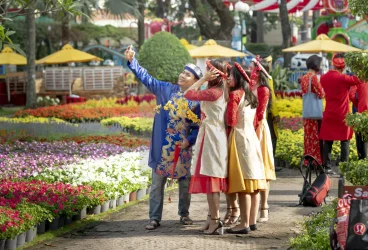
The costumes are part of the performance. The women wear wide round hats and scarves, the men turbans and long tunics, umbrellas in hand. Singers use four vocal techniques, translated loosely as restrained, resonant, ringing and staccato. The men often answer with the same melody but new lyrics, so each reply is a small test of wit.
The rest of the festival is village sport. Human chess is played with people as the pieces. Elsewhere you find bamboo swings, wrestling bouts and a rice-cooking contest. Look out too for the weavers from Noi Due, young women who work their looms while singing. UNESCO listed quan ho Bac Ninh folk songs in 2009.
Noi Bai International Airport serves Hanoi; a hired driver can collect you there and go straight to Lim. See Bangkok to Hanoi and Chiang Mai to Hanoi flights.
Lim is roughly 20 km from Hanoi; the drive takes one to one and a half hours on festival day.
Buses run from My Dinh or Gia Lam stations to Bac Ninh city; a taxi or Grab covers the last 8 to 10 km.
Agree a pick-up time with your driver before you set off.
Base yourself in Hanoi and treat Lim as a long day trip; there is no ticket to buy and nothing to reserve at the hill.
Hanoi is busy in the weeks after Tet, so book your room ahead.
February in northern Vietnam is mild, grey and drizzly. Hanoi averages a high of 21.7°C and a low of 16.4°C, with only about 20 mm of rain but drizzle on twelve days (1991-2020 normals).
Expect overcast skies and damp grass on the hill.
Met at arrivals at Noi Bai International Airport (HAN) and driven door to door to Lim hill.
Others of this kind you opened on this device, so you can get back to them quickly.
No questions yet about Lim Festival. Ask the community or our travel team, and the answer will show here once it is published.
Our team answers questions here
Festivals held in the same weeks, if you want to plan more than one.
Cultural Events, National Day, Social Festivals
Vietnam
2 photos
Cultural Events, Carnivals, Parade
Singapore City, Singapore

Cultural Events, Social Festivals
New Taipei, Taiwan
Cultural Events, Religious Festivals, Parade
Singkawang, Indonesia
Festivals and events across Vietnam, with dates, venues and ticket details where available.

Cultural Events, Religious Festivals
Hanoi, Vietnam
2 photos

Cultural Events, Religious Festivals, National Day
Việt Trì, Vietnam
2 photos

Cultural Events, Folk Festival, Social Festivals
Ha Giang, Vietnam
4 photos

Cultural Events, Folk Festival, Religious Festivals
Hanoi, Vietnam
3 photos

Cultural Events, Social Festivals
Vietnam
2 photos
Tell us where and when you want to go, and local travel experts send you offers for your trip.
General
No. The harmonies and the back-and-forth between the pairs carry the performance. Knowing that most songs are about love, longing and parting is enough to follow the mood.
The 12th is quieter and good for relaxed listening, but processions, games and the strongest singers concentrate on the 13th. If you have only one day, choose the main one and arrive early.
On the small ponds around the hill. Singers sit in the boats and the audience gathers on the banks, which gives one of the best views of the day without standing in a tight circle.
Human chess, bamboo swings, wrestling, tug of war and rice-cooking contests are the regulars, held in village courtyards and around the communal houses. Visitors can usually watch freely, and some games charge a token fee to join.
Young women from Noi Due village take part in a weaving contest, working their looms while they sing. It joins two village skills in one performance and draws a steady crowd.
Yes, if they are happy to stand and walk on uneven ground. There is little seating and the main day is crowded, so the 12th, or an early start on the 13th, is easier on the legs.
Easily. The Perfume Pagoda season opens about a week before Lim, on the other side of Hanoi from Lim. Two separate day trips from the capital cover both.
Yes. Street stalls and small markets set up around the hill, selling snacks, drinks, crafts and souvenirs. Expect simple local food, and pay in cash.
Booking
The repertoire runs to more than 400 song texts set to 213 melody variations. Most of the texts are love songs.
Bac Ninh usually releases the detailed programme in January. Until then the dates for 2027 are calculated from the lunar calendar, not confirmed.
We use necessary cookies to make this site work. With your permission we would also like to remember your preferences, measure how the site is used, and show relevant ads and partner offers. You can change your mind at any time under "Cookie settings" on our Privacy policy page.
