


Venue
Izuro and Sanbashi-dori, Tenmonkan, Kagoshima, Kagoshima Prefecture, Japan

Ohara Festival (Kagoshima) guide
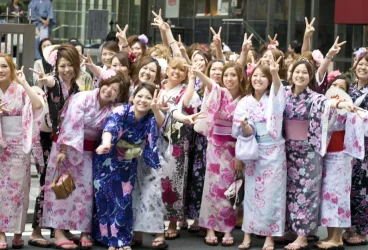
Kagoshima's Ohara Matsuri takes place every year on 2 and 3 November. Neighbourhood groups, office teams and school clubs in matching kimono and straw hats dance slowly down the tram street to local folk songs, with Sakurajima across the bay. It suits travelers who want a residents' festival, and visitors are welcome to join the dancing.
The Ohara Matsuri is Kagoshima's great street dance. Neighbourhood groups, office teams and school clubs in matching kimono and straw hats move in long, slow lines down the tram street through Tenmonkan, keeping step to old local folk songs while Sakurajima smokes across the bay.
It is a residents' festival first. People dance for their street or their company, and the crowd knows the songs by heart. Visitors are welcome to fall in behind them, and that openness is what makes it worth the trip south.
Izuro and Sanbashi-dori, Tenmonkan, Kagoshima, Kagoshima Prefecture, Japan
Hotels near the venue fill up around the event dates.
The city runs free dance workshops in the weeks before the festival, with no booking needed. In 2026 the last two sessions are on 22 October at Kamoike Public Hall and 28 October at Kagoshima Arena, both from 18:00 to 20:00. Even one session makes the walk-in lines far less daunting. If you dance on the day, wear shoes you can stand in for hours, keep pace with the line in front and leave the middle of the street to the registered teams.
Spots along the tram street go through the morning of the main day. Stay behind the kerb, keep bags out of the dancers' path and do not cut across between teams. Bring water and a hat for the midday sun, and pick a place near a side street so you can step out for food and a drink without losing the parade entirely.
Everyone dances at once, then the Ogojo Taiko drum contest. Over by about 20:20.
The main day opens along the tram street.
Marching bands and a joint slot for Shibuya and Kagoshima.
More group dances and drums.
The modern routine closes the day. Traditional performances run at Centerstage Square between sets.
The 2026 Ohara Festival is the 75th, and Kagoshima expects around 18,000 dancers across its two days. The whole show happens along the tram street through Tenmonkan, so the simplest plan is to sleep there. The district is the city's main shopping and dining quarter, built around the covered arcade of Tenmonkan-dori, and from most hotels you can walk to the route in minutes, slip back for a rest at midday and return for the afternoon sets.
The area around Kagoshima-Chuo Station is the alternative. It suits anyone arriving by Shinkansen late on the first evening, and Amu Plaza, the big complex by the station, keeps shops, restaurants and a cinema open when you need a break from the crowds. From there the route is a short tram ride away.
Book for the nights of 2 and 3 November together. The second day is a national holiday, Culture Day, and Kagoshima spends it dancing from mid-morning, so rooms are in demand. Our Japan travel guide helps with the rest of a trip through Kyushu and beyond. Leave a spare day for the volcano across the bay.
Kagoshima launched the festival in 1949 to mark sixty years of city status, at a time when wartime damage still scarred much of the centre, and the dancing was meant to give people something to look forward to while they rebuilt. It has since grown into the biggest festival in southern Kyushu.
The name comes from a song. Ohara-bushi goes back to the early Edo period and became known across Japan after a recording in 1934. Dancers move to it and to Kagoshima Hanya-bushi, with Shibuya-ondo added to the group dance, in long lines that fill the street from kerb to kerb. Costumes are kimono, tabi socks and straw hats, every team in its own matching costume. Between the dance blocks come taiko drummers and modern groups, so the mood swings from slow and stately to loud.
This year the city also runs the flower tram, a car decked out in lights that rolls through the city in the run-up to the event. Food is part of the evening. Tenmonkan has plenty of places to eat between sets, and the obvious drink is the local sweet potato shochu, which you will also be offered on the street.
Kagoshima Airport buses leave about every 10 minutes and take around an hour to Kagoshima-Chuo Station, usually stopping in Tenmonkan. The fare was 1,500 yen in 2025.
The Kyushu Shinkansen ends at Kagoshima-Chuo; the fastest trains from Hakata take about 80 minutes.
Tenmonkan is a short tram ride or about 20 minutes' walk from the station. Trams stop at Tenmonkan-dori and Izuro-dori.
About 1,480 m of tram street from Takamibaba to Sanbashi-dori is closed, and trams and buses are diverted. Check the city's notice or walk in.
The next edition runs from 2 November to 3 November 2026. Book your room as soon as your dates are fixed, since rooms close to the festival are the first to go.
Early November is pleasant in Kagoshima. The 1991-2020 normals give a November average high of 20.6°C and a low of 12.2°C, with about 102 mm of rain over nine days.
Daytime on the holiday is usually comfortable; the night programme on the 2nd needs a jacket.
Met at arrivals and driven door to door to Tram street between Takamibaba.
Places to eat in Japan before or after the celebrations.
1F, 1-7-19 Otemachi, Naka-ku, Hiroshima, Japan
Cuisine:Hiroshima okonomiyaki
1-4-15 Dotonbori, Chuo-ku, Osaka 542-0071, Japan
Cuisine:OkonomiyakiOsaka
459 Shimokawara-cho, Higashiyama-ku, Kyoto 605-0825, Japan
Cuisine:Kyoto kaisekiJapanese
Minamiaoyama Garden Court, 2-6-15 Minami-Aoyama, Minato-ku, Tokyo 107-0062, Japan
Cuisine:InnovativeJapanese
Others of this kind you opened on this device, so you can get back to them quickly.
No questions yet about Ohara Festival (Kagoshima). Ask the community or our travel team, and the answer will show here once it is published.
Our team answers questions here
Festivals held in the same weeks, if you want to plan more than one.
Cultural Events, Arts Festivals, Winter Festivals
Sapporo, Japan


Cultural Events, Exhibition, Fair
Sharjah, United Arab Emirates
Arts Festivals, Film Festivals
Thessaloniki, Greece
Festivals and events across Japan, with dates, venues and ticket details where available.

Cultural Events, Religious Festivals, Winter Festivals
Nara, Japan
Cultural Events, Religious Festivals, Parade
Takayama, Japan
Cultural Events, Religious Festivals, Parade
Kyoto, Japan
Cultural Events, Religious Festivals, Parade
Osaka, Japan
Tell us where and when you want to go, and local travel experts send you offers for your trip.
Booking
About 18,000 for the 2026 edition, the 75th. They dance in teams spread along the whole course over the two days.
Kagoshima City's general information call centre, on 099-808-3333, and the festival page on the city's tourism website, which also posts the tram and bus diversions.
General
Yes. Walk-in groups, called tobiiri-ren, form on the day with no sign-up, and anyone can tag on. The official guidebook lists where they set off from.
A local shaved-ice dessert topped with condensed milk, fruit, small mochi and sweet bean paste. One story says the coffee shop Mujaki first arranged the toppings to look like a polar bear from above.
The local favourite is imo-jochu, distilled from sweet potato, often taken oyu-wari: cut with hot water, which suits a cool November evening on the street.
An illuminated, decorated tram that runs through the city in the days leading up to the festival. In 2026 it runs until the day before the dancing starts, so see it on the evening you arrive.
Easily. The ferry from Kagoshima port takes about 15 minutes and runs around the clock, so a morning on the volcano island fits before or after the festival days.
Mostly volunteers. Teams come from neighbourhood associations, companies and schools, and each one turns out in its own matching kimono, tabi and straw hats.
Yes. The 2026 festival has an open photo contest, with entry rules and deadlines posted on the official festival page. The parade on the holiday afternoon gives the best light.
Its main day is fixed on 3 November, which is also the national holiday. With schools and offices closed, residents have the day free, and the dancing runs from mid-morning to mid-afternoon.
Prices & payment
Not the Welcome Suica. Kagoshima uses its own RapiCa card, which you can buy at the station, or pay the flat fare of 170 yen in cash.
We use necessary cookies to make this site work. With your permission we would also like to remember your preferences, measure how the site is used, and show relevant ads and partner offers. You can change your mind at any time under "Cookie settings" on our Privacy policy page.
