
The most mysterious places in the world include the Bermuda Triangle, Area 51 in Nevada, the Nazca Lines in Peru, Stonehenge, the Richat Structure in Mauritania and Blood Falls in Antarctica. They fall into three groups: natural features science has only recently explained (or still argues over), ancient works whose builders left no written record, and sites where folklore has grown far larger than the evidence. This guide covers 40 of them across six continents, from the Bermuda Triangle and Blood Falls in Antarctica to Bhangarh Fort in Rajasthan, and is honest about which mysteries researchers have now cracked and which are still open.
Planning more of the trip? Start with our guide to the most famous landmarks around the world.
For each place you will find where it is, what the current best explanation is, whether you can actually visit and when to go. Several entries sit next to famous sights covered in our other guides, such as places to visit in Egypt and famous landmarks in the USA, so you can fold a mystery stop into a wider trip.
Each entry was checked against published research and official site information in October 2026. Where science has moved on, as with Blood Falls, the sailing stones and the Darvaza crater, the entry says so. Where a story rests only on legend, we say that too.
Mysterious places at a glance
Of the 40 places in this guide, most can be visited, many freely, such as the Crooked Forest in Poland and Eternal Flame Falls in the USA. A few cannot: Area 51 is a closed military base, Blood Falls in Antarctica is reachable only by expedition, and Devil’s Bridge in Germany is view only. Tap a name to jump to its full entry.
| # | Place | Country | Kind of mystery | Visitable? |
|---|---|---|---|---|
| 1 | Area 51 | USA | Secret military base | No |
| 2 | The Bermuda Triangle | Atlantic Ocean | Disappearances at sea | Yes (by ship or plane) |
| 3 | Blood Falls | Antarctica | Red waterfall | Expedition only |
| 4 | Coral Castle | USA | One-man megalith | Yes |
| 5 | Crooked Forest | Poland | Bent trees | Yes, free |
| 6 | Devil's Bridge (Rakotzbrücke) | Germany | Circle illusion | View only |
| 7 | Door to Hell (Darvaza Gas Crater) | Turkmenistan | Burning crater | Yes, with a tour |
| 8 | Eternal Flame Falls | USA | Fire behind a waterfall | Yes, free |
| 9 | Great Blue Hole | Belize | Giant sea sinkhole | Yes, dive or fly |
| 10 | Lake Natron | Tanzania | Caustic red lake | Yes |
| 11 | Magnetic Hill | India | Gravity illusion | Yes |
| 12 | Mount Roraima | Venezuela, Brazil, Guyana | Lost-world plateau | Yes, multi-day trek |
| 13 | Nazca Lines | Peru | Giant desert drawings | Yes, by air |
| 14 | Plain of Jars | Laos | Stone jar fields | Yes |
| 15 | Richat Structure (Eye of the Sahara) | Mauritania | Giant rings | Yes, remote |
| 16 | Sailing Stones of Racetrack Playa | USA | Moving rocks | Yes |
| 17 | Stonehenge | England | Prehistoric monument | Yes |
| 18 | The Catacombs of Paris | France | Bone-lined tunnels | Yes |
| 19 | The Devil's Sea (Dragon's Triangle) | Pacific Ocean, Japan | Disappearances at sea | Via sea route |
| 20 | Moai Statues on Easter Island | Chile (Rapa Nui) | Giant statues | Yes |
| 21 | The Pyramids of Giza | Egypt | Ancient engineering | Yes |
| 22 | The Ruins of Petra | Jordan | Rock-cut city | Yes |
| 23 | The Temple of the Moon | Peru | Hidden cave temple | Yes |
| 24 | Shicheng Underwater City | China | Sunken city | Divers only |
| 25 | Yonaguni Monument | Japan | Underwater terraces | Yes, divers |
| 26 | Uluru (Ayers Rock) | Australia | Sacred monolith | Yes |
| 27 | Valley of the Kings | Egypt | Royal tombs | Yes |
| 28 | Vile Vortices | Global | Theory map | No single site |
| 29 | Wycliffe Well | Australia | UFO hotspot | Yes |
| 30 | Zhangye Danxia Landform | China | Rainbow mountains | Yes |
| 31 | The Green Children of Woolpit | England | Medieval legend | Yes (village) |
| 32 | Winchester Mystery House | USA | Maze-like mansion | Yes |
| 33 | Island of the Dolls | Mexico | Haunted island | Yes |
| 34 | Hoia Baciu Forest | Romania | Haunted forest | Yes |
| 35 | Great Pyramid of Cholula | Mexico | Hidden pyramid | Yes |
| 36 | The Uffington White Horse | England | Hill figure | Yes |
| 37 | Bhangarh Fort | India | Haunted ruins | Yes, daytime |
| 38 | The Skirrid Inn | Wales | Haunted pub | Yes |
| 39 | Aokigahara Forest | Japan | Silent forest | Yes |
| 40 | The Crooked House of Windsor | England | Leaning house | Yes |
40 most mysterious places in the world, explained
The forty places below run alphabetically through the best-known mysteries, from Area 51 and the Bermuda Triangle to the Nazca Lines, Stonehenge and the Pyramids of Giza, then on to folklore sites such as Bhangarh Fort and Aokigahara Forest. Each entry says where the place is, what science now explains, what remains open, and whether you can visit.
Area 51

The world's most famous military secret is a United States Air Force facility beside Groom Lake in Lincoln County, Nevada, about 130 km north-west of Las Vegas. For decades the government would not confirm it existed, which turned it into the centre of UFO folklore. In 2013 declassified CIA documents finally acknowledged the site as a test area for the U-2 and later spy planes, which explains many of the strange lights people reported in the 1950s and 1960s.
What happens there today is still classified. The boundary is marked by signs and patrolled, and crossing it is a criminal offence, so you cannot visit. The nearest most travelers get is the Extraterrestrial Highway (Nevada State Route 375) and the small town of Rachel, which leans heavily into alien-themed tourism. That road trip is best done between October and April, away from the desert heat. Do not cross the boundary signs.
The Bermuda Triangle

No legend on this list is better known. The Bermuda Triangle is a loosely defined area of the western North Atlantic between Miami, Bermuda and Puerto Rico, and its reputation comes from a run of lost ships and aircraft, most famously Flight 19, five US Navy bombers that vanished in 1945.
Investigators, including the US Coast Guard and Lloyd's of London, have found no evidence that losses here are higher than in other busy stretches of ocean. Heavy traffic, sudden storms, the Gulf Stream and human error explain the incidents without anything stranger. Cruise ships and flights cross it every day, and most Caribbean cruises pass through. If you are planning a Bermuda or Bahamas trip, go between December and May; hurricane season runs June to November.
Blood Falls

Here is a mystery science has solved. Blood Falls pours a rust-red stream from the tongue of the Taylor Glacier in Antarctica's McMurdo Dry Valleys, and for about a century the colour puzzled scientists. Research published in 2022 and widely reported in 2023 showed the red comes from tiny iron-rich nanospheres that form when salty, oxygen-free brine from beneath the glacier meets the air and oxidises.
Earlier work traced the brine to a subglacial lake that hosts microbes living without light or oxygen, which is why astrobiologists study it as a model for life on other worlds. Access is limited to research teams and a small number of helicopter-supported expedition cruises in the Antarctic summer, November to February. If you book an expedition, ask the operator whether Dry Valleys flights are included.
Coral Castle

Florida's weirdest roadside stop stands at 28655 South Dixie Highway in Homestead, south of Miami. Coral Castle is a garden of carved limestone blocks, about 1,100 tons in total, made by a single Latvian immigrant, Edward Leedskalnin, between 1923 and 1951. He worked alone, often at night, with hand tools, and in 1936 moved the whole structure about 10 miles from Florida City to its present site.
No one saw him lift the heaviest stones, and he claimed to know the secrets of the pyramid builders. Engineers point to levers, pulleys and tripods, all of which he owned. It is now a ticketed museum with guided tours, an easy half-day stop on the way to the Florida Keys. November to April is the cooler time to go.
Crooked Forest

Photographers come to Nowe Czarnowo, close to Gryfino in West Pomerania, for about 400 pine trees planted around 1930 that all bend sharply north just above the ground before curving upright. The grove is now a protected natural monument.
No document explains the shape. The favoured theory, still unproven, is that foresters bent the young trees on purpose to grow curved timber for furniture or boats, a plan cut short by the Second World War. Snow damage and tank traffic have also been suggested, but neither explains how uniform the curves are. The woodland is open and free, about 30 minutes from Szczecin, and May to October is the best time to visit.
Devil's Bridge (Rakotzbrücke)

Kromlau Park in Gablenz, Saxony, holds what may be Germany's most photographed bridge. The Rakotzbrücke is a thin stone arch over the Rakotzsee lake, built by a local landowner in the second half of the 19th century. When the water is still, the arch and its reflection form an almost exact circle.
The name comes from a legend that only the devil could have built something so delicate, so the mystery lives in folklore alone. The park is free. Walking on the bridge is not allowed, to protect it, but paths around the lake give the classic view. Autumn brings the colours and calm mornings; arrive early, before the wind ripples the lake.
Door to Hell (Darvaza Gas Crater)

About 260 km north of Ashgabat, the Darvaza crater is a collapsed pit in the Karakum Desert that has burned for decades and is now fading fast. The usual story says Soviet geologists set it alight in 1971 to burn off methane (Live Science), though records are thin and some local accounts date the collapse and fire differently. Natural gas has burned there since a collapse, most likely in the 1970s.
The fire is shrinking. Turkmenistan ordered work to put it out in 2022, and monitoring reported in 2025 and 2026 shows the flames much weaker than before. Visitors still camp nearby, but go soon if you want to see it burning, and see it after dark when the glow is strongest. Turkmenistan has strict entry rules; most visitors need a letter of invitation arranged through a licensed agency and travel on a licensed tour, often as part of an overland Central Asia trip. April to May and September to October are the best months.
Eternal Flame Falls

In Chestnut Ridge Park near Orchard Park, New York, south of Buffalo, a small flame burns in a grotto behind a waterfall. Natural gas seeps from the shale rock and feeds the fire.
Research has found the gas here is hotter and richer in ethane than expected for shale this shallow, so its exact source is still debated. The flame sometimes goes out and visitors relight it. This is the easiest hike on the list: a short, free trail, though muddy and slippery, so wear shoes with grip. Go between late spring and autumn, as a day trip from Buffalo or Niagara Falls.
Great Blue Hole

Belize's top dive site is a near-circular marine sinkhole about 300 m across and 124 m deep at the centre of Lighthouse Reef, roughly 70 km off the mainland and Belize City. It formed as a cave on dry land in past ice ages and flooded as sea levels rose.
Stalactites inside it confirm the cave origin. Experienced divers go to about 40 m to see them, and scenic flights show the full circle, so book one if you want the whole shape. The mystery is mostly visual, since the science is well understood. Seas are calmest from April to June.
Lake Natron

In the Arusha Region near the Kenyan border, Lake Natron is a shallow soda lake so alkaline it can burn skin and eyes. Its water turns red and pink from salt-loving microorganisms, and animals that die in it can be preserved by the minerals, which created the famous "stone" bird photos.
It is also the main breeding ground for lesser flamingos in East Africa, which draws wildlife photographers. The area is remote and hot, reached by 4x4 from Arusha and usually combined with a climb of nearby Ol Doinyo Lengai volcano. Visit in the dry season, June to October, and do not swim in the lake.
Magnetic Hill

Drive the Leh-Kargil highway about 30 km from Leh and you reach a short stretch of road that looks as if it pulls cars uphill when they are left in neutral. A painted box on the tarmac marks where drivers stop to try it, and a signboard tells the story of a magnetic force strong enough to affect aircraft.
The effect is an optical illusion: the surrounding slopes hide the horizon, so a gentle downhill looks like uphill. It makes a roadside stop on a half-day drive from Leh, combined with Pathar Sahib Gurdwara and the Indus-Zanskar confluence nearby. The road season is June to September, and you should allow time to acclimatise to the altitude first.
Mount Roraima

The best trek on this list climbs a flat-topped tepui with sheer cliffs about 400 m high, rising in the Canaima National Park border region where Venezuela, Brazil and Guyana meet. Mount Roraima's summit is a separate world of black rock, crystals, pools and plants found nowhere else, which inspired Arthur Conan Doyle's The Lost World.
The ancient sandstone, among the oldest rock on Earth, was isolated by erosion into this plateau. The usual route starts in Venezuela and takes about six days; guides are required, and the trek suits fit walkers. December to April is drier. Check your government's current advice for travel in Venezuela.
Nazca Lines

Scraped into the Nazca Desert of Peru's Ica Region between about 500 BC and AD 500, this UNESCO site holds hundreds of figures and straight lines, including a hummingbird, monkey and spider. Many are only readable from the air.
Researchers link them to water and fertility rituals of the Nazca culture and to processions walked along the lines. New figures are still being found with drones and AI. Small-plane flights leave from Nazca and Pisco, and a roadside tower gives a partial view. You can go year-round, but fly in the morning when the air is calmer and turbulence is lower.
Plain of Jars

Thousands of large stone jars lie scattered across hillsides around Phonsavan in Xieng Khouang province, Laos. They date back roughly 1,500 to 2,000 years and became a UNESCO World Heritage Site in 2019.
Most archaeologists see them as Iron Age funerary sites, since human remains have been found around them. The province was heavily bombed during the Vietnam War, and the main sites have cleared, marked paths; stick to them. History travelers should aim for November to April.
Richat Structure (Eye of the Sahara)

Seen from space, the Richat Structure is a set of concentric rock rings about 40 km wide in the Sahara near the old caravan town of Ouadane, in Mauritania's Adrar Region. It is so clear from orbit that astronauts use it as a landmark, and early space crews thought it might be a meteorite crater.
Geologists explain it as an eroded dome of uplifted rock. It is often linked online to Atlantis, a claim no researcher supports. On the ground the rings are hard to see, because the scale shows only from the air. Sahara travelers reach it by 4x4 from Atar with a hired local driver, ideally between November and February.
Sailing Stones of Racetrack Playa
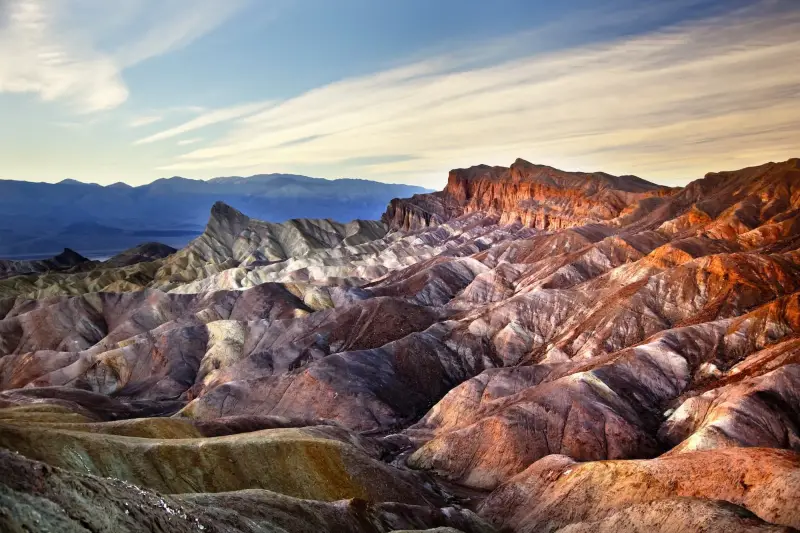
Death Valley National Park solved its own mystery in 2014. On Racetrack Playa, rocks leave long trails across the dry lakebed, and that year researchers filmed the cause: thin sheets of ice form after rain, then light winds push the ice and the stones slide slowly.
The playa is remote, reached by a rough dirt road that needs a high-clearance 4x4; carry two spare tyres. Never move or take stones. November to March avoids the worst heat.
Stonehenge

Britain's UNESCO icon on Salisbury Plain, Wiltshire, was built in stages from around 3000 BC. Its smaller bluestones came from the Preseli Hills in Wales, and research published in 2024 traced the Altar Stone to north-east Scotland.
The monument aligns with the midsummer sunrise and midwinter sunset, and it was used for burials, so most see it as a ceremonial and calendar monument. How it was used day to day is still debated. English Heritage runs timed tickets, which you should book online, and solstice gatherings give access to the stones. Spring or autumn weekdays are quietest, and it works as a day trip from London or Bath.
The Catacombs of Paris

Under the Left Bank of Paris runs a network of old limestone quarries, the stone that built much of the city, and the eeriest city site on this list. From 1786, when overflowing cemeteries became a public health crisis, the remains of about six million Parisians were moved into part of these tunnels and arranged into walls of skulls and long bones.
The visitor route, entered at Place Denfert-Rochereau in the 14th arrondissement, covers about 1.5 km, around 20 m below the street, and takes roughly an hour. Hundreds of kilometres of further tunnels are closed to the public, and entering them is illegal, though urban explorers (cataphiles) still do. Timed tickets are sold online and sell out in busy months, so book ahead whenever you go; queues are long. The exit is a short walk from the entrance.
The Devil's Sea (Dragon's Triangle)

Japan has its own Pacific legend. The Devil's Sea, also called the Dragon's Triangle, is a stretch of ocean south of Tokyo around Miyake Island, and its reputation grew in the early 1950s after several Japanese vessels were lost, including the research ship Kaiyo Maru No. 5, which had been sent to study the area.
The cause of that loss is well documented: the ship was destroyed by an underwater volcanic eruption at Myojin-sho reef in 1952. Typhoons, sudden swells and seismic activity explain the rest. Ferries to the Izu Islands cross these waters every day, and the islands themselves are a good escape from Tokyo for hot springs and diving. April to June avoids typhoon season.
Moai Statues on Easter Island

Rapa Nui, the Chilean island that is the most remote inhabited place on Earth, holds almost 1,000 moai. Polynesian islanders carved them mostly between the 13th and 16th centuries from volcanic tuff at the Rano Raraku quarry, where hundreds of unfinished figures still lie in the hillside. The statues represent deified ancestors and most stood on stone platforms (ahu) facing inland, watching over villages.
How the islanders moved statues weighing many tonnes for kilometres without wheels or large animals was long a puzzle. Field experiments in 2012 showed small teams with ropes could rock an upright moai forward so it "walked", which matches island oral tradition. Flights go from Santiago. Visitors need a Rapa Nui National Park ticket, key sites can only be visited with a licensed local guide, and October to April is the best season for this once-in-a-lifetime trip.
The Pyramids of Giza

The Great Pyramid of Khufu on the Giza Plateau, at the western edge of Cairo, was built around 2560 BC and is the last of the Seven Wonders of the Ancient World still standing, part of a UNESCO site. For centuries people suggested lost civilisations or worse to explain it. Excavations of the workers' town south of the plateau, and the papyrus logbooks of an official named Merer found at Wadi al-Jarf, show organised, fed and paid crews moving limestone by boat along canals from the Nile.
What remains open is the detail. Scholars still argue over whether ramps were straight, zigzag or spiral, and muon scans since 2017 have revealed a large hidden void above the Grand Gallery whose purpose is unknown. The new Grand Egyptian Museum next to the plateau now holds the full Tutankhamun collection, which makes Giza a full-day visit. Site tickets are sold at the gate, with extra charges for the interiors. Go between October and April and arrive at opening to beat heat and crowds.
The Ruins of Petra

Petra, at Wadi Musa in southern Jordan, is a UNESCO site and one of the New 7 Wonders. It was the capital of the Nabataeans, Arab traders who grew rich on incense routes and carved tombs and temples straight into rose-coloured sandstone from around the 4th century BC. After earthquakes and shifting trade routes, it faded from European knowledge until the Swiss traveler Johann Ludwig Burckhardt reached it in 1812.
The "mystery" lies in how much is still unknown: the purpose of many façades, the full extent of the city (most of it is unexcavated) and the clever water system that let thousands live in a desert valley. A walk through the Siq to the Treasury is only the start; the Monastery is a climb of about 800 steps. Buy day tickets or the Jordan Pass, allow two full days, and enter at opening for an empty Siq. March to May and September to November are the best months.
The Temple of the Moon

Most visitors to Machu Picchu never see this Inca secret. The Temple of the Moon sits in a natural cave on the far side of Huayna Picchu, the steep peak behind the citadel, about 400 m lower than the summit. Inside are finely cut stone niches and a carved throne-like rock, some of the best masonry in the area.
No one knows exactly what it was for. The name was given by later explorers, and the most common view is that it was a burial or ceremonial shrine. Reaching it means buying a Huayna Picchu ticket (daily numbers are capped, and tickets sell out weeks ahead) and taking a steep detour that adds about two hours to the climb, so it suits fit hikers. Go in the dry season, April to October.
Shicheng Underwater City

Shicheng, the "Lion City" in Chun'an County, Zhejiang, was a regional centre in eastern China for well over a thousand years. In 1959 the government flooded its valley to build the Xin'an River hydroelectric dam, creating Qiandao (Thousand Island) Lake, and the city disappeared under the water.
Cold, still water has kept its walls, gates and stone carvings unusually well preserved at depths of around 25 to 40 m. Divers rediscovered and documented the site in the early 2000s. Diving is restricted and visibility is poor, so only advanced and technical divers on organised trips go down; everyone else can take a Qiandao Lake cruise. April to October is the season.
Yonaguni Monument

Few sites here are as hotly debated. Off the south coast of Yonaguni, Okinawa, the westernmost inhabited island of Japan, a local diver came across huge stepped rock terraces in 1986. The flat faces and right angles look built, and a Japanese geologist argued that people shaped them before sea levels rose.
Most geologists disagree. The local sandstone splits naturally along straight planes, which creates exactly these steps. Whatever you believe, the dive is impressive. Strong currents mean it is for experienced divers, best booked with a Yonaguni dive shop, and winter brings schools of hammerhead sharks to the same waters. Seas are calmer from April to June.
Uluru (Ayers Rock)

Uluru, a sacred site in the UNESCO-listed Uluru-Kata Tjuta National Park, Northern Territory, rises 348 m above the flat red centre of Australia and runs several kilometres underground. It is sacred to the Anangu, the traditional owners, whose law and stories are tied to features all around the rock. Its colour shifts from orange to deep red and purple as the sun rises and sets.
The mystery for most visitors is how something so large stands alone in the desert. Geologists explain it as tilted, hard sandstone that resisted erosion while the softer land around it wore away. Climbing has been banned since October 2019 at the Anangu's request; with a national park pass, sunrise, the 10.6 km base walk and ranger-led walks are the way to see it. Visit in the cooler months, May to September, and respect signs at sacred sites where photography is banned.
Valley of the Kings

On the west bank of the Nile at Luxor, pharaohs of the New Kingdom were buried in rock-cut tombs for about 500 years, and the valley is now a UNESCO site. More than 60 tombs are known. Howard Carter's discovery of Tutankhamun's nearly intact tomb in 1922 made the valley world famous.
The "curse" that supposedly killed those who opened it was a newspaper invention; most of the team lived long lives. The real open questions are archaeological, and teams still search for missing royal burials. The standard ticket covers three tombs, and special tombs such as Tutankhamun's and Seti I's cost extra. Photography rules vary by tomb. Go early in the morning, between October and April.
Vile Vortices

This entry is pure theory. The "vile vortices" come from the American writer Ivan Sanderson, who in 1972 claimed that twelve points spread evenly around the globe, including the Bermuda Triangle and the Devil's Sea, shared unusual disappearances and magnetic oddities.
No data supports this. The zones were drawn to fit a pattern, and most lie in open ocean with ordinary shipping risks. It belongs on this list because it ties several other entries together in popular culture. There is no single place to visit and no season to plan around; it is a subject for reading.
Wycliffe Well

Wycliffe Well is a small roadhouse and caravan stop on the Stuart Highway in the outback, about 130 km south of Tennant Creek in the Northern Territory. It calls itself the UFO capital of Australia, and its walls and grounds are covered in alien murals, models and newspaper cuttings about sightings.
Clear, dark outback skies and almost no light pollution mean satellites, meteors and aircraft lights stand out, which explains most reports. As a night stop on the long drive between Alice Springs and Darwin it is fun, and the stargazing is genuinely excellent, so bring a star chart. May to September is the time to go.
Zhangye Danxia Landform

In Zhangye National Geopark, Gansu province, the hills are striped red, orange, yellow and green. They look painted, which is why photos of them are often accused of being edited.
The colours come from layers of sandstone and siltstone laid down over millions of years with different minerals, then folded and worn down. The area is part of the China Danxia UNESCO site listed in 2010. It is a ticketed park where shuttle buses and boardwalks link viewing platforms. Light is best late in the day, the season runs June to September, and you should stay on the boardwalks because the soil is fragile.
The Green Children of Woolpit

Two 12th-century chroniclers tell of a boy and girl with green skin who appeared at harvest time near Woolpit, a Suffolk village near Bury St Edmunds. They spoke an unknown language and at first ate only beans. The boy died; the girl lost her green colour, learned English and said they came from a land of twilight.
Historians have offered several theories: a form of anaemia caused by poor diet, or Flemish-speaking children lost after persecution of Flemish settlers. Woolpit itself is a pretty village with a medieval church, and its sign shows the two children. It makes a countryside stop any time from spring to autumn.
Winchester Mystery House

Sarah Winchester, widow of the rifle maker's son, kept builders working on her house at 525 South Winchester Boulevard, San Jose, from 1886 until her death in 1922. The result has about 160 rooms, stairs that lead into ceilings, doors that open onto walls and windows set into floors.
Legend says she built to confuse the ghosts of people killed by Winchester rifles. Historians see a wealthy, private woman who enjoyed design and constantly changed her plans, with earthquake damage in 1906 adding to the oddities. Guided tours run daily, year-round; book a slot online for a half-day in the Bay Area.
Island of the Dolls

Perhaps the eeriest sight on the list sits on a small chinampa (floating garden) in the canals of Xochimilco, southern Mexico City. A caretaker named Don Julián Santana Barrera hung hundreds of dolls from trees over several decades, saying they appeased the spirit of a girl who drowned nearby.
Weathered by sun and rain, the dolls look disturbing. The place is a caretaker's personal shrine, and its legend comes from him alone. Reaching it takes a long trajinera (painted boat) ride, usually two to four hours round trip from the further embarcaderos such as Cuemanco, so plan a half-day on the canals and agree the boat price before setting off. The dry season, November to April, is best.
Hoia Baciu Forest

Transylvania's haunted forest is a woodland on the western edge of Cluj-Napoca. Hoia Baciu is famous for twisted trees, a round clearing where little grows, and stories of lost time, ghosts and a 1968 UFO photograph.
No study has confirmed anything unusual. Twisted trees occur in many windy woodlands, and soil conditions can explain the clearing. Entry is free and it is an easy walk from the city; local guides run evening tours for the atmosphere, so bring a torch. May to October is the season.
Great Pyramid of Cholula

The pyramid at San Andrés Cholula, near Puebla, is the largest in the world by volume, larger than the Great Pyramid of Giza. You would not guess it. Built in several stages over centuries, it was overgrown and looked like a natural hill when the Spanish arrived and built a church on top.
The Santuario de la Virgen de los Remedios still crowns it. Archaeologists dug kilometres of tunnels through the structure in the 20th century; a section is sometimes open to visitors, and the museum explains the building phases. One ticket covers the site and museum. On clear days the Popocatépetl volcano rises behind the church, so climb up for the view. It is a day trip from Puebla or Mexico City, best from October to April.
The Uffington White Horse

Cut into the chalk of White Horse Hill near Uffington, Oxfordshire, this flowing, stylised horse is about 110 m long. Dating of soil layers suggests it was made around 3,000 years ago, in the Late Bronze Age, which makes it the oldest chalk figure in Britain.
Why it was made, and why it is so abstract, is unknown. It may have been a tribal emblem or linked to a sun god. It is best seen from the hills and fields opposite. The National Trust looks after the site, with a free car park, and volunteers re-chalk it to keep it white. Visit between spring and autumn and combine it with a walk on the Ridgeway path.
Bhangarh Fort

Bhangarh is a ruined 17th-century town in Alwar district, Rajasthan, about 85 km from Jaipur, with a palace, temples and bazaar streets set against the Aravalli hills. Local legend blames the town's abandonment on a curse by a sorcerer, and the place is often called India's most haunted site.
A sign from the Archaeological Survey of India forbids entry before sunrise and after sunset. Officials point to safety among unstable ruins and wildlife; the folklore says otherwise. By day it is a quiet, beautiful site that sees far fewer visitors than Jaipur's forts. Make it a day trip from Jaipur between October and March, and leave well before sunset.
The Skirrid Inn

Wales has a haunted pub in Monmouthshire. The Skirrid Mountain Inn at Llanvihangel Crucorney, north of Abergavenny, claims to be one of the oldest pubs in the country. Local tradition says it once served as a courtroom and that convicted people were hanged from a beam in the stairwell, where a rope mark is still pointed out.
Records for the earliest claims are thin, but the building is genuinely old and atmospheric. It is still a working pub with rooms, open year-round and popular with walkers on the Skirrid and Black Mountains, who stop for lunch after a hill walk.
Aokigahara Forest

At the north-west foot of Mount Fuji in Yamanashi, Aokigahara grows on a lava flow from an eruption in 864. The trees root into porous black rock and moss, which absorbs sound and leaves the forest in deep silence. Compasses are said to fail here; in practice, small local magnetic effects in the rock are minor.
The forest has a sad reputation and is linked in Japanese folklore to spirits. Treat it with respect. Stay on marked trails, which link the popular Narusawa Ice Cave and Fugaku Wind Cave and fit into a Fuji Five Lakes day. April to November is the season.
The Crooked House of Windsor

On Market Street, just outside Windsor Castle, this historic timber-framed building leans so sharply it looks ready to topple. It was rebuilt in the 1680s, reportedly with unseasoned green oak, which warped as it dried.
Stories of a secret tunnel to the castle are a local legend. The building has been used as shops and tea rooms over the years, and its exterior is visible at any time of year. It takes a minute to see and makes a good photo stop on a castle day.
 Get the bookingMentor app
Which mysteries has science already solved?
Three of the best-known puzzles on this list have clear answers now. The sailing stones of Death Valley were filmed moving on wind-pushed ice in 2014. Blood Falls owes its colour to iron-rich nanospheres, described in research published in 2022. The Bermuda Triangle has no higher loss rate than other busy seas.
Two more desert puzzles have settled explanations. Geologists describe the Eye of the Sahara (the Richat Structure in Mauritania) as an eroded dome about 40 km across, pushed up by molten rock and then worn into rings, with no impact involved. Darvaza's burning crater in Turkmenistan is usually traced to Soviet gas drilling around 1971, although the exact date is disputed, and Turkmen authorities reported in 2025 that the fire had shrunk to about a third of its former size after wells were drilled to capture the gas.
Others remain partly open: the exact building methods of the Giza pyramids, the purpose of the Nazca Lines and the Uffington White Horse, and the use of the Plain of Jars. Then there are places that are mysterious only in story, such as Hoia Baciu, Wycliffe Well and the vile vortices.
Tips for visiting mysterious places safely
Respect closed and sacred areas. Area 51, the Rakotzbrücke deck, Bhangarh after dark and the summit of Uluru are all off limits for legal, safety or cultural reasons, and the fines and damage to sites are real.
Check entry rules early. Turkmenistan, Antarctica, Rapa Nui and parts of Venezuela need special arrangements or have strict rules. Visa requirements depend on your passport, so check each country's official portal.
Divers should be honest about their experience. Shicheng, Yonaguni and the Great Blue Hole are for experienced divers only; bring your logbook and certification.
Death Valley, Lake Natron, Darvaza and Bhangarh are extremely hot in summer. Visit in the cooler months and start early.
Finally, use guides who know the history, because many sites mix documented history with legend. At Bhangarh, for example, the Archaeological Survey of India bars entry before sunrise and after sunset. That rule is standard practice for unlit ruins, yet it is often retold as proof of ghosts.
Planning a trip to Bermuda? Read our Bermuda travel guide or search flights.









{{item.get_author.first_name}} {{item.get_author.last_name}}
{{item.comment_txt}}
{{item_reply.get_author.first_name}} {{item_reply.get_author.last_name}}
@ {{item_reply.reply_to}}, {{item_reply.reply_txt}}