


Venue
Notting Hill, Royal Borough of Kensington and Chelsea, London W10/W11, United Kingdom

Notting Hill Carnival guide
Notting Hill Carnival runs every year on the Sunday and Monday of the August bank holiday weekend. Families should pick Sunday, Families and Children's Day with its own parade, while the main mas parade comes on Monday. Expect a crowd in the range of one to two million, sound systems and soca trucks, so plan your day first.
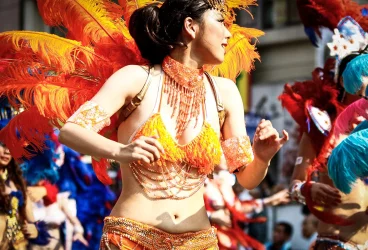
Notting Hill Carnival is London's Caribbean carnival and the biggest street festival in Europe: two days of mas bands in feathers and sequins, steel pans, soca trucks and towering sound-system stacks, spread across the streets of west London for a crowd usually put at between one and two million people.
It is a community event before it is a tourist one. Mas camps work all year on the costumes, sound-system crews come back to the same street corners every summer, and the British West Indian community treats the weekend as its own.
Nobody watches carnival from a seat. You stand, dance and eat your way through it, and the best days are the ones where you stop trying to see everything.
Notting Hill, Royal Borough of Kensington and Chelsea, London W10/W11, United Kingdom
Hotels near the venue fill up around the event dates.
You will be on your feet from morning until the crowds thin out, so dress for that first and for the party second.
Most of the trouble at carnival is the ordinary kind that comes with dense crowds, and a few habits keep it away.
The carnival runs through residential streets, and many residents board up their windows and doors for the weekend. Remember that the steps and basement railings you are leaning on belong to someone who still has to live there on Tuesday.
Use the public toilets, however long the queue, and never a doorway or a front garden. Take your rubbish to a bin or carry it out. If you want photographs of the costumes, a front-row spot on the parade route gives you clean shots without pushing past people who claimed their place first.
The steelband competition. In 2026 the steel orchestras played from 4pm until midnight. Go early to hear the whole field.
A loose, messy procession before breakfast.
Families and Children's Day takes over, with the sound systems warming up and the grills getting going.
The mas bands dance their way round the loop, each behind its own music truck.
The hardest time to move and the best time to stand still and watch. The walk out at the end of the day is every bit as slow as the walk in.
Pick your day before anything else. Sunday is Families and Children's Day, with its own children's parade and a crowd that is merely large. Monday is Adults Day, when the full mas bands come round and the streets are at their tightest, worst of all in the afternoon. If you have one day and no children, Monday is the one to see.
Then plan the day around a base. Because the parade circles and each sound system keeps its own corner, the smart move is to settle near a stack whose music you like, hold that spot for a few hours and let the bands come past you. Wandering the whole area sounds tempting. In practice the crowds make it slow work, and you see less, not more.
The carnival has two parents. In 1959 Claudia Jones, a Trinidad-born journalist and activist, staged a Caribbean carnival indoors at St Pancras Town Hall, an answer to the race riots that had shaken Notting Hill the summer before. Seven years later the local community worker Rhaune Laslett joined forces with the London Free School to hold a street festival, and steel bands such as Ebony and the Metronomes played from the early days. With no office of its own, the carnival leaned on the Mangrove restaurant, run by Frank Crichlow, as an informal base.
Growth brought trouble. By 1976 about 150,000 people came, and clashes with the police, born of years of harassment, marred that year and several after it. Hostile press coverage fed calls for a ban, and anti-racist campaigners helped see them off. By 2003 a limited company, the Notting Hill Carnival Trust, was running the event.
Today the organisers speak of five disciplines: steelpan, soca, mas, calypso and the static sound systems. Mas camps spend the whole year on costumes. And then there is the food. Follow the smoke from oil-drum grills to jerk chicken, look for curry goat with rice and peas, and wash it down with carrot juice or a rum.
Most international visitors land at London Heathrow. The Heathrow Express runs to Paddington in 15 minutes from Terminals 2 and 3, every 15 minutes, and the carnival area is within walking distance of Paddington.
More than 100 roads around the route closed in 2026, from 6am on the Sunday to 6am on the Tuesday. Do not drive.
In 2026 Ladbroke Grove station shut on both days, while Holland Park, Royal Oak, Westbourne Park and Notting Hill Gate ran with entry or exit limits from late morning. Check the TfL Go app that morning, use a station a little further out, such as Kensal Green or Paddington, and walk the last stretch.
Stewards and police seal streets as they fill, so crossing from one side of the loop to the other takes far longer than the map suggests.
The Night Tube did not run on either carnival night in 2026. Sort out the journey back before you set out.
Rooms across west London go quickly for the bank holiday weekend, so reserve a few months ahead.
Staying a few Tube stops away and walking in beats sleeping on the route itself, where the sound systems play into the evening.
Late August is usually warm in London. Average highs at Heathrow are about 23°C with lows around 14°C, and August brings around 53 mm of rain over eight or so days.
A long day on your feet in a dense crowd feels warmer than the thermometer says, but a shower is never far away.
The busiest routes into London (LHR).
 Biman Bangladesh Airlines
Met at arrivals at London Heathrow Airport (LHR) and driven door to door to Ladbroke Grove and surrounding streets.
Places to eat in United Kingdom before or after the celebrations.
14 Pier Road, Whitby YO21 3PU, United Kingdom
Cuisine:SeafoodFish and chips
12 Ashton Lane, Glasgow G12 8SJ, United Kingdom
Cuisine:ScottishModern British
78 Commercial Quay, Leith, Edinburgh EH6 6LX, United Kingdom
Cuisine:Modern ScottishSeasonal
12 Upper St Martin's Lane, London WC2H 9FB, United Kingdom
Cuisine:IndianBombay café
Others of this kind you opened on this device, so you can get back to them quickly.
No questions yet about Notting Hill Carnival. Ask the community or our travel team, and the answer will show here once it is published.
Our team answers questions here
Sights within easy reach of the festival.
United Kingdom
Westfield London is a large shopping centre in White City, west London, beside Shepherd's Bush in the Borough of Hammersmith and Fulham. With about 2.6 million...
United Kingdom
The park covers about 25 hectares in the London Borough of Camden, immediately north of Regent's Park across the Regent's Canal, and is one of the Royal Parks....
United Kingdom
The square lies in the City of Westminster where the West End meets Whitehall. It is named after the naval Battle of Trafalgar of 1805 and is the point from whi...
Festivals held in the same weeks, if you want to plan more than one.
Live Events, Cultural Events, Arts Festivals
Edinburgh, United Kingdom
16 photos
Food Festivals, Leisure Events, Social Festivals
Buñol, Spain
9 photos
Musical Events, Carnivals, Parade
Tokyo, Japan
21 photos
Festivals and events across United Kingdom, with dates, venues and ticket details where available.
Leisure Events, Cultural Events, Exhibition
London, United Kingdom
Food Festivals, Leisure Events, Exhibition
Woking, United Kingdom
1 photo
Tell us where and when you want to go, and local travel experts send you offers for your trip.
Booking
Not for the carnival itself. Sunday and Monday on the streets are free. The one ticketed event of the weekend is Panorama, the steelband competition on the Saturday night, so that is the only thing worth booking in advance.
General
J'ouvert is the early-morning opening of carnival Sunday. In 2026 it ran from 6am to 9am, setting off from the Sainsbury's on Canal Way in Ladbroke Grove. Smearing each other with chocolate, paint or powder is an old J'ouvert habit, so wear clothes you can throw away afterwards.
The UK National Panorama Steelband Competition, in which steel orchestras play for the national title. It is held at Emslie Horniman's Pleasance, a park off Kensal Road that has long been the carnival's starting point, and it is the best place all weekend to hear pan played at full strength.
The Monday parade has traditionally set off around 10am, with judging of the mas bands finishing in the early evening. Exact times change from year to year and are only confirmed a few weeks before carnival, alongside the route map.
Mostly reggae and dancehall, played from the same street corners year after year. Sound systems are thought to have joined the carnival around 1973. On the parade route you will hear soca and calypso from the music trucks, and steelpan from the bands that keep the older tradition going.
Bigger than it looks from the kerb. There are around 40 static sound systems, some fifteen thousand handmade costumes estimated to take a million hours of work, tens of thousands of volunteers and several thousand police officers on duty over the two days.
A London Development Agency report on the 2002 carnival estimated that it brought around £93 million into the London and UK economy, against estimated costs of £6 to 10 million. That report is still the figure most often quoted.
Yes. In 2005 groups from Notting Hill joined the carnival in Bridgwater, Somerset, the largest illuminated carnival in Europe and part of the West Country circuit. If you want to see the form at its biggest, Rio de Janeiro's carnival in the days before Lent is the one to aim for.
Getting there
No. The parade moved to its present circular route in 2004. Before that the procession set out from Emslie Horniman's Pleasance and wound through the neighbourhood. The loop means you can stay in one place and see every band pass.
Stay & facilities
The estimates are huge: around five million hot and cold drinks over the two days, including some 70,000 litres of carrot juice and twenty-five thousand bottles of rum. Some two hundred and forty food stalls sell Caribbean dishes along the way.
Timing & weather
In 2016, with a Golden Jubilee edition marking fifty years since the 1966 street festival. A music streaming platform broadcast 42 hours of live video from the streets that weekend for people who could not be there.
We use necessary cookies to make this site work. With your permission we would also like to remember your preferences, measure how the site is used, and show relevant ads and partner offers. You can change your mind at any time under "Cookie settings" on our Privacy policy page.
