
 Get the app
Phuket, Thailand has more than two dozen beaches, and the 25 best, covered below, differ sharply in crowds, access and sea conditions. Patong is wall-to-wall nightlife, Nai Harn feels like a local swimming hole, Freedom Beach can only be reached by boat or a jungle trail, and the beaches of Sirinat National Park in the north have turtles nesting on them in winter. The 25 beaches below cover the whole island, from the Sarasin Bridge in the north to Cape Panwa in the east, with the area, who each beach suits, sea conditions through the year and how to get there.
You will find the bigger picture in our guide to the best things to do in Thailand.
The one thing that matters most when choosing a Phuket beach is the season. From November to April the west coast is calm and clear; from May to October the southwest monsoon sends surf and rip currents onto the same beaches, and lifeguards fly red flags. This guide tells you which beaches stay swimmable when that happens. For other parts of the country, see our guide to the best beaches in Thailand, and if you are planning a couples trip, our Thailand honeymoon guide.
How we put this list together: our travel desk compared beach access, safety reports from Phuket lifeguards, seasonal sea conditions and park rules, and checked access status for every beach in October 2026. Access to some small coves changes when landowners or beach clubs change their rules, so we have flagged the beaches where it is worth checking locally before you go.
Phuket beaches compared: quick comparison table
Each row links to the full entry. The "Monsoon swim" column describes typical May to October conditions; always follow the flag on the day.
| # | Beach | Area | Best for | Monsoon swim | Access |
|---|---|---|---|---|---|
| 1 | Freedom Beach | South of Patong | Snorkelling, couples | Poor | Boat or steep trail |
| 2 | Kata Beach | Southwest | Families, surfing | Red flags common | Road, easy |
| 3 | Patong Beach | Central west | Nightlife, water sports | Red flags common | Road, easy |
| 4 | Karon Beach | West | Space, walks | Dangerous | Road, easy |
| 5 | Nai Harn Beach | Far south | Clear water, locals | Red flags common | Road, easy |
| 6 | Kata Noi Beach | Southwest | Quiet, couples | Caution | Road, easy |
| 7 | Laem Singh Beach | West | Scenery | Poor | Stairs or boat |
| 8 | Ya Nui Beach | Far south | Kayaking, snorkelling | Poor | Road, easy |
| 9 | Kamala Beach | West | Families | Caution | Road, easy |
| 10 | Bang Tao Beach | Northwest | Resorts, beach clubs | Red flags common | Road, easy |
| 11 | Surin Beach | West | Sunsets, couples | Red flags common | Road, easy |
| 12 | Paradise Beach | South of Patong | Beach club | Often OK | Road or boat |
| 13 | Nai Thon Beach | Northwest (Sirinat NP) | Quiet | Poor | Road, easy |
| 14 | Mai Khao Beach | Far north (Sirinat NP) | Seclusion | Dangerous | Road, easy |
| 15 | Ao Sane Beach | Far south | Snorkelling | Poor | Narrow road |
| 16 | Banana Beach | Northwest | Hidden cove | Poor | Short path |
| 17 | Pansea Beach | West | Seclusion | Poor | Resort or boat |
| 18 | Tri Trang Beach | South of Patong | Calm, snorkelling | Often OK | Road, easy |
| 19 | Layan Beach | Northwest | Quiet walks | Caution | Road, easy |
| 20 | Nai Yang Beach | Northwest (Sirinat NP) | Airport stays | Often OK | Road, easy |
| 21 | Sai Kaew Beach | Far north | Solitude | Poor | Road, easy |
| 22 | Ao Yon Beach | East (Cape Panwa) | Monsoon swims | Good | Road, easy |
| 23 | Rawai Beach | South | Seafood, boats | Not for swimming | Road, easy |
| 24 | Laem Ka Beach | South | Closed | Closed | Closed |
| 25 | Panwa Beach | East (Cape Panwa) | Calm, families | Good | Road, easy |
25 best Phuket beaches: full guide
Freedom Beach

Freedom Beach sits in a small bay on the headland south of Patong, close enough to see the town but cut off from it by jungle and granite boulders. The sand is fine and pale, the water in the dry season is clear enough to see fish around the rocks at both ends, and there is no road down, which is why it keeps a quieter feel than anywhere else this close to Patong. There is a simple restaurant and sunbeds in season, and the beach collects an entry fee that changes from year to year, so carry cash. Most visitors arrive by longtail from the southern end of Patong Beach; the alternative is a steep jungle trail from the road above, which takes roughly 15 to 20 minutes down and feels much longer coming back up in the heat. Do not plan a visit for the monsoon months: boats run less often or stop when the swell picks up, and the trail turns slick after rain.
It is our pick for a hidden cove on the west coast, suited to couples, snorkellers and anyone after a half-day break from Patong. The longtail ride from south Patong takes about 10 to 15 minutes.
Agree the return pick-up time with your boatman before you step off, and go in the morning before day-trip boats arrive.
Kata Beach

Kata is the beach most Phuket regulars recommend to first-timers who want a bit of everything. The bay is a neat curve of soft sand with Koh Pu island offshore, the water shelves gently in the dry season, and the town behind it has restaurants, massage shops and mid-range hotels without the noise of Patong. Families like it because children can paddle safely from November to April and the walk from most hotels to the sand is short. The character of the beach flips in the low season. From May to October the southwest swell turns Kata into one of Phuket's main learner surf spots, with board hire and lessons on the sand, and the same waves create rip currents that lifeguards mark with red flags. Swim only between the flags in those months. The northern end, toward the Club Med frontage, is usually less crowded than the middle.
Of all the beaches here, Kata is the best all-round family choice, with lifeguards on duty, and it works just as well for first-time visitors and beginner surfers. Allow about an hour by road from the airport, or 15 to 20 minutes from Patong.
If you are coming to surf, book a lesson for the morning, when onshore winds are lighter.
Patong Beach

Patong is Phuket's busiest and most developed beach, a long crescent backed by hotels, shopping centres and the bars and clubs of Bangla Road. It is the place to stay if you want nightlife, restaurants of every price level and easy tour pick-ups, and it is the base from which longtails leave for Freedom and Paradise beaches. As a beach it is decent: the sand is wide, the water is clean enough for a swim in the dry season, and the south end near the rocks is usually calmer than the middle. Expect jet skis, parasailing and a steady stream of vendors. Smoking is banned on the sand outside marked smoking areas, and Patong was the first beach where the rule was enforced. In the monsoon months red flags go up regularly and lifeguards pull out swimmers who ignore them every season.
No beach on the island is livelier. Patong suits first-timers and travelers without a car; the drive from the airport takes about an hour, and Phuket Town is 25 to 30 minutes away over the hill.
Stay a block or two back from Bangla Road if you want to sleep before 3am.
Karon Beach

Karon is one of the longest beaches on the west coast, and its width means you can always find room, even in late December. The sand is coarse and pale, the slope into the water is steeper than at Kata, and the beach has a reputation among lifeguards as the worst on the island for rip currents once the monsoon arrives, so take the flags seriously from May onward. In the dry season it is a relaxed place to swim and walk at sunset. The resort strip behind the beach is quieter and a little cheaper than Patong, with a temple fair and night market area near Wat Karon. The southern end shares a small headland with Kata, which makes it easy to eat in Kata and swim in Karon. A road separates most hotels from the sand, so few rooms are truly beachfront.
You get more room on the sand at Karon than anywhere else in this guide, and it rewards long walks, couples and mid-range budgets. It lies about an hour from the airport and 15 minutes south of Patong.
Walk to the north end in the early morning for the emptiest stretch of sand.
Nai Harn Beach

Nai Harn sits near Phuket's southern tip, tucked between green hills, with a freshwater lake and the Wat Nai Harn temple right behind it. Long-stay residents of Rawai and Nai Harn treat it as their local beach, and in the dry season it has some of the clearest, calmest water on the island, with yachts anchored in the bay. The beach was cleared of most permanent sunbed and restaurant businesses during the island-wide beach clean-ups, so bring a towel and shade, though food stalls and cafes line the lane by the lake. The loop path around the lake is popular for jogging at dawn and dusk. Nai Harn is not a monsoon beach: from May to October it is one of the places where rip currents form, and red flags are common. The Promthep Cape viewpoint is a short drive south for sunset.
Expect to share it with long-stay residents, since this is their favourite, and it suits longer stays and dry-season swimmers. The beach lies near Rawai, about 1 hour 15 minutes from the airport and 20 minutes from Kata.
Arrive before 10am on weekends, when the small car park and roadside spaces fill.
Kata Noi Beach

Kata Noi is Kata's little sister, a separate bay just south of the main beach, reached by a short road over the headland. There is only one road in and most of the frontage is taken up by a large resort, so the beach stays calm even when Kata is busy. The sand is fine, the water is clear in the dry season, and the rocks at the southern end are good for a short snorkel on flat days. Facilities are limited to a few cafes and sunbed operators at the northern end. Like the rest of the southwest coast, Kata Noi takes the full force of the swell in the monsoon and can have strong currents, so check the flags. The Karon viewpoint on the road to Nai Harn looks straight down on Kata Noi, Kata and Karon, and is worth a stop on the way.
Think of it as a quieter Kata, good for couples and for family days away from the crowds. From Kata it is a short drive or a 20-minute walk over the hill.
Pair it with the viewpoint on the road south for late-afternoon photos.
Laem Singh Beach

Laem Singh is a small cove between Surin and Kamala, framed by huge granite boulders and jungle on the cliffs above. Its access story is complicated: the land path was closed in 2017 during a dispute with landowners, and later reports describe access reopened via a hillside stairway and small car park off the coastal road, with a fee sometimes collected for parking or entry. Check the situation locally before you go, because it has changed more than once. The descent is steep, roughly a hundred steps with rope handrails in places, which rules it out for anyone with mobility issues or small children. The reward is turquoise water, shade under the trees and a sense of being away from everything. It faces west and takes heavy swell in the monsoon, so treat it as a dry-season beach.
For sheer setting, nowhere on this list is more dramatic, and photographers, couples and fit walkers get the most from it. Besides the stairs from the coastal-road car park, you can come by longtail from Kamala.
The coastal road viewpoint above gives the classic photo even if you skip the stairs.
Ya Nui Beach

Ya Nui is a pocket-sized beach on the road between Nai Harn and Promthep Cape, split into two halves by a rocky outcrop. Its draw is the small island of Koh Man just offshore: on calm days people hire kayaks or snorkel gear on the sand and paddle out to the coral and fish around the island. The beach is narrow and fills with day visitors by late morning, and the roadside parking is limited. Swimming is gentle in the dry season, but the bottom is rocky in places, so reef shoes help. Ya Nui is also a good stop for a late lunch before the sunset crowds head to Promthep Cape or the windmill viewpoint above the bay. In the monsoon the sea here is rough and rental huts may not open.
Paddlers should head here first: this tiny beach is the best kayak launch on the island, and it is just as good for snorkelling or a short stop. It is about 10 minutes south of Nai Harn by road.
Ask about the tide before kayaking: the reef around Koh Man is best near high water.
Kamala Beach

Kamala is a long, gently curving beach on the west coast between Patong and Surin, with a fishing-village core that still shows behind the resorts. It suits families and couples who want restaurants and shops within walking distance but would rather not stay in Patong. The southern end is greener and quieter, with a few upmarket resorts, while the northern end has the beach bars and a busier strip of sand. The swimming is good in the dry season and the beach shelves gradually. Kamala also has a temple and mosque close together, a reminder of its mixed Thai Buddhist and Muslim community. In the monsoon the bay gets surf and currents like the rest of the west coast, so check the flags before swimming.
Among mid-size resort beaches, Kamala is our favourite, and families, couples and longer stays all fit its village pace. It is about 45 minutes from the airport and 15 to 20 minutes north of Patong over the hill.
The coastal road north to Surin passes Laem Singh, so combine the two in one morning.
Bang Tao Beach

Bang Tao is one of Phuket's longest beaches, a broad bay on the northwest coast with the Laguna Phuket resort complex behind its middle section and beach clubs scattered along its length. It works well for families and couples who want a resort holiday with space, golf and restaurants, while staying about 30 minutes from the airport. The sand is wide and the beach rarely feels crowded. The southern end, near Surin, has more of a local village atmosphere and fishing boats. Bang Tao faces the open Andaman, so in the monsoon it has big surf and strong currents; lifeguards patrol the busier sections and fly red flags, and there have been drownings on this stretch in the rainy season.
Travelers after an upscale resort stay will find the strongest choice here, and the bay, between Surin and Layan, works equally well for beach-club days and families.
Walk north toward Layan for the quietest end of the bay.
Surin Beach

Surin is a short, steep beach north of Kamala, popular with Phuket residents for sunset and with visitors staying in the villas and boutique hotels on the surrounding hills. For years its sand was crowded with restaurants and beach clubs, which were cleared in a series of crackdowns from 2014 onward, and vendor numbers have been cut back again more recently, so expect a cleaner, simpler beach with fewer facilities right on the sand. The water is clear in the dry season. The steep shelf means you are quickly out of your depth, and in the monsoon Surin is one of the beaches where lifeguards report frequent rip currents. It is a good beach for an evening swim and a meal in the cafes on the road behind it.
Of the smaller beaches, Surin is the most upmarket. It lies between Kamala and Pansea, about 30 minutes from the airport, and suits couples, villa stays and sunset watchers.
Weekday evenings are the quietest time for a sunset swim.
Paradise Beach

Paradise Beach is a pair of small coves about 4 km south of Patong, privately managed and run as a beach club, so you pay an entrance fee at the gate. In return you get sunbeds, a bar and restaurant, and a calmer patch of sea than Patong's main beach; the headland blocks much of the southwest swell, so swimming is often possible when the open beaches fly red flags, though big monsoon days still bring waves. In high season the club hosts music events and gets busy with day-trippers. It is more commercial than other small coves on the island, so it suits travelers who want comfort and service, and solitude seekers should look elsewhere. The fee and opening arrangements change, so confirm before you travel. You can reach it by road from south Patong or by longtail from Patong Beach.
As beach-club coves go, this is the best on Phuket, and groups and families who want facilities will be comfortable. It is often swimmable year-round, with waves only on big monsoon days.
Bring cash for the gate and check the event calendar if you want a quiet day.
Nai Thon Beach

Nai Thon is a curved bay north of Layan, inside Sirinat National Park, with only a handful of hotels and restaurants behind it. It is the beach to choose if you want space, a proper swim in the dry season and almost no hawkers. The road around the headland from Bang Tao gives sweeping views on the way in. Because it is a park beach, development is limited and the atmosphere stays sleepy even in high season. There is no nightlife, and dining options are small local restaurants. In the monsoon it takes the full swell, and there are no permanent lifeguard posts on many stretches here, so do not swim when the sea is rough. A turtle nested at Nai Thon in 2020, a sign of the park's conservation work.
No bay on the west coast is quieter, which is why couples and long-distance swimmers like it in the dry season. The airport is about 20 minutes away.
Have dinner in Bang Tao or Nai Yang if you want more choice than the few local restaurants.
Mai Khao Beach
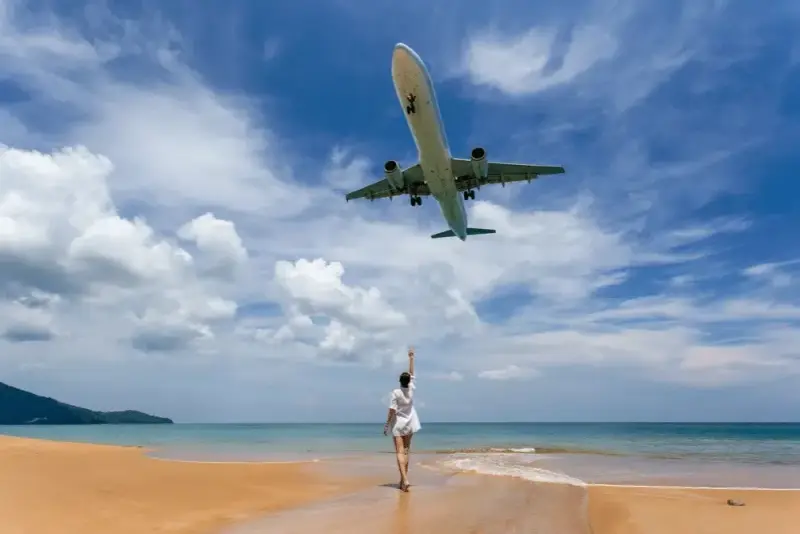
Mai Khao is Phuket's longest beach, running north from the airport along the edge of Sirinat National Park, with luxury resorts set well back in the trees and long stretches with nobody on them. It is also one of the island's turtle nesting beaches: leatherback and other sea turtles come ashore between roughly November and February, and rangers and a local conservation group watch over the nests. If you see a marked nest, keep away and switch off lights at night. The sea deepens quickly here and the beach faces the full monsoon swell, so it is a walking and sunbathing beach more than a swimming one for much of the year. The southern end sits under the approach to Phuket International Airport, where aircraft pass low overhead.
It is the emptiest beach on the island as well as the longest, best for resort stays, walks and wildlife; swim only on calm dry-season days. The airport is 10 to 15 minutes away.
Ask your resort about turtle nest releases if you are visiting between November and February.
Ao Sane Beach

Ao Sane is a small, rocky cove on the headland north of Nai Harn, reached by a narrow road that passes the Nai Harn yacht club area. The sand is coarse and limited, but the water is the point: the reef and rocks just off the beach make it one of the better shore snorkelling spots in the south of the island, and divers sometimes use it for training. A small beach restaurant and bungalows operate here. Bring reef shoes, as the entry is over stones and coral fragments, and never stand on live coral. In the monsoon the cove is exposed to waves, visibility drops and snorkelling is not advisable. Parking is very limited, so motorbike or taxi drop-off is easiest.
Shore snorkellers will rate it above anywhere else on this list, and it makes a peaceful spot for a quiet afternoon. The narrow road from Nai Harn takes about 5 minutes.
Snorkel early in the day when the water is flattest and visibility best.
Banana Beach

Banana Beach is a short stretch of sand tucked between rocky headlands below the coastal road linking Bang Tao and Nai Thon. You reach it by a brief walk down a forested path from the road, and parking along the roadside is limited, which keeps numbers down. In season a small beach restaurant rents sunbeds, and the clear water and rocks at each end make it pleasant for a swim and a snorkel. It is a good stop on a drive around the northwest coast, and it combines easily with Nai Thon. The beach faces the open sea, so it gets surf and currents in the monsoon and is best left for the dry months.
Among Phuket's secret beaches, Banana is the best, and it works for couples, short swims and road-trip stops.
Look for parked motorbikes on the road; the path is easy to miss.
Pansea Beach

Pansea is a short, beautiful beach just north of Surin, backed by two luxury resorts that control the land access. All beaches in Thailand are public up to the high-water line, but in practice non-guests have limited ways in: walking around the rocks from Surin at low tide, or arriving by longtail from Surin or Bang Tao. The sand is fine and the water clear in the dry season, and the beach is almost always quiet. Facilities belong to the resorts, so non-guests should bring their own water and shade. In the monsoon the beach takes heavy swell.
It is the most exclusive beach on the island, best for seclusion and, inevitably, for resort guests.
Check tide times before trying the rock walk from Surin.
Tri Trang Beach

Tri Trang is a small bay about 10 minutes south of Patong, reached along the coastal road past the headland. It sits behind the southern end of Patong Bay, so it is usually calmer than the open beaches, and it is lined by a couple of resorts with a public section at the end. The seabed is rocky close to shore, which makes swimming poor at low tide and much better at high tide; at high water, the rocks give decent snorkelling with plenty of small fish. It is a good choice if you want to be close to Patong without its crowds. Even in the monsoon it can be swimmable on moderate days, but treat rough seas with caution.
That makes it the best calm escape near Patong, good for a quiet stay or a snorkel.
Check a tide table and plan your swim within two hours of high water.
Layan Beach

Layan is the northern extension of Bang Tao, a quiet strip of sand with casuarina trees, a lagoon and a small island off its far northern end. There are a few resorts and villas behind it but little development on the beach itself, and it feels much emptier than the Laguna stretch to the south. The far northern corner beside the island is the most sheltered place to swim. Elsewhere, take care: the lagoon outflow can pull hard on a falling tide or after heavy rain, behaving like a rip current, and the open sections take full monsoon surf.
Quiet walks and quiet stays are what Layan does best, about 25 to 30 minutes from the airport.
Avoid swimming near the lagoon mouth, especially after heavy rain.
Nai Yang Beach

Nai Yang is a shady, casuarina-lined beach inside Sirinat National Park, a few minutes from the airport, which makes it a favourite for a first or last night on Phuket. A reef 100 to 200 metres offshore breaks the waves, so the water is calmer than most west-coast beaches on many monsoon days. Even so, stay inside the reef, and remember there is no lifeguard station; drownings have happened here in the rainy season. The southern end has simple seafood restaurants and the park headquarters, while the northern end has hotels and better sand. Turtles nest on this coast in season, and rangers have led evening walks at that time.
Nothing near the airport beats it, and families and budget seafood fans do well here too. The terminal is about 5 to 10 minutes away.
It is the easiest arrival-day swim: no hour-long drive south needed.
Sai Kaew Beach

Sai Kaew, also called Haad Sai Kaew, is the beach at Phuket's northern tip, running up to the Sarasin Bridge that links the island to the mainland. It continues straight on from Mai Khao with no clear dividing line, but it lies just outside the national park boundary. There are almost no hotels and only one or two cafes, so it is the place for a long walk on fine white sand with nobody around. The water deepens quickly and there are no lifeguards, so swim only in very calm conditions. Bring everything you need, especially water and shade.
As the northernmost beach on Phuket, it stays very quiet and is best for solitude and walks, about 15 minutes from the airport by road.
Pair it with Mai Khao and the bridge viewpoints for a half-day north-coast drive.
Ao Yon Beach

Ao Yon is a sheltered bay on Cape Panwa, on Phuket's east coast, between the cape and the Novotel Cape Panwa. Because it faces away from the southwest monsoon, it is often close to flat when the west coast is closed by red flags, and Phuket residents name it as one of the most reliable places for a real swim in the middle of the rainy season. It has a relaxed local atmosphere with a few restaurants, kayak rentals and a pier at one end. Park on the hillside road and walk down. The water is shallow and calm, which suits children, though the east coast is less clear than the Andaman side.
When the rain sets in, this is the best bet on the island for a swim, and families and kayakers enjoy it too. Phuket Town is about 20 to 25 minutes away.
On red-flag days this is the first place Phuket residents drive to.
Rawai Beach

Rawai is a working beach on Phuket's south coast, more of a harbour than a swimming beach. The sand is narrow, the water is shallow and muddy at low tide, and longtail boats crowd the shore. People come here for two reasons: the seafood market, where you choose fish and shellfish and have it cooked at the nearby restaurants, and the longtail and speedboat pier for day trips to Coral Island, Koh Bon and other small islands to the south. The sea gypsy community lives nearby. If you want to swim, go to Nai Harn or one of the islands.
Island-hoppers should start here, since no beach in the south is better placed for boat trips. The drive from the airport takes about 1 hour 15 minutes.
Compare boat prices at the pier office and agree on the itinerary before leaving.
Laem Ka Beach

Laem Ka is a small rocky bay on the south coast near Rawai that used to be a weekend picnic spot for Thai families, with views toward Koh Bon. Reports from 2024 state that public access was closed to allow construction of a new hotel, so do not count on reaching it by road. Check the current status locally before planning anything. If you want to see this stretch of coast, longtail trips from Rawai pass close by on the way to Koh Bon, a short boat ride offshore with its own beach and restaurant.
Until access reopens, the view from the water is the only way to enjoy it.
Visit Koh Bon from Rawai pier for a similar view with a beach to swim from.
Panwa Beach

Panwa Beach, sometimes called Kao Khad, lies on Cape Panwa on the east coast, near the Phuket Aquarium at the tip of the cape. The sea here is calm almost all year because it faces away from the monsoon swell, but it is shallow, with dead coral and broken shells, so it is better for wading and kayaking than for swimming. Come at high tide. It is close to Phuket Town and is a good choice if you want a quiet resort base away from the west-coast crowds. Combine it with the aquarium and the Khao Khad viewpoint.
Its water is the calmest year-round of any beach here, which suits families and quiet stays. Phuket Town is about 20 to 25 minutes away.
Plan any swim around high tide to avoid the shallow, shell-strewn flats.
 Umrah packages from Dhaka
Getting between Phuket beaches: bus, songthaew, Grab or scooter
Phuket's beaches are spread along about 50 km of west coast, from Mai Khao near the airport down to Nai Harn and Rawai at the southern tip, and there is no coastal road linking every bay. Most journeys between beaches go inland and back out, so a hop that looks short on the map can take 30 to 45 minutes in traffic. The fares below are indicative (as of October 2026) and are rounded from operator notices and recent traveler reports.
| Option | Typical fare | Best for | Watch out for |
|---|---|---|---|
| Phuket Smart Bus | Flat fare of about 100 baht | Airport to the west-coast beaches (Patong, Karon, Kata) and Rawai | Limited frequency; card, QR code or cash payment |
| Blue songthaew (shared pickup bus) | About 30 to 50 baht | Phuket Town to a single beach, in daytime | Routes run to and from Phuket Town, with none along the coast; few after dark |
| Grab or Bolt car | Often a few hundred baht between neighbouring beaches; higher from the airport | Point-to-point trips with luggage or at night | Prices surge in rain and late evening; pickups are restricted in some areas |
| Tuk-tuk or local taxi | Set by negotiation; often several hundred baht even for short hops | Short rides where no app car is available | Agree the price before getting in |
| Rented scooter (125cc) | About 150 to 350 baht per day, plus a cash deposit | Exploring quiet southern and northern beaches | Needs a motorcycle licence; hilly roads and heavy traffic |
Scooters are the cheapest way to reach the quieter beaches, but they are also the main cause of visitor injuries in Phuket. Thai law requires a motorcycle licence: a car licence is not enough, and an International Driving Permit must include the motorcycle category. Police checkpoints commonly fine riders without a valid licence or helmet around 500 baht each, and travel insurers often refuse claims for unlicensed riders. Never hand over your passport as a rental deposit.
For a beach-hopping day without a scooter, hire a car with driver for a fixed number of hours, or base yourself between two neighbouring beaches, such as Karon and Kata, which are linked by a short walk or a cheap ride.
How to choose a Phuket beach by area and season
Think of Phuket in four parts. The southwest, from Patong down to Kata, has the busiest beaches with the most hotels, restaurants and lifeguards; it suits first-time visitors and anyone without a car. The far south around Nai Harn and Rawai is quieter and popular with long-stay residents, with the best sunset viewpoints on the island. The northwest, from Surin up to Mai Khao, has the long beaches, the luxury resorts and the national park, and is closest to the airport. The east coast around Cape Panwa is calm year-round but less clear, and serves best as a base for island ferries and monsoon swims.
Season should decide the rest. In the dry months almost every beach on this list is swimmable, so pick by atmosphere. In the monsoon months, pick a hotel near a sheltered beach such as Ao Yon or Panwa, or accept that the west coast is mostly for walks, surfing lessons and sunsets. Families traveling with young children can find more ideas in our guide to Thailand with kids, and you can compare stays on our hotel booking page.
Tips for visiting Phuket beaches safely
- Obey the red flag. A red flag means swimming is forbidden. Lifeguards rescue swimmers who ignore them every monsoon on Patong, Karon and Kata.
- Know how rips work. If you are pulled out, swim parallel to the shore until you are free of the current, then head back in. Do not fight it head-on.
- Smoke only in marked zones. Smoking on Patong and other designated beaches is banned outside smoking areas, and littering is banned too. Penalties are heavy.
- Respect nesting beaches. On Mai Khao and the other Sirinat beaches, keep away from marked turtle nests and keep lights low at night between November and February.
- Check tides on small coves. Tri Trang, Panwa and Ao Sane are rocky or shallow at low tide. Plan swims and snorkelling around high water.
- Carry cash for small beaches. Boat trips, entry fees at coves such as Paradise and Freedom, parking and sunbeds are usually paid in cash.
Planning a trip to Phuket? Read our Phuket travel guide, compare hotels in Phuket or search flights.










{{item.get_author.first_name}} {{item.get_author.last_name}}
{{item.comment_txt}}
{{item_reply.get_author.first_name}} {{item_reply.get_author.last_name}}
@ {{item_reply.reply_to}}, {{item_reply.reply_txt}}