


Venue
Not confirmed yet. Please check with the organiser before you go.

Lunar New Year (Tet Nguyen Dan) guide
Tet falls on the first day of the lunisolar new year, usually between late January and mid-February, and it changes how the whole country works. Families clean, cook, honour ancestors and visit relatives and pagodas, while cities empty out. It rewards patient travellers interested in custom, but plan for closures and busy transport around the holiday.
Tet Nguyen Dan, the Lunar New Year, is the biggest holiday in Vietnam, the week when cities empty and the country goes home. Families clean and decorate, cook for days, honour their ancestors and call on relatives, neighbours and the local pagoda, all to start the year on the right foot.
Tet is about luck as much as celebration. What happens in the first days of the year is believed to shape the months that follow, so households take care over who comes through the door, what is said and what goes on the table. Seeing it as a guest, even briefly, shows a side of Vietnam that is hard to meet at any other time of year.
Not confirmed yet. Please check with the organiser before you go.
Hotels near the venue fill up around the event dates.
An invitation to a family home at Tet is a real honour, and a few customs matter.
If you are staying with a family, or simply want to thank the children of a guesthouse, lucky money is the gesture people understand.
In the north the custom is often called mung tuoi; in the south, li xi.
Pagodas are packed during the first days of the year, and the fireworks sites draw the biggest crowds of the holiday.
The main cities where the festival is celebrated.
Day 23 of the 12th lunar month. Families hold a home ceremony to send the Kitchen Gods off to report on the household's year.
Houses are scrubbed, the ancestral altar is laid with fruit and incense, relatives' graves are tidied and the flower markets are at their busiest.
Families gather for the meal and the countdown; official fireworks go up in the big cities.
The first morning. Adults give lucky money in red envelopes to children and older relatives, and the day is kept for close family.
The days that matter most to families, and the streets are at their quietest.
By the year's first full moon the holiday mood has largely faded and normal life returns.
Tet punishes late planning more than any other week of the Vietnamese year. With the whole country heading home together, domestic flights and long-distance buses should be booked by November 2026. Sleeper berths on the trains tend to go four to six weeks in advance, and during Tet 2026 fares on popular routes roughly doubled.
Stay off the roads and rails on the peak days. The outbound rush is heaviest from 3 to 5 February 2027 and the return from 9 to 12 February. The simplest plan is to reach your chosen city before the 3rd and stay put through the first three days of the new year. One base, enjoyed slowly, beats chasing celebrations up and down the country.
Food sits at the centre of Tet. Northern families wrap banh chung, square cakes of sticky rice filled with meat or beans, in dong leaves and boil them for hours. The square stands for the Earth. In the south the same ingredients are rolled into banh tet, a cylinder that stands for the moon. Few households would call it Tet without them.
Flowers tell you which region you are in. Peach blossom branches come indoors in the north. The centre and south choose yellow mai, the ochna flower. Potted kumquat trees, a sign of plenty, crowd balconies and shopfronts across the country. On the altar sits the mam ngu qua, a tray of five fruits. Southern households pick custard apple, coconut, papaya and mango because, said aloud in the local dialect, their names sound like a wish to have just enough.
One greeting follows you everywhere: Chuc mung nam moi.
Hanoi's Noi Bai and Ho Chi Minh City's Tan Son Nhat are the main gateways, with flights such as Bangkok to Hanoi and Bangkok to Ho Chi Minh City. Both airports are at their most crowded on the peak travel days, so leave extra time.
The airport lies about 35 km north-east of the city. Orange public bus 86 links both terminals with the Old Quarter and the main railway station for 45,000 VND, and taxis wait outside arrivals.
A bus station sits just outside the international terminal, where shuttle bus 49 and city routes 109 and 152 leave for the centre.
The north-south railway runs 1,726 km on a single metre-gauge track. Even SE1/SE2, the quickest train on the line, needs 33 hours end to end, calling at Hue and Da Nang. For anything longer than an overnight hop, book a domestic flight early.
Choose one base and arrive before the outbound rush. Hotels and international chains keep trading through Tet, and life goes on in the main visitor districts, from Hoi An to the Old Quarter in Hanoi.
Elsewhere, expect shutters. Small restaurants and street food stalls often close from 6 to 8 February, as do many banks and museums, so draw cash before the holiday and plan a few meals at your hotel.
Tet falls in very different weather north and south. Hanoi is in its cool, grey drizzle season: the 1991–2020 normals at Láng give February an average high of 21.7 °C and a low of 16.4 °C, with only about 20 mm of rain but light drizzle on a dozen days. Ho Chi Minh City is in the heart of its dry season, with average February highs around 32.7 °C, lows of 23.1 °C and almost no rain at Tan Son Nhat.
Met at arrivals at Da Nang International Airport (DAD) and driven door to door to Vietnam.
Others of this kind you opened on this device, so you can get back to them quickly.
No questions yet about Lunar New Year (Tet Nguyen Dan). Ask the community or our travel team, and the answer will show here once it is published.
Our team answers questions here
Festivals held in the same weeks, if you want to plan more than one.

Cultural Events, Religious Festivals
Hanoi, Vietnam
2 photos

Musical Events, Cultural Events, Folk Festival
Bắc Ninh, Vietnam
2 photos
Festivals and events across Vietnam, with dates, venues and ticket details where available.

Cultural Events, Religious Festivals, National Day
Việt Trì, Vietnam
2 photos

Cultural Events, Religious Festivals, Community Events
Cần Thơ, Vietnam
2 photos

Cultural Events, Religious Festivals
Vietnam
2 photos

Cultural Events, Social Festivals
Vietnam
2 photos

Cultural Events, Religious Festivals
Phan Rang, Vietnam
2 photos
Tell us where and when you want to go, and local travel experts send you offers for your trip.
General
The Goat. The Vietnamese zodiac differs slightly from the Chinese one: it has the Goat where China has the Sheep, the Buffalo where China has the Ox and, most famously, the Cat where China has the Rabbit.
Almost always, because both follow the same lunisolar reckoning. The exception came in 1985, when Vietnam celebrated a month earlier than China.
A cay neu, a bamboo pole about 5 to 6 m high, hung with charms, origami fish and other decorations that change from place to place. Look for one outside homes and temples in the countryside, where the custom holds on most strongly.
Look for xoi gac, red sticky rice coloured with gac fruit and often served with cha lua pork sausage, and thit kho nuoc dua, pork belly and eggs stewed overnight in coconut water and fish sauce. Bitter melon soup, mut candied fruit and coconut candy round out the table.
The usual phrase for celebrating the holiday is an Tet, literally to eat Tet. It shows how far the festival revolves around cooking, sharing food and the offerings on the altar.
No. Household firecrackers were banned in 1995 after fatal accidents. Since 2021 adults aged 18 and over may buy sparklers, but bigger displays are left to official shows.
Bau cua ca cop, a gambling game played with three dice. It turns up on pavements across the country over the holiday, and onlookers are rarely short of advice.
Gap nhau cuoi nam, a satirical comedy show on VTV that sends up the past year. It has become as much a part of the evening as the meal and the countdown.
The lion stands for strength, and its dance is believed to chase away evil spirits for the year ahead. Troupes perform in the streets and at businesses during the first days of Tet.
The first day is kept for close family. Friends usually come on the second, and the third traditionally belongs to teachers, a sign of the respect Vietnamese culture gives to education.
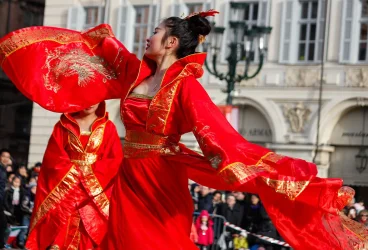
Yes. Red is thought to bring luck, and wearing new clothes for the new year is considered lucky too, so families often dress in their best and brightest for the first day.
Families & accessibility
Song lau tram tuoi, live to a hundred. Everyone counts as a year older at Tet, so it is the natural wish for an elder. Adults trade others such as an khang thinh vuong, for security and prosperity, and van su nhu y, may everything go your way.
We use necessary cookies to make this site work. With your permission we would also like to remember your preferences, measure how the site is used, and show relevant ads and partner offers. You can change your mind at any time under "Cookie settings" on our Privacy policy page.

 Plan your trip with AI