
 AI trip planner
In short: plan Dhaka by neighborhood, not by list. Spend one day in the old city on the river, one day between the museums of Shahbag and the Parliament district at Sher-e-Bangla Nagar, and use the metro to skip the worst of the traffic. With a third day, take a trip to the old capital of Sonargaon, about 30 kilometers southeast.
Facts, prices and rules were checked against official sources in November 2026. Ticket prices at Dhaka's public museums are set by government bodies and change without much notice, so treat every figure here as a guide and confirm at the counter.
How Dhaka's districts fit together
Dhaka grew north from the Buriganga River. The oldest neighborhoods sit on the riverbank in the south. The colonial and early independence city lies in the middle around Shahbag, Ramna and the university. North of that come the planned districts of the 1960s to 1980s, including Dhanmondi, Sher-e-Bangla Nagar and Agargaon, then the embassy and business districts of Gulshan, Banani and Baridhara, and finally Uttara near the airport.
Most international visitors stay in Gulshan or Banani, and that shapes everything. The sights are in the south and center, and the drive can take more than an hour at peak times. The solution is to cluster sights by area and use the metro where it helps.
| Area | What to see | Time needed | Nearest metro stop |
|---|---|---|---|
| Old Dhaka | Mughal fort, Nawab palace, mosques, river port | Full day | Bangladesh Secretariat or Motijheel |
| Shahbag and the university | National Museum, Curzon Hall, Shaheed Minar, Ramna Park | Half day | Shahbag or Dhaka University |
| Sher-e-Bangla Nagar and Agargaon | Parliament building, Liberation War Museum, Chandrima Udyan | Half day | Agargaon or Bijoy Sarani |
| Hatirjheel to Gulshan | Lakefront promenade, galleries, cafes | Late afternoon and evening | None; use a cab |
| Sonargaon | Panam Nagar, folk art museum | Full day trip | None; hire a car |
Old Dhaka in brief
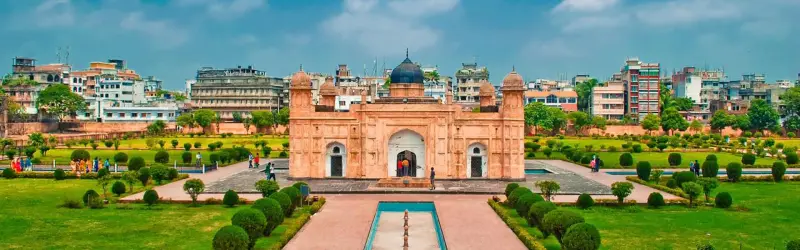
The old city along the Buriganga is the reason most travelers come to Dhaka. Its main sights are the unfinished Mughal fort at Lalbagh, the pink Ahsan Manzil palace, the tile-covered Star Mosque, an 18th-century Armenian church, the conch-shell workshops of Shankhari Bazar and the river terminal at Sadarghat. Because two of the monuments close on different days, the order of the walk matters. Our Old Dhaka guide sets out the full route with times, closing days and entry fees, so we do not repeat them here.
 Umrah packages from Dhaka
Shahbag and the university quarter
Bangladesh National Museum
The National Museum at Shahbag is the country's largest collection of sculpture, coins, textiles, folk art and natural history. The ground and upper floors cover Buddhist and Hindu stone carving from the Pala and Sena periods, Mughal-era manuscripts, and galleries on the 1952 Language Movement and the 1971 war. The jamdani and nakshi kantha textile rooms are worth the time even if you rush the rest.
Published guides consistently put the foreign visitor ticket at Tk 500, with Tk 300 for SAARC nationals, and give Thursday as the weekly closed day with afternoon-only opening on Fridays. A bdnews24 report says tickets moved to an online system when the museum reopened after a closure, so check whether the gate still sells paper tickets before you go.
University of Dhaka and Curzon Hall
The campus is open and green, a rare thing in Dhaka. Curzon Hall, a red-brick building that mixes Mughal arches with European proportions, was built in the British era and now houses the science faculty. Walk the lawns, then head to the Central Shaheed Minar, the memorial to the students killed in the 1952 Language Movement. On 21 February, International Mother Language Day, the area fills with flowers from before dawn.

Ramna Park and Suhrawardy Udyan
These two large parks sit next to each other between Shahbag and the Supreme Court. Ramna is the setting for the Pohela Boishakh (Bengali New Year) concerts on 14 April, and Suhrawardy Udyan is the ground where Pakistan's forces surrendered on 16 December 1971. A glass tower, the Independence Monument, marks the place. Morning walkers are out by 6 a.m., and it is a good place to watch the city wake up.
Sher-e-Bangla Nagar and Agargaon
The National Parliament building
Louis Kahn's Jatiya Sangsad Bhaban is one of the great buildings of the 20th century: a cluster of concrete volumes cut with huge circles, triangles and rectangles, standing in an artificial lake. The building took two decades to complete and was finished after Kahn's death.

Access to the interior is restricted and depends on Parliament's security rules at the time of your visit, so most visitors see it from Manik Mia Avenue on the south side and from the Chandrima Udyan park to the north. Late afternoon light is best for photographs.
Liberation War Museum
Now in a purpose-built home in Agargaon, the Liberation War Museum tells the story of the 1971 war through photographs, personal items and testimony. Some galleries are graphic. Allow two hours and leave time to sit outside afterward.
Listings disagree on its weekly closing day, with Sunday mentioned most often, and on the foreign visitor ticket. Hours have been listed as 10 a.m. to 6 p.m. from March to September and 10 a.m. to 5 p.m. from October to February, with shorter hours during Ramadan. Check the museum's own website before visiting.
Bangladesh Military Museum
The museum at Bijoy Sarani sells tickets on its own website and suits families with children who have had enough of older galleries.
Hatirjheel, Gulshan and modern Dhaka
Hatirjheel is a lake development that cuts across the middle of the city with walkways and curving bridges. It is at its best in the evening when the bridges light up and families come out for snacks. Cabs can reach it from Gulshan in 20 minutes outside rush hour.
Gulshan and Banani are where you will find most of the city's cafes, art galleries and international restaurants. Rather than repeat restaurant lists here, our guides cover the options: restaurants in Dhaka for the overall picture, restaurants for couples for a quieter evening, and seafood restaurants for hilsa and prawn dishes. If you need somewhere to meet friends, see meetup places in Dhaka.
Getting around: the metro and everything else
MRT Line 6, Dhaka's first metro line, runs elevated for about 20 kilometers through 16 stations from Uttara North in the north to Motijheel in the south. Fares are calculated by distance, with a minimum of Tk 20 and a maximum of Tk 100 according to Metroeasy. Single-journey cards are sold from machines and counters at each station, and rechargeable MRT Pass cards save time on repeat trips. Service hours were extended by 20 minutes at night in June 2026, the Dhaka Tribune reported, and Friday service starts later in the day.
The line does not reach Gulshan, Banani or the airport directly. From Gulshan, a cab to Farmgate or Karwan Bazar station is usually the fastest way to join it. An extension south to Kamalapur railway station has been under construction for some time; it had not opened by November 2026.
| Mode | Best use | Things to know |
|---|---|---|
| Metro (MRT Line 6) | North to south trips between Uttara, Agargaon, Shahbag and Motijheel | Fast and air-conditioned; crowded at rush hour |
| App cabs | Gulshan, Banani and the airport | Fixed fare shown in the app; traffic still applies |
| CNG auto-rickshaws | Medium distances | Agree the fare first; meters are rarely used |
| Cycle rickshaws | Short hops, Old Dhaka lanes | Banned from some main roads; cheap and slow |
| Walking | Old Dhaka, the university, Hatirjheel | Pavements are uneven; cross roads with locals |
Day trip to Sonargaon and Panam Nagar
Sonargaon was a capital of Bengal under the medieval sultans and later a trading town on the river routes. Its best-known sight is Panam Nagar, a single street of crumbling 19th-century merchant houses that the Department of Archaeology now protects. The Folk Arts and Crafts Museum, set in a colonial-era mansion with a large pond, sits nearby.
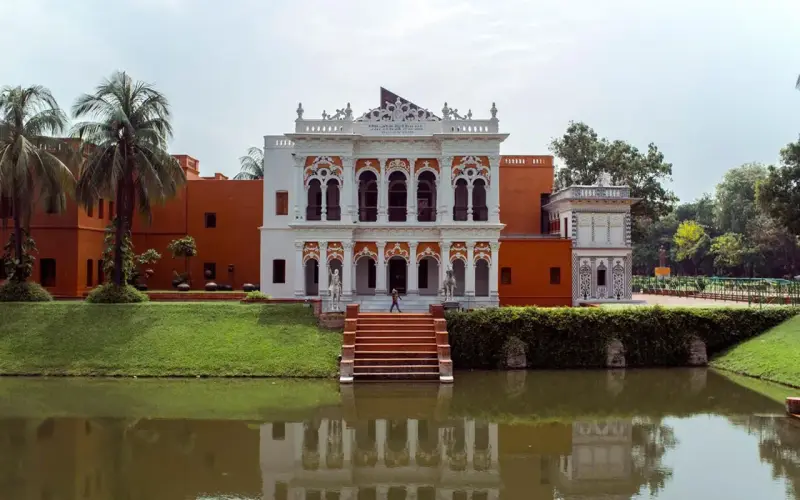
The town lies about 30 kilometers from central Dhaka, and the drive takes around one and a half hours in moderate traffic, according to a Dhaka Tribune day-trip feature. Published guides list a Tk 100 ticket for foreign visitors at Panam Nagar and a Sunday closure; confirm on the day, because the department has been working on visitor facilities. Hiring a car and driver for the day is the most practical way to go.
More experiences beyond the monuments
Baitul Mukarram and Motijheel
Baitul Mukarram, the national mosque, stands near the southern end of the metro line in the commercial district of Motijheel. Its plain white cube was designed to recall the Kaaba in Mecca, a contrast to the ornate domes of older mosques. Non-Muslim visitors are generally allowed into the courtyard outside prayer times if dressed modestly; ask at the gate before going further. The surrounding market lanes sell prayer caps, attar perfume and religious books.
Karwan Bazar early in the morning
Karwan Bazar is the city's largest wholesale market for fish, vegetables and fruit. The busiest trading happens before sunrise, when trucks from the countryside unload and porters carry baskets on their heads. Arrive at dawn with a guide or a friend who speaks Bengali, wear closed shoes, and keep your camera discreet. The market sits next to the Karwan Bazar metro station, so it is easy to reach before traffic builds.
A sunset boat on the Buriganga
Even if you skip the full old city walk, a boat ride from Sadarghat at the end of the afternoon shows how much of Dhaka's life still happens on water: ferries, cargo boats, ship repair yards and the crowds on the pontoons. Agree on the price before boarding and stay seated.
Art galleries and handicraft shops
Dhanmondi and Gulshan have the main private galleries showing contemporary Bangladeshi painting and photography. Exhibitions change often, so check gallery social media pages for current shows. For crafts, the fixed-price shops save you from bargaining while giving a fair return to the artisans who supply them.
Mistakes first-time visitors make
The most common is trying to see sights in three parts of the city on the same day. Traffic turns a 10-kilometer trip into an hour or more, and the day disappears in a car. Pick one area per half day.
The second is ignoring the weekly closures. Several major sites shut on different days, and Friday mornings are quiet across the city. Check each place's closed day before fixing your plan.
The third is relying on maps alone for rickshaws. Many lanes are one-way for cars but not for rickshaws, and drivers know shortcuts the apps do not show. Tell the driver your destination, agree a fare, and let them choose the route.
Plans for one, two or three days
One day
Spend it in Old Dhaka. Start at Lalbagh Fort in the morning, walk east through the old lanes, eat lunch on the way, and finish at Sadarghat as the light drops on the river. This gives you the history and the street life together.
Two days
Add a day in the center and north. Take the metro to Shahbag for the National Museum when it opens, walk across to the university and the Shaheed Minar, then ride north to Agargaon for the Liberation War Museum after lunch. End at the Parliament building for the evening light and a walk in Chandrima Udyan.
Three days
Use the third day for Sonargaon, leaving early to miss traffic. Return in the evening for a walk along Hatirjheel and dinner in Gulshan.
Who Dhaka suits, and who should keep it short
Dhaka rewards travelers interested in architecture, recent history and everyday urban life. Photographers, architecture students and people with family roots in Bangladesh tend to stay longer than they planned. Travelers who want quiet streets, nightlife or easy sightseeing usually prefer to spend two days here and move on to the tea gardens covered in our Sylhet travel guide, the hills, or the coast at Cox's Bazar.
Families with young children can manage well by keeping days short, using the metro, and building in parks such as Ramna or Chandrima Udyan between museum visits. Travelers with limited mobility will find the old city's lanes hard going, while the newer districts and the metro are far easier to manage.
Seasons and events worth timing a trip around
The dry months from November to February are the most comfortable for sightseeing. Pohela Boishakh on 14 April, Victory Day on 16 December and Language Martyrs' Day on 21 February all bring big public celebrations. Expect road closures around Shahbag and the university on those days, and plan the quieter districts instead.
The month-long Ekushey Book Fair runs through February near the Bangla Academy and Suhrawardy Udyan. It is mainly in Bengali, but the atmosphere is worth an evening. Our best time to visit Bangladesh guide covers the weather in more detail.
Practical notes for first-time visitors
Dress modestly across the city; Gulshan is relaxed, but the old city and religious sites are not. Carry small notes in taka for rickshaws, tea and donations. ATMs from major banks are common in Gulshan, Banani and Motijheel.
Keep an eye on news for hartals and street protests, which can close main roads at short notice. Local SIM cards with data are cheap and make app cabs much easier. Our Bangladesh travel guide for foreigners covers visas, SIM cards and money in more depth, and if you are arriving overland, read the Dhaka to Kolkata overland guide for the latest on the border crossing.
For somewhere to stay, our list of guest-friendly hotels in Dhaka notes which properties are comfortable for international visitors.
 Get the app










{{item.get_author.first_name}} {{item.get_author.last_name}}
{{item.comment_txt}}
{{item_reply.get_author.first_name}} {{item_reply.get_author.last_name}}
@ {{item_reply.reply_to}}, {{item_reply.reply_txt}}