
 Get the app
In short: Old Dhaka is best seen on foot in one long morning and early afternoon, walking from Lalbagh Fort east through the lanes of Chawk Bazar and Armanitola to Ahsan Manzil and the river at Sadarghat. Go on a Saturday, Tuesday or Wednesday. Lalbagh Fort shuts on Sundays and Ahsan Manzil shuts on Thursdays, so those two days break the route, and Friday mornings bring prayers and closed shops.
Facts, prices and rules were checked against official sources in November 2026. Where official and published figures disagree, we say so rather than pick one.
How the old city came to look this way
Dhaka was a Mughal provincial capital in the 17th century, and that era left the fort, the caravanserais and the mosques around Chawk Bazar. When the Mughal capital moved away, the city shrank, and the Armenian and European trading families that stayed built their churches and warehouses along the river.
Under British rule, the city's center of gravity drifted east. Banglapedia describes how administrative offices moved toward Sadarghat in the 1820s, with the Buckland Bund embankment along the river becoming the city's front. The Nawabs of Dhaka built Ahsan Manzil on that waterfront later in the century. In the 20th century the new city grew north, and Old Dhaka kept its tight lanes, trades and mohalla (neighborhood) loyalties, which is why the area still feels so different from Gulshan or Dhanmondi.
Knowing this order helps on the walk. The western end around Lalbagh is Mughal, the middle around Armanitola reflects the trading communities, and the eastern end on the river belongs to the 19th-century Nawabs and the steamer age.
Which day to go
The two ticketed monuments on this route keep different weekly closures, and this is the detail that ruins most self-planned visits. The Department of Archaeology lists Sunday as the closed day at Lalbagh Fort. Ahsan Manzil, run by the Bangladesh National Museum, closes on Thursdays and opens only in the afternoon on Fridays.
| Day | Lalbagh Fort | Ahsan Manzil | Verdict |
|---|---|---|---|
| Saturday | Open | Open | Good; busy with local families |
| Sunday | Closed | Open | Skip the fort or come back |
| Monday | Afternoon only, per tour operators | Open | Reverse the route |
| Tuesday | Open | Open | Best |
| Wednesday | Open | Open | Best |
| Thursday | Open | Closed | Palace seen from outside only |
| Friday | Open (check) | Afternoon only | Quiet streets, many shops shut until after midday prayers |
Government holidays close both sites, and hours shrink during Ramadan. Ahsan Manzil also closes on Eid day and the day before.
 Plan your trip with AI
The walking route at a glance
The route below runs roughly west to east, about 4 kilometers on foot with short rickshaw hops where the lanes get tiring. Allow five to six hours including the two monuments, a meal and a boat ride. Most operator tours follow a similar loop; the Daily Star's 2011 walk by Ihtisham Kabir ran it the other way, starting near the river.
| Stop | Time to allow | Getting to the next stop |
|---|---|---|
| Lalbagh Fort | 60 to 75 minutes | Walk about 8 minutes |
| Dhakeshwari Temple | 20 minutes | Rickshaw to Chawk Bazar, 10 minutes |
| Chawk Bazar and Bara Katara | 30 minutes | Walk to Armanitola, 15 minutes |
| Star Mosque | 20 minutes | Walk south, about 5 minutes |
| Armenian Church | 25 minutes | Walk east via Islampur, 15 minutes |
| Shankhari Bazar | 20 minutes | Walk south, 10 minutes |
| Ahsan Manzil | 60 minutes | Walk along the riverfront, 10 minutes |
| Sadarghat and a boat on the Buriganga | 45 minutes | End |
Stop by stop
Lalbagh Fort
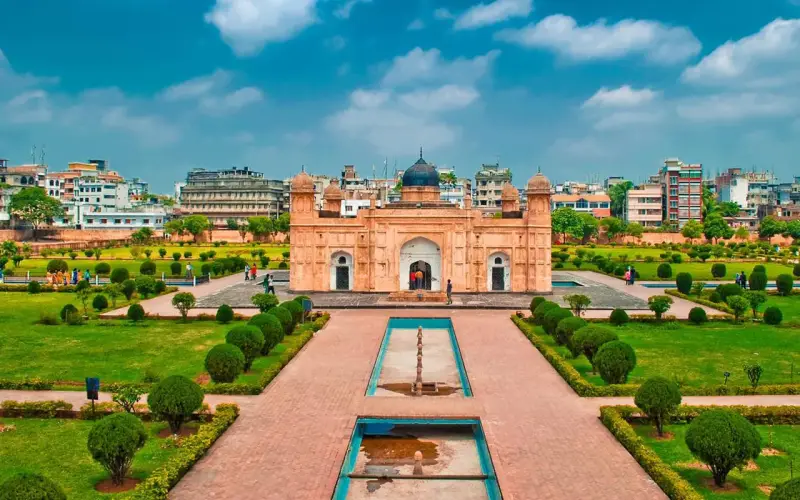
Prince Muhammad Azam, a son of the emperor Aurangzeb, began the fort in 1678 while serving as viceroy of Bengal. According to Banglapedia, his father recalled him after about 15 months, and his successor Shaista Khan let the work lapse after his daughter, known as Bibi Pari, died inside the walls in 1684. The fort was never finished.
What survives is a walled garden with three main buildings in a line. The three-domed mosque sits on the west. Bibi Pari's tomb stands in the center, its interior lined with white marble and its octagonal false dome wrapped in brass. To the east is the two-story Diwan-i-Aam with a bathhouse attached, and a small site museum near the entrance.

Arrive at opening time. By late morning the lawns fill with school groups, and the light on the red brick is softer early. The Department of Archaeology has also run an evening light and sound show at the fort since 2014.
Dhakeshwari Temple
A short walk east of the fort brings you to Dhakeshwari, the most important Hindu temple in the city and the one many people link to the name "Dhaka." The compound is active, so remove your shoes where signs ask and ask before photographing worshippers. Visitors do not pay to enter.
Chawk Bazar and Bara Katara
Chawk Bazar is the old Mughal market square, now a dense wholesale district selling spices, perfumes, plastics and paper. During Ramadan it becomes the city's best-known iftar market. A few minutes south stands Bara Katara, a Mughal-era caravanserai. Much of it has been lost to shops and repairs, and only the gateway gives a sense of its former scale. You can view it from the lane; do not climb on the structure.
Star Mosque
The Star Mosque, or Tara Masjid, in Armanitola carries no foundation inscription. Its builder is usually named as Mirza Golam Pir, who died in 1860, which places the original building in the first half of the 19th century. The look you see today comes from a 1926 renovation paid for by a merchant, Ali Jaan Bepari, who covered the walls and domes in broken china, the technique Bengalis call chini tikri, set in patterns of blue stars.
The mosque is usually locked outside prayer times, but the caretaker will often open it for visitors who ask politely. Do not arrive during the five daily prayers, and avoid Friday midday. Nijhoom Tours notes that shorts are not acceptable for men or women and that women need to cover their hair. There is no entry fee, though a small donation is welcome.
Armenian Church of the Holy Resurrection
A few hundred meters from the mosque, through a gate on Armenian Street, is the church completed in 1781 for the Armenian merchant community that once traded from Dhaka. The surrounding cemetery holds Armenian graves with inscriptions, some older than the church itself. The Daily Star's history of the Armenians of Dacca tells how the community shrank to almost nothing during the 20th century.
A caretaker lives on site. Opening is informal, so knock at the gate and leave a donation if you are let in. Keep your voice down; it is still a consecrated church.
Shankhari Bazar
This narrow street takes its name from the conch-shell cutters (shankharis) who have worked here for generations. Houses are tall and thin, some only a room wide, and the ground floors hold workshops making conch bangles, kites, idols and wedding ornaments. Before Durga Puja the lane fills with painted clay figures. Walk single file and expect to step aside for rickshaws.
Ahsan Manzil
The pink palace on the Buriganga was built between 1859 and 1872 for Nawab Abdul Ghani and named after his son, Khwaja Ahsanullah. A tornado on 7 April 1888 badly damaged it, and Ahsanullah rebuilt the palace with the tall dome you see from the river. Banglapedia records that the restored building passed to the Bangladesh National Museum on 20 September 1992.

Inside, galleries recreate the darbar hall, the dining room, the billiard room and the ballroom, along with portraits and documents of the Dhaka Nawab family, which shaped city politics in the late 19th and early 20th centuries. Photography rules inside the galleries change, so check at the entrance. Bags may need to be left at a cloakroom.
Sadarghat
Sadarghat is the river terminal where launches leave for Barishal, Bhola and the coastal south. Banglapedia notes that silt now keeps the largest vessels away, but the scene from the pontoons is still one of the busiest river ports anywhere. Small wooden boats called nouka ferry people across the Buriganga to Keraniganj.

To enter the terminal you buy a pontoon ticket. For a short ride, agree a price with a boatman for a half-hour loop before you step in. Sit low and keep cameras in a bag when crossing the wake of the big launches.
Entry fees and closing days
Ticket prices at Old Dhaka's monuments appear in many different versions online, and most of them are out of date. The table shows what the official sources say, and where they leave gaps.
| Site | Foreign visitor ticket | Weekly closure | Source |
|---|---|---|---|
| Lalbagh Fort | Tk 200 for non-SAARC foreigners, Tk 100 for SAARC nationals, Tk 20 for Bangladeshis (show prices) | Sunday | Department of Archaeology; page last updated 2015 |
| Ahsan Manzil | Published figures range from Tk 75 to Tk 500; confirm at the counter | Thursday; Friday afternoon only | Bangladesh National Museum |
| Star Mosque | Free; donation welcome | Closed to visitors during prayers | Caretaker |
| Armenian Church | Free; donation welcome | Informal hours | Caretaker |
| Dhakeshwari Temple | Free | Open daily | Temple committee |
Both ticketed sites can be booked through the government's MyGov e-ticketing portal, which is the most reliable way to see the current price. Bring small notes in taka in case the counter cannot accept cards.
Getting to Old Dhaka
Traffic into the old city is slow at almost any hour, so the metro is the best first leg from the northern hotel districts. MRT Line 6 runs from Uttara North to Motijheel. Get off at Bangladesh Secretariat or Motijheel and take a rickshaw to Lalbagh, a ride of about 20 to 30 minutes through the old lanes.
From Gulshan or Banani, an app cab to Lalbagh can take more than an hour in the late morning. Start early, and tell the driver to drop you at the fort gate; cars cannot easily follow the route once you are walking.
At the end of the day, Sadarghat has heavy traffic. Walk to Ahsan Manzil Road and catch a rickshaw toward Gulistan, then take a cab or the metro from there. Our guide to things to do in Dhaka explains how the metro connects the rest of the city.
Eating along the way
Old Dhaka is where the city's kacchi biryani, bakarkhani flatbread and morog polao come from, and many of the old family shops are within a few minutes of the route. Lunch near Nazira Bazar or Bangshal fits naturally between the Star Mosque and Ahsan Manzil. Our list of restaurants in Dhaka covers specific places, and the guide to Bangladeshi food explains the dishes.
Eat where the food is cooked fresh and the turnover is high. Bottled water is sold everywhere, and the sweet milky tea from street stalls is boiled, which makes it one of the safer things to try.
What to wear and how to behave
Dress modestly. Long trousers or a long skirt, covered shoulders and a scarf for women will see you through the mosque, the temple and the church without fuss. Shoes come off at religious buildings, so wear something easy to slip on and off.
Ask before photographing people. Many shopkeepers are happy to pose, but women and worshippers often prefer not to be photographed. Old Dhaka is conservative, and visitors who keep a low profile get a warmer welcome.
Safety and comfort
The old city is generally safe for daytime visitors. The real hazards are traffic, uneven pavements and open drains. Watch your step, walk facing the traffic where there is no pavement, and keep phones and wallets in front pockets in crowds.
The heat is the other issue. From April to October, start by 9 a.m. and plan the indoor visit to Ahsan Manzil for the hottest hours. November to February is the most comfortable time, which our best time to visit Bangladesh guide covers in detail.
Political rallies and strikes, known as hartals, occasionally close streets in the old city. Check local news the night before, and if a hartal is announced, postpone.
A shorter half-day version
If you only have a morning, take a cab or rickshaw straight to Lalbagh Fort at opening time, then ride a rickshaw east to Armanitola for a quick look at the Star Mosque from the street. Continue to Ahsan Manzil for the galleries and finish with ten minutes on the Sadarghat pontoons. You lose Shankhari Bazar and the market lanes, which are the most atmospheric part of the walk, but you see the two main monuments and the river in about four hours.
Guided or self-guided?
A guide makes sense on a first visit if you want the stories behind the buildings and help with rickshaw prices. Licensed local operators sell full-day private walks; Travel and Explore BD listed its walk at BDT 13,000 for one person in November 2026. Group rates fall per head.
A self-guided walk works well if you are comfortable with crowds, carry an offline map and follow the order above. The lanes are confusing but compact, and someone will always point you toward Lalbagh or Sadarghat if you ask.
Adding more to the day
With extra time, consider the old Ruplal House near Farashganj, best seen from a boat because the riverside lanes are crowded with markets. In January, the kite festival of Shakrain fills Old Dhaka's rooftops, the one time of year when the skyline turns colorful.

If you came overland from India, the Dhaka to Kolkata overland guide explains the reverse journey. For a wider trip, our historical places in Bangladesh list covers the Mughal and Sultanate sites beyond the capital.
 Holiday offers










{{item.get_author.first_name}} {{item.get_author.last_name}}
{{item.comment_txt}}
{{item_reply.get_author.first_name}} {{item_reply.get_author.last_name}}
@ {{item_reply.reply_to}}, {{item_reply.reply_txt}}