


Venue
Asakusa, Taito-ku, Tokyo, Japan

Asakusa Samba Carnival guide
The Asakusa Samba Carnival is usually held on the last Saturday of August, which would make it 28 August 2027, with confirmation on the official site in early summer. Japanese samba schools in feathers and sequins compete through the streets near Senso-ji. It suits curious visitors to Tokyo; crowds run into the hundreds of thousands, so arrive early.
The Asakusa Samba Carnival turns the old streets around Senso-ji temple in Asakusa, Tokyo's old downtown, into a samba runway for one summer afternoon. Japanese samba schools in feathers and sequins dance and drum their way past the crowds, competing for points in a contest modelled on Rio's.
The organisers bill it as the largest samba carnival in the northern hemisphere, and the numbers support the claim: about 470,000 people came to watch the 40th edition in 2025.
It is also one of the more surprising sides of Tokyo. Thousands of amateur dancers and drummers, from neighbourhood clubs to university bands, have made Brazilian carnival their own, and the result is a parade that feels at once foreign and completely at home in the old downtown.
Asakusa, Taito-ku, Tokyo, Japan
Hotels near the venue fill up around the event dates.
The course is fenced, and spectators stand inside the barriers for the whole parade. Sitting on the pavement is not allowed.
The parade happens in the hottest part of the day at the hottest point of Tokyo's year. Treat the heat seriously.
You will still have a choice of places along the fences. By 11:30 the good stretches are gone.
Retreat to a hotel or cafe if the heat gets to you.
The parade runs through the afternoon heat, one samba school after another, each with its drum section, dancers and floats.
Judges score each team; in 2026 the results were online the same day.
The parade is free and there are no grandstands. Everyone watches on foot from inside the fences that line the course, and the handful of reserved seats go to individual sponsors of the carnival. So the planning comes down to two choices: which part of the route you want, and where you can retreat when the heat gets to you.
In 1981 the comedian Junzaburo Ban and Taito Ward's mayor of the day proposed a parade carrying a dose of Brazilian carnival spirit, and the shopkeepers of the old downtown took on the work of staging it. A local executive committee runs it to this day.
It has since grown into a serious competition. Teams are sorted into four divisions, with the S1 League at the top, the S2 League below it and two more, the Communication League and the Theme Samba League. The 2025 top flight had 8 teams with roughly 2,600 people between them; the second tier had 7 teams and roughly 1,200.
Even the words come from Brazil: the decorated floats are called allegorias, as in Rio. The setting, though, is pure Tokyo. The parade starts in the shadow of Senso-ji, where the Kaminarimon gate hangs a red lantern 3.9 m tall, and temple pilgrims stand among the samba fans. Two teams have marched in every edition since the first, one of them a neighbourhood group from Asakusa itself.
The Keisei Access Express reaches Asakusa Station without a change in about 50 minutes (Tokyo Narita).
Take the Keikyu Line about 21 minutes to Sengakuji and continue on the Toei Asakusa Line for about 16 minutes; some trains run through (Tokyo Haneda).
JR Yamanote Line two minutes to Kanda, then the Ginza Line for about 14 minutes.
Asakusa Station is a minute from the course and very crowded. Tawaramachi on the Ginza Line, three minutes' walk away, is calmer; for the western end use the Tsukuba Express Asakusa Station.
Difficult once the parade is under way, so arrive on the side you mean to watch from.
Sleep in Asakusa if you can. A room a few streets from the course lets you go back for a shower and an hour of air conditioning before the 13:00 start.
With crowds of around half a million, rooms in the district go early.
Tokyo
Late August is the hottest stretch of the Tokyo summer. Average highs are about 31°C with nights around 24°C and heavy humidity, and August brings roughly 155 mm of rain, often in short afternoon storms.
The busiest routes into Tokyo (NRT).
 Biman Bangladesh Airlines
Met at arrivals at Narita International Airport (NRT) and driven door to door to Umamichi-dori and Kaminarimon-dori.
Places to eat in Japan before or after the celebrations.
1F, 1-7-19 Otemachi, Naka-ku, Hiroshima, Japan
Cuisine:Hiroshima okonomiyaki
1-4-15 Dotonbori, Chuo-ku, Osaka 542-0071, Japan
Cuisine:OkonomiyakiOsaka
459 Shimokawara-cho, Higashiyama-ku, Kyoto 605-0825, Japan
Cuisine:Kyoto kaisekiJapanese
Minamiaoyama Garden Court, 2-6-15 Minami-Aoyama, Minato-ku, Tokyo 107-0062, Japan
Cuisine:InnovativeJapanese
Others of this kind you opened on this device, so you can get back to them quickly.
No questions yet about Asakusa Samba Carnival. Ask the community or our travel team, and the answer will show here once it is published.
Our team answers questions here
Festivals held in the same weeks, if you want to plan more than one.
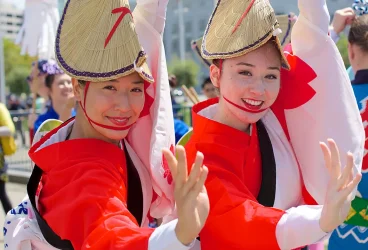
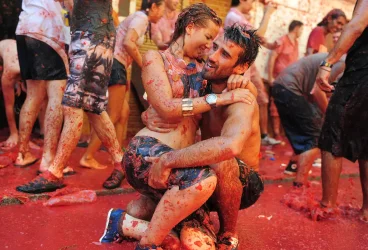
Food Festivals, Leisure Events, Social Festivals
Buñol, Spain
9 photos
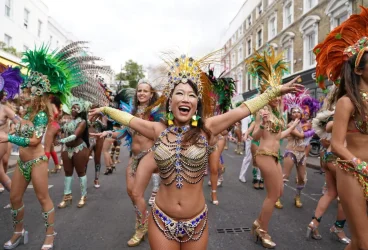
Musical Events, Carnivals, Parade
London, United Kingdom
6 photos
Festivals and events across Japan, with dates, venues and ticket details where available.
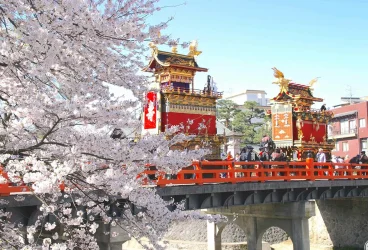
Cultural Events, Religious Festivals, Parade
Takayama, Japan

Cultural Events, Religious Festivals, Parade
Tokyo, Japan

Cultural Events, Religious Festivals, Parade
Tokyo, Japan
Cultural Events, Arts Festivals, Film Festivals
Tokyo, Japan
Tell us where and when you want to go, and local travel experts send you offers for your trip.
Booking
Only by becoming an individual sponsor. Supporters' seats come with an original towel and the official pamphlet, and they are the only places where a tripod is allowed, at face height.
The organisers say recent editions have drawn around 500,000 visitors a year, which makes the streets around the course extremely crowded from late morning.
General
Yes. In 2026 the cable broadcaster J:COM showed the parade live on television and streamed it online, which is a good option on a very hot day.
The judges' scores are published as a PDF on the official site, asakusa-samba.org. In 2026 they went up on the day of the parade.
G.R.E.S. Nakamise Barbaros, a neighbourhood team from Asakusa, and Union dos Amadores, made up mostly of university students. Both took part in the first parade in 1981.
An allegoria is a decorated float, borrowed from Rio's carnival vocabulary. Expect them to tower over the dancers, and to slow the parade at the corner onto Kaminarimon-dori.
No. The Sanja Matsuri, often called Tokyo's largest festival, is also centred on Senso-ji but runs for 3 to 4 days in late spring. The samba carnival is a single afternoon in late summer.
It was the carnival's comeback after a break, and it ran as a scaled-down event with no floats and no contest. Full competition returned afterwards.
Nakamise-dori, the 250 m approach to the temple, has around 72 shops. Try ningyoyaki, small sponge cakes filled with red bean paste, and buy cold drinks before you claim a spot.
Timing & weather
About 5 minutes on the Ginza Line, so hotels around the station are a practical base if rooms near the temple are gone. Trains run often, though they are packed in both directions on parade day.
We use necessary cookies to make this site work. With your permission we would also like to remember your preferences, measure how the site is used, and show relevant ads and partner offers. You can change your mind at any time under "Cookie settings" on our Privacy policy page.

 Exclusive holiday package offers