


Venue
Tomar, Santarém district, Portugal

Festa dos Tabuleiros guide
Held only every four years, in early July, the Festa dos Tabuleiros sees hundreds of young women walk Tomar carrying trays of bread and paper flowers as tall as themselves. Residents spend weeks making the flowers that cover the streets. It suits travelers who want a rare, deeply local procession; check which year it falls and book early.
The Festa dos Tabuleiros is Tomar's great religious procession, held only once every four years, in which hundreds of young women walk the town carrying towers of bread and paper flowers on their heads. Each tray stands about as tall as the woman beneath it, and hundreds of residents spend weeks making the paper flowers that cover the streets.
It belongs to Tomar in a way few festivals belong to anywhere. The town grew up beneath the Templar castle and the Convent of Christ, and the festival keeps alive a medieval devotion to the Holy Spirit that once spread across Portugal. Every parish of the municipality sends its bearers, families decorate their own streets, and the bread carried in the procession ends up shared among the people. Watching it is less like attending a show than being admitted to a town's family occasion.
Tomar, Santarém district, Portugal
Hotels near the venue fill up around the event dates.
The main Sunday procession is long and slow, and the route is lined many people deep. In 2023 it set off from Praça Infante D. Henrique and passed Praça Alves Redol, Rua Serpa Pinto, Praça da República and Avenida Marquês de Tomar before finishing at Várzea Grande. Check the 2027 route when the organisers publish it.
Arrive well before the start and pick a spot with some shade. A narrower street gives you a closer view of the trays, and windows above are hung with quilts while residents throw flowers onto the bearers.
For many families carrying a tray is an act of faith. Give them room, step back when a line passes, and never touch a tray or its crown. Close-up portraits need permission.
At the mass, when the trays are set down and then raised again on the third bell, the crowd falls completely silent. Do the same. Phones away, voices down, and no flash.
Central Portugal in July is hot, and you will spend most of the day outdoors. Bring a wide hat, high-factor sun cream and more water than you think you need, and refill whenever you pass a café. Light cotton clothes and comfortable shoes beat anything formal; there is a lot of standing and some walking between viewpoints.
Eat before you take up your position, since leaving a good spot means losing it. A folding stool or a cushion makes the wait easier.
The children's procession.
Streets dressed in paper flowers made by hundreds of residents open to visitors.
The parishes set out from different corners of the municipality, converge on the town hall and continue to the Mata dos Sete Montes. The finished trays are on show, and traditional games are played.
Pipers, drums and rockets, the Holy Spirit's banner, the long double line of bearers, then the ox carts with bread, meat and wine. At the mass the bearers raise their trays in silence for the blessing.
The sharing out of blessed food.
Use the quiet mornings for the town's other reasons to visit. The Convent of Christ, founded by the Templars and on UNESCO's World Heritage list since 1983, sits on the hill above, with its round Charola church and the famous Manueline window of the Chapter House. In the old streets below stands a synagogue from the middle of the 15th century, the finest survivor of its age anywhere in Portugal. Visitors who want to roam central Portugal afterwards can pick up a rental car for the region.
Underneath the procession lie harvest rites far older than the Church's calendar. In the Middle Ages they were absorbed into the cult of the Holy Spirit, celebrated at Pentecost from the 13th century and encouraged in Portugal by Queen Isabel of Aragon. The cult carried a radical idea. It foretold a Third Age governed by an Empire of the Holy Spirit, a time when people would no longer need the hierarchy of the Church to reach God.
Each family's tray was meant as a contribution to that coming kingdom, a column for a symbolic temple modelled on the Heavenly Jerusalem and Solomon's Temple. The crown on top makes the point. Most carry the white dove of the Holy Spirit; others bear an armillary sphere, the emblem of Portugal's sea voyages, beneath the cross of the Order of Christ, whose cross also appears on the convent.
Charity was always the other half. The bread, meat and wine carried in the procession were once distributed to the poor, and the Pêza keeps that custom alive. The festival as visitors see it today, with its fixed order of processions and costumes, was standardised in 1950. Plenty of older customs survive inside it.
Fly into Lisbon. From Terminal 1 it is about 10 minutes on the metro to Gare do Oriente.
Direct regional trains run from Oriente, and from Santa Apolónia, to Tomar in a little under two hours. Tomar station is about 610 m from Praça da República.
Rede Expressos runs from Sete Rios in Lisbon, useful if the trains are full on the main weekend.
About 135 km north of Lisbon on the A1. On festival days the organisers open car parks around town, with shuttle buses from the more distant ones.
Tomar is a small town of about 20,000 people, and in a festival summer it takes in thousands more, most aiming for the same Sunday. Reserve as soon as you can.
Give yourself at least the Saturday and Sunday nights; arrive on Friday to catch the Cortejo do Mordomo too. If rooms in town are gone, Lisbon works as a long day trip by train.
July in the Ribatejo is hot and usually dry, and the procession runs through the heat of the day. Bring a hat, water and shade if you plan to watch from the kerb.
Met at arrivals and driven door to door to Praça da República.
Others of this kind you opened on this device, so you can get back to them quickly.
No questions yet about Festa dos Tabuleiros. Ask the community or our travel team, and the answer will show here once it is published.
Our team answers questions here
Festivals held in the same weeks, if you want to plan more than one.

Cultural Events, Religious Festivals, Parade
Matera, Italy
1 photo

Musical Events, Cultural Events, Arts Festivals
Águeda, Portugal
9 photos
Cultural Events, Religious Festivals, Parade
Pamplona, Spain
Festivals and events across Portugal, with dates, venues and ticket details where available.
Cultural Events, Religious Festivals, Social Festivals
Portugal
11 photos

Musical Events, Social Festivals, Community Events
Lisbon, Portugal
8 photos
Tell us where and when you want to go, and local travel experts send you offers for your trip.
General
About 12 kg of bread alone. Thirty loaves of roughly 400 grams each are threaded onto five or six canes set in a wicker basket, in six rows of five or five rows of six, before the paper flowers, greenery and crown go on.
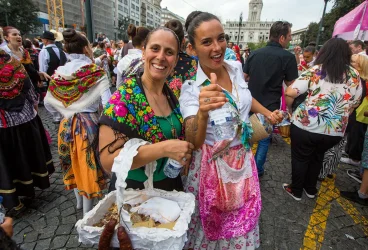
The young women wear long white dresses with a coloured sash across the chest. The young man beside each one wears a white shirt with rolled sleeves, dark trousers, a black tasselled cap and a tie matching the colour of her sash.
Not quite. In 1998 Tomar pushed it back a year so the town could take part in Expo 98 in Lisbon, and the schedule shifted from there.
An elected mordomo coordinates each edition. The vote on 18 April 2026 approved the 2027 festival and chose its mordomo at the same time; Mário Formiga, who led the 2023 edition, takes the role again.
Yes. In the village of Carregueiros the full medieval ceremony is still practised, including the Coronation of the Emperor and the Bodo feast.
Fatias de Tomar, the town's own traditional sweet. Ask for it by name in any local pastry shop; it travels well if you want to take some home.
No. The ox slaughter ended in 1966. Since then the oxen simply parade, garlanded with flowers, and local butchers donate the meat that is distributed to poorer families.
Four summers later, if the cycle holds. Nothing is automatic, though: each edition depends on the people of Tomar voting in favour.
Booking
All 11 parishes of Tomar municipality take part, each marching behind its own banner and crown, so the procession is in effect a portrait of the whole district.
Timing & weather
In 2023, when the July programme ran from 2 to 10 July. The 2027 festival keeps the same early-July slot.
We use necessary cookies to make this site work. With your permission we would also like to remember your preferences, measure how the site is used, and show relevant ads and partner offers. You can change your mind at any time under "Cookie settings" on our Privacy policy page.

 Get the bookingMentor app