

Venue
east end of Shijo-dori, Gion, Higashiyama-ku, Kyoto, Japan

Kyoto Gion Matsuri (Gion Festival) guide
Gion Matsuri suits travelers interested in Kyoto's merchant neighbourhoods and their towering wooden floats. It always runs from 1 to 31 July, with processions on 17 and 24 July. Shape the trip around two choices: the yoiyama evenings when floats are on display, and which procession morning to watch.
Gion Matsuri is the July festival of Yasaka Shrine in Kyoto, and its float processions are among the most admired sights in Japan. It began more than a thousand years ago as a plea against an epidemic. Today it fills the old merchant streets with towering wooden floats, festival music and warm evening crowds for a whole month.
It is a festival of neighbourhoods as much as of the shrine. Each float is kept by its own local association, dressed in its own textiles and ornaments, and the streets that build them treat July as their own. For visitors that means a rare chance to see Kyoto's townspeople at the centre of things.
east end of Shijo-dori, Gion, Higashiyama-ku, Kyoto, Japan
Hotels near the venue fill up around the event dates.
For a free roadside spot on 17 July, be in place by 8:00, especially near Shijo-Kawaramachi, where the first corner turn draws the densest crowd. Bring something to sit on and a folding fan, and expect to stay put until the last float passes.
The evenings before each procession are crowded but easy-going. Charms sold by the float associations are the thing to buy, and the stalls are least crowded soon after dusk.
Downtown streets close to cars and fill with night stalls selling yakitori, taiyaki, takoyaki, okonomiyaki and traditional sweets. Carry small change. Be patient in the crush, follow the direction the stewards set, and take your rubbish with you.
July in Kyoto is hot and sticky, and procession mornings mean hours in the sun with little shade along the route. Carry water and drink it often, wear a hat, and keep a small towel in your bag to wipe your face and neck.
Light, breathable clothes help, and a cotton yukata is a comfortable choice for the evenings. Take breaks indoors in the middle of the day, when the heat peaks, and save your energy for yoiyama after dark.
The larger group of floats stands lit in the streets each evening.
The procession leaves Shijo-Karasuma, rolls east on Shijo-dori, north up Kawaramachi-dori and west along Oike-dori.
The last floats return to their neighbourhoods.
The remaining floats are lit, with more room on the pavements.
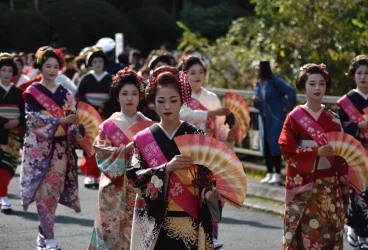
The second procession leaves Karasuma-Oike and follows the course in reverse. The Hanagasa parade, with flower parasols, goes out the same day.
The month of rites at Yasaka Shrine ends.
Gion Matsuri lasts the whole of July, but a visit really hangs on two choices. The first is the yoiyama evenings, when the floats stand lit in the streets of central Kyoto and the mood is relaxed. The second is the procession mornings of 17 and 24 July. You can do both in one stay by arriving for the evenings before a procession and staying through the morning itself.
In 2027 both processions fall on Saturdays, so the two weekends will be the tightest of the month for rooms. Reserve as early as you can, and aim for a hotel within walking distance of the Shijo and Karasuma junction. Being able to walk out at seven in the morning, and back for a rest at midday, makes the day far easier in the heat.
Then settle on a viewing plan. Standing at the kerb is free. The alternative is a reserved seat on the stand along Oike-dori, opposite Kyoto City Hall, sold in advance and worth it if you would rather not queue from dawn. Anyone stringing Kyoto together with other regions can use our Japan destination pages for the wider route.
The festival was born out of fear of disease. In 869, with an epidemic sweeping the capital, prayers were ordered by the emperor and 66 halberds were set up, a halberd for every province in Japan. The rite outlived the epidemic, and it has centred on Yasaka Shrine ever since.
There are 34 floats in all. The 10 hoko are the giants, crowned with long poles and hauled by big crews. The other 24 are yama, smaller and dressed in textiles with carved and metal ornaments. Musicians ride on many of them, playing as the floats inch along, and on a still morning you hear a float well before you see it.
Hauling a hoko round a corner is the moment people wait for. The tsuji-mawashi takes place at a junction, where the crew lays split bamboo on the road, soaks it with water and then drags the float through 90 degrees. It is slow, noisy work, and the crowd cheers when the float finally faces its new street. Each float belongs to its own association of neighbours, and the pride on show at a clean turn is easy to read.
Fly into Kansai International Airport and take the JR Haruka limited express to Kyoto Station, around 75 minutes.
The Karasuma subway runs north from Kyoto Station to Shijo in a few stops. Hankyu's Karasuma station sits at the same junction.
For Yasaka Shrine and the east of Shijo-dori, use Kyoto-Kawaramachi or Gion-Shijo.
The route is closed and nearby roads clog, so do not rely on taxis. Walk, set off early and allow twice the time a map suggests.
Both processions fall on Saturdays in 2027, so the two weekends will be the tightest for rooms. If central Kyoto is full, Osaka is a short train ride away.
Kyoto
Osaka
Kyoto's 1991 to 2020 normals give July an average high of 32.0 °C and a low of 23.6 °C, with 224 mm of rain and average humidity of 69%. The record is 39.8 °C.
The rainy season usually ends during the festival, and the heat that follows is hard going on procession mornings. Shade along the route is scarce.
Met at arrivals at Kansai International Airport (KIX) and driven door to door to Yasaka Shrine.
Places to eat in Japan before or after the celebrations.
1F, 1-7-19 Otemachi, Naka-ku, Hiroshima, Japan
Cuisine:Hiroshima okonomiyaki
1-4-15 Dotonbori, Chuo-ku, Osaka 542-0071, Japan
Cuisine:OkonomiyakiOsaka
459 Shimokawara-cho, Higashiyama-ku, Kyoto 605-0825, Japan
Cuisine:Kyoto kaisekiJapanese
Minamiaoyama Garden Court, 2-6-15 Minami-Aoyama, Minato-ku, Tokyo 107-0062, Japan
Cuisine:InnovativeJapanese
Others of this kind you opened on this device, so you can get back to them quickly.
No questions yet about Kyoto Gion Matsuri (Gion Festival). Ask the community or our travel team, and the answer will show here once it is published.
Our team answers questions here
Festivals held in the same weeks, if you want to plan more than one.
Cultural Events, Folk Festival, Religious Festivals
Loei, Thailand
1 photo


Musical Events, Leisure Events, Social Festivals
Boryeong, South Korea
14 photos
Cultural Events, Religious Festivals, Parade
Osaka, Japan
Festivals and events across Japan, with dates, venues and ticket details where available.

Cultural Events, Religious Festivals, Winter Festivals
Nara, Japan
Cultural Events, Religious Festivals, Parade
Takayama, Japan

Cultural Events, Religious Festivals, Parade
Tokyo, Japan
Tell us where and when you want to go, and local travel experts send you offers for your trip.
General
No. The festival takes its name from the Gion district, where the shrine stands, and the shrine itself was known as Gion Kanjin'in until the Meiji era, when it took the name Yasaka Jinja.
On some of them, during the yoiyama evenings. At the Niwatoriboko, for example, festival-goers take turns climbing aboard by way of a side building. Go early in the evening, before the queues build.
The first turn, at Shijo-Kawaramachi, comes at around 9:30 to 9:40 on 17 July and draws the biggest crowd. Later turns at Kawaramachi-Oike, around 10:30, and Shinmachi-Oike, around 11:20, are easier places to find room.
A hoko weighs about 12 tons, stands roughly 27 metres tall and runs on wheels about 1.9 metres across. Some 30 to 40 people pull it, while usually two men steer with wedges.
The Folding Screen Festival. On yoiyama evenings some old private houses open their front rooms so passers-by can see family heirlooms, including screens, one of the few times Kyoto homes open to strangers.
Easily. Tenjin Matsuri falls on 24 and 25 July, so you can watch Kyoto's Ato Matsuri on the morning of 24 July and be in Osaka by train for Tenjin's main evening the next day.
Yes. Takayama holds a float festival in autumn, which makes a good reason to come back to Japan later in the year and compare the two traditions.
Families & accessibility
The chigo, a boy from a Kyoto merchant family who acts as the deity's sacred page. After weeks of purification he must not touch the ground, and on 17 July he cuts the sacred shimenawa rope with a sword to open the procession.
Timing & weather
By around the year 1000. The rite first held against the epidemic of 869 was repeated until it settled into an annual event, which it has remained ever since.
In 2009, when the float ceremony joined UNESCO's Representative List of the Intangible Cultural Heritage of Humanity, recognising more than a thousand years of tradition.
We use necessary cookies to make this site work. With your permission we would also like to remember your preferences, measure how the site is used, and show relevant ads and partner offers. You can change your mind at any time under "Cookie settings" on our Privacy policy page.

 Umrah packages from Dhaka