
 Holiday offers
Two weeks in Thailand works best split three ways: about four days in Bangkok, four in the north around Chiang Mai, and six on the islands. The one decision that changes everything is which coast you finish on. Travel between December and April and you end on the Andaman side (Krabi, Phi Phi, Phuket); travel between June and September and you end in the Gulf (Koh Samui, Koh Tao).
Facts, prices and rules were checked against official sources in November 2026.
The route below gives the shared first eight days, then two versions of the final six, with travel times and typical fares. All baht prices are converted at roughly 33.5 baht to the US dollar, the rate in early November 2026.
Pick your version first
| Travel dates | Days 9 to 14 | Why |
|---|---|---|
| December to April | Andaman version: Krabi, Phi Phi, Phuket | Dry season on the west coast |
| May to September | Gulf version: Koh Samui, Koh Tao | Andaman monsoon; Gulf is drier |
| October | Either, with flexible bookings | Both coasts are changeable |
| November | Andaman version | Gulf's wettest month |
Our month-by-month guide to the Thai islands explains the weather logic in detail. This page is about the route.
Days 1 to 4: Bangkok
Day 1: arrive and recover
Most long-haul flights land at Suvarnabhumi. The Airport Rail Link runs from the basement of the terminal to Phaya Thai in about 26 to 30 minutes for 45 baht ($1.35), per 2026 transfer guides, with a BTS connection at the far end. Services were cut to every 30 minutes after a disruption in July 2026, The Nation reported, so check the current frequency on arrival. Stay near the river or around Sukhumvit, where the BTS Skytrain makes getting around simple. Keep the first evening light: a riverside dinner or a walk through a night market is enough after a long flight.
Before you fly, complete the free Thailand Digital Arrival Card on the official site, and check the current entry rules in our Thailand visa-free rules guide. A 14-day trip sits well inside the 30-day visa-free stay for US, UK and Indian passport holders.
Day 2: the old city
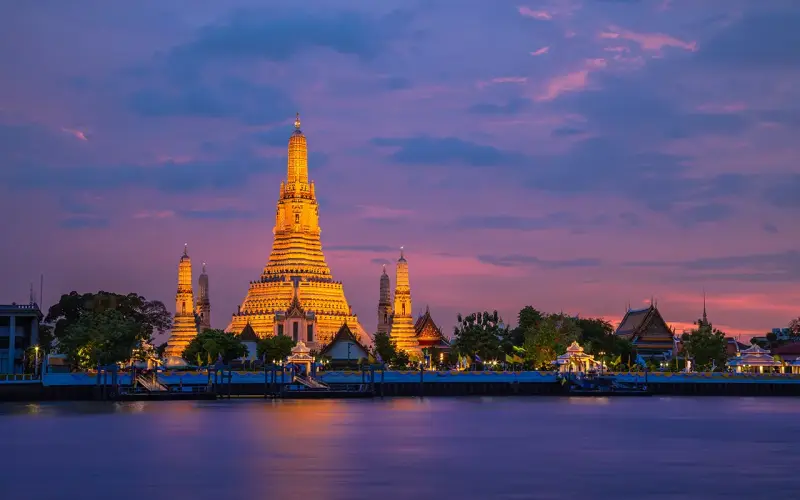
Start early at the Grand Palace and Wat Phra Kaew before the heat builds, walk to Wat Pho for the reclining Buddha, then cross the river by ferry to Wat Arun. Dress code applies at all three: shoulders and knees covered.
The Grand Palace's official ticket page gives opening hours of 8:30 a.m. to 4:30 p.m. daily, and the foreigner ticket is widely listed at 500 baht ($15), with sales ending around 3:30 p.m. The palace can close at short notice for royal ceremonies. Wat Pho is listed at 300 baht and Wat Arun at 200 baht in 2026 guides, and both are reported to take cash only, so carry small notes.
Day 3: markets and canals
If your trip includes a weekend, Chatuchak Weekend Market fills a morning. Otherwise, take a longtail boat through the Thonburi canals, then spend the afternoon in Chinatown along Yaowarat Road, which is at its best for street food after dark.
Day 4: a day trip, then the night train
Ayutthaya, the former royal capital, is an easy morning by train or minivan. Return by late afternoon to catch an overnight train north. The best-known sleeper is Special Express No. 9 from Krung Thep Aphiwat Central Terminal, scheduled at 18:40 and due in Chiang Mai around 07:15 under the State Railway timetable of December 2025, as summarized by Thai Train Guide. The same source lists second-class berths at 941 baht upper and 1,041 baht lower ($28 to $31), and first-class cabins at 1,453 to 1,653 baht ($43 to $49). Tickets open 90 days ahead on the State Railway of Thailand's D-Ticket site, which shows the live fare. If you would rather not spend a night on the train, a one-hour flight is the alternative.
 Plan your trip with AI
Days 5 to 8: Chiang Mai and the north

Day 5: the old town
Arrive in the morning, drop your bags, and walk the moated old city. Wat Chedi Luang and Wat Phra Singh are both inside the walls. On a Sunday, the walking-street market fills Ratchadamnoen Road from late afternoon.
Day 6: Doi Suthep and a cooking class
The temple on Doi Suthep overlooks the city; a red songthaew shared taxi or a ride-hailing car gets you up the mountain. Spend the afternoon at one of the many farm-based cooking schools outside town, which usually include a market visit.
Day 7: an ethical elephant visit or Doi Inthanon
Choose an elephant sanctuary that does not offer riding or performances, or take a day trip to Doi Inthanon, Thailand's highest mountain, for waterfalls and hill-tribe villages. Both need a full day.
Day 8: Chiang Rai or rest, then fly south
A long day trip to Chiang Rai's White Temple is popular, but it means about six hours on the road. If you would rather slow down, spend the morning at a café in Nimman and take an afternoon flight south. From Chiang Mai there are direct flights to Krabi, Phuket and Koh Samui, though Samui routes are fewer and pricier.
Days 9 to 14, Andaman version (December to April)
Days 9 and 10: Krabi and Railay
Base yourself in Ao Nang. Longtail boats run to Railay, a peninsula reachable only by water, in about 15 minutes. Spend one day on a four-islands boat trip and the other climbing, kayaking or just swimming at Phra Nang beach.
Days 11 and 12: Koh Phi Phi
Ferries from Krabi take you to Ton Sai on Phi Phi Don. Book a morning boat trip around Phi Phi Leh, where Maya Bay can be viewed from a boardwalk but not swum in; the bay closes each August and September and reopened on 1 October 2026.
Days 13 and 14: Phuket
Ferries from Phi Phi to Rassada Pier in Phuket take roughly 1.5 to 2 hours, and several operators run the route daily in the dry season. Stay on the west coast at Kata or Karon for easy beaches, and fly home from Phuket International Airport or connect through Bangkok.
Days 9 to 14, Gulf version (May to September)
Days 9 to 11: Koh Samui
Fly from Chiang Mai or connect through Bangkok. Samui's airport is small and served mainly by Bangkok Airways, which is why fares run higher than to Phuket. Stay in Bophut or Chaweng and take a day trip to Ang Thong Marine National Park, a cluster of limestone islands to the west.
Day 12: Koh Phangan or a rest day
Phangan is a short ferry ride north. Unless your dates line up with the Full Moon Party, the north and west coasts are quiet and good for a lazy day.
Days 13 and 14: Koh Tao
Lomprayah high-speed boats from Samui reach Koh Tao in about 1 hour 45 minutes to 2 hours, with check-in an hour before departure. Koh Tao is one of the cheapest places in Asia to learn to dive; a two-day taster fits the final days. Head back to Samui or take the boat-and-bus combination to Chumphon for a flight or train to Bangkok.
 Get the bookingMentor app
Transport summary and costs
| Leg | Mode | Typical time | Typical fare (2026) |
|---|---|---|---|
| Suvarnabhumi to central Bangkok | Airport Rail Link | 26 to 30 minutes | 45 baht ($1.35) |
| Bangkok to Chiang Mai | Sleeper train No. 9 | About 12.5 hours | 941 to 1,041 baht 2nd class ($28 to $31) |
| Phi Phi to Phuket | Ferry | 1.5 to 2 hours | Varies by operator |
| Koh Samui to Koh Tao | Lomprayah catamaran | 1h45 to 2 hours | About 700 baht ($21) on booking sites |
The train fare follows the State Railway timetable; boat fares come from booking listings because the operators do not publish full fare tables online, so check the live price when you book. Domestic flight prices swing widely with dates, which is why we have not given a single figure.
Where to stay at each stop
In Bangkok, the riverside around Charoen Krung and the old city suits sightseeing days, since the palace and temples are close and the Chao Phraya Express boats connect them. Sukhumvit is better for food, nightlife and the airport link, and its hotels run from hostels to high-rise towers. Silom sits between the two and has both BTS and MRT stations.
In Chiang Mai, staying inside or just outside the old city walls puts the temples and the Sunday market on foot. Nimman, to the west, has newer hotels, cafés and coworking spaces, and is closer to the road up Doi Suthep. Riverside guesthouses along the Ping are quieter but need a ride to most sights.
On the Andaman leg, Ao Nang is the practical base for Krabi, with boats to Railay and the islands from the beach. On Phi Phi, Ton Sai village is busy and loud at night; the beaches beyond Loh Dalum or on the east side are quieter but involve a longtail transfer. In Phuket, Kata and Karon are calmer than Patong and closer to the south-coast viewpoints.
For the Gulf version, Bophut's Fisherman's Village is the more relaxed choice on Samui, while Chaweng has the longest beach and most nightlife. On Koh Tao, Sairee Beach has most dive schools and bars; Chalok Baan Kao in the south is quieter.
Smoke season in the north
If your dates fall in March or April, take the air quality around Chiang Mai seriously. Agricultural burning and forest fires produce heavy haze most years, and in 2026 the city topped IQAir's global pollution rankings several times, reaching an AQI of 263 on 29 March. Readings had fallen below 100 micrograms of PM2.5 per cubic meter across all districts by 27 April, according to Chiang Mai University data reported by Chiang Mai CityLife.
For a spring trip, cut the northern section to two nights and give the extra time to the islands, or bring N95 masks and check the AQI each morning before planning outdoor days. Travelers with asthma or heart conditions may prefer to skip the north entirely in those weeks.
Booking timeline
Three months out, book the sleeper train if you want a lower berth, and any Christmas, New Year or Songkran island hotels. One to two months out, book domestic flights, which rise as seats sell. In the final week, complete the TDAC and confirm ferry times, since operators adjust schedules between seasons. Day tours, cooking classes and boat trips can usually wait until you are in the country, except the Similan Islands at peak times.
Stretching or shrinking the route
With ten days instead of fourteen, take a night out of Bangkok and one out of the north, and give the islands four nights in one place rather than hopping. The Andaman version then becomes Krabi plus either Phi Phi or Phuket, not all three; the Gulf version becomes Samui plus Koh Tao, with Phangan as a day trip.
With three weeks, the north is where extra days pay off most. Pai is a winding road trip from Chiang Mai, and Chiang Rai deserves a night of its own rather than a long day trip. On the coast, Koh Lanta fits between Krabi and Phi Phi in the dry season, and Koh Phangan earns two or three nights in the Gulf version.
Whatever the length, keep the order: city first, mountains second, beach last. Reversing it puts your most weather-dependent days at the start, when a cancelled boat can knock out the rest of the plan.
Who this route suits
The plan is built for first-time visitors who want a taste of each region without spending whole days in transit. It works for couples and friends, and for families with older children who can handle a night train and a few boat transfers.
It is less suited to travelers who mainly want a beach holiday; they would do better with a few days in Bangkok and ten nights on one island. Serious divers should also rework it, moving the Similans or Koh Tao to the center of the trip and treating the north as optional.
Packing for this route
Two climates and a lot of temple visits shape the bag. Bring a light layer for the north, where mornings on Doi Suthep and Doi Inthanon can be cool in December and January, and a sarong or light trousers to cover legs at temples. Reef-safe sunscreen, a dry bag for boat days and sandals that can get wet earn their place on the islands.
Pack light enough to carry your bag down a pier and onto a longtail, because most island transfers have no porters. A soft duffel or backpack is easier than a large hard suitcase on Phi Phi and Koh Tao.
Mistakes that cost time
Trying to fit both coasts into one trip in the wrong season is the most common. Between May and October, one of them will usually be wet, and the cross-country link takes most of a day.
Underestimating the north is another. Chiang Mai rewards three or four nights; a single night there feels rushed.
Finally, boats are weather-dependent. Leave at least one night between your last island and your international flight.
For the bigger picture on budgets, safety and where else to go, see the Thailand travel guide, and for ideas to swap into this route, our list of the best things to do in Thailand.
 Umrah packages










{{item.get_author.first_name}} {{item.get_author.last_name}}
{{item.comment_txt}}
{{item_reply.get_author.first_name}} {{item_reply.get_author.last_name}}
@ {{item_reply.reply_to}}, {{item_reply.reply_txt}}