
 Umrah packages
Paris packs more world-famous sights into a small, walkable centre than almost any city on earth, and the top 10 tourist attractions in Paris sit within a few Metro stops of each other. The Eiffel Tower, the Louvre and Notre-Dame anchor most first trips, while Versailles needs half a day of its own outside the city. The challenge for a first visit is less what to see and more how to book, sequence and time each stop so you spend your days inside the sights and not in queues.
This guide covers each attraction with what you will actually see, current ticket rules, the best time of day to go and the mistakes that cost visitors hours. If you want activities beyond the headline sights (food markets, cooking classes, day trips), read our separate guide to the best things to do in Paris, and if you are planning a couple's trip, our Paris honeymoon guide covers romantic hotels and dinners.
How this list was put together: The ten sights below are the ones that appear on nearly every first-time Paris itinerary, ranked by how much a short visit gives back. Prices, opening days and closures were checked against official and current published sources in October 2026. Fees change every January and some sites adjust seasonally, so confirm the exact figure on each official ticketing page before you pay.
- Sights covered: 10
- Louvre, most non-EU visitors: €32
- Notre-Dame reopened: 2024
- Steps up the Arc de Triomphe: 284
Quick comparison of the top Paris attractions
Sights are sorted by area and day below. Prices are adult standard rates as published for 2026; children and EU residents under 26 often pay less or nothing.
| # | Attraction | Area | Adult entry (2026) | Closed | Time needed |
|---|---|---|---|---|---|
| 1 | Eiffel Tower | 7th arr. | €36.70 summit by lift | Rarely | 2 to 3 hrs |
| 2 | Louvre Museum | 1st arr. | €32 non-EU / €22 EU | Tuesday | 3 to 4 hrs |
| 3 | Palace of Versailles | Versailles | €25 to €35 Passport | Monday (palace) | Half to full day |
| 4 | Latin Quarter | 5th arr. | Free to walk | Never | Half day |
| 5 | Seine River and cruises | Central | Cruise fee varies | Never | 1 to 2 hrs |
| 6 | Montmartre and Sacré-Cœur | 18th arr. | Free; dome €8 | Never | Half day |
| 7 | Musée d'Orsay | 7th arr. | Paid entry | Monday | 2 to 3 hrs |
| 8 | Arc de Triomphe | 8th/16th/17th | €16 to €22 | Rarely | 1 hr |
| 9 | Centre Pompidou | 4th arr. | Closed until c. 2030 | Renovation | Outside view |
| 10 | Notre-Dame de Paris | Île de la Cité | Free; towers €16 | Never | 1 to 2 hrs |
A workable grouping: pair the Eiffel Tower with a Seine cruise and the Musée d'Orsay, which share the Left Bank side of the 7th; combine the Louvre, Notre-Dame and the Latin Quarter in one walkable central day; give Montmartre its own afternoon; and set aside a full day for Versailles. The RER C reaches Versailles Château Rive Gauche, the station closest to the palace, in roughly 40 minutes from central Paris; board trains signed for that station, since some RER C services end at Versailles-Chantiers instead.
Top 10 best tourist attractions in Paris: full guide
Eiffel Tower (Tour Eiffel)

Parisians still call it La Dame de Fer, the Iron Lady, and no first trip feels complete without standing under its four legs on the Champ de Mars. Gustave Eiffel's company built it for the 1889 World's Fair, and it now has three visitor levels: the first floor with its glass floor, the second floor with the best views of the city's rooftops, and the summit, reached by a separate lift from the second floor.
The adult summit ticket by lift is listed at €36.70 for 2026, with youth (12 to 24) and child (4 to 11) rates roughly half and a quarter of that, and under-4s free. Taking the stairs to the second floor is the cheapest way up and usually has a shorter wait. Tickets are released online on the official toureiffel.paris site, and summer slots sell out weeks ahead, so book the moment your dates are fixed.
For the classic photo, cross the river to the Trocadéro terraces at sunrise, when the esplanade is almost empty. After dark the tower sparkles for five minutes at the start of every hour. Nearby, the Musée Rodin (home of The Thinker) and the narrow Île aux Cygnes with its small Statue of Liberty replica are both an easy walk and far quieter than the tower base.
- Area: Champ de Mars, 7th arrondissement
- Price: €36.70 adult summit by lift (2026); stairs cheaper
- Best time: Opening slot or after 9 pm
- Getting there: Metro Bir-Hakeim (line 6) or RER C Champ de Mars
First-time visitors and photographers get the most from it. Buy only on the official site; resellers add a heavy markup for the same timed slot.
Louvre Museum (Musée du Louvre)

The world's largest art museum, and the obvious refuge on a rainy day, fills the former royal palace on the Right Bank. It holds the Mona Lisa, the Venus de Milo, the Winged Victory of Samothrace and the Great Sphinx of Tanis, the granite sphinx that greets you in the Egyptian crypt. The collection is too large for one visit, so pick two wings and accept that you will come back.
From 14 January 2026 the Louvre charges most visitors from outside the EU, Iceland, Liechtenstein and Norway €32, up from €22, while EU and EEA residents keep the €22 rate. A timed ticket booked online is effectively required. The museum closes on Tuesdays, which pushes heavy crowds onto Mondays and Wednesdays.
Enter through the Carrousel du Louvre shopping arcade or the Porte des Lions when the main pyramid queue is long. See the Mona Lisa first thing or in the last hour, then move to quieter rooms such as the Napoleon III Apartments. Afterwards, walk west through the Tuileries Garden past the Arc de Triomphe du Carrousel towards Place de la Concorde.
- Area: Rue de Rivoli, 1st arrondissement
- Price: €32 most non-EU visitors, €22 EU/EEA (2026)
- Closed: Every Tuesday
- Getting there: Metro Palais Royal–Musée du Louvre (lines 1, 7)
Art lovers should take the first morning slot and go straight to the Denon wing before the tour groups arrive.
Palace of Versailles (Château de Versailles)

Louis XIV turned his father's hunting lodge into the seat of French royal power, and the result, now a UNESCO-listed palace and the classic day trip from Paris, is one of the most visited monuments in France. The State Apartments, the Royal Chapel, the Royal Opera and the Hall of Mirrors fill the main palace. Beyond them, the gardens run down to the Grand Canal, where you can hire a rowing boat in season.
The Passport ticket, which covers the palace, the Trianon estate and Marie-Antoinette's Hamlet, is listed at €25 in low season and €35 in high season for 2026, when musical fountain shows and gardens events push the price up. A cheaper late-entry palace ticket exists from mid-afternoon. The palace closes on Mondays, but the gardens stay open, so a Monday can still work for a garden-only visit.
Arrive at opening and see the palace first, then spend the afternoon in the gardens, the Petit Trianon and the Hamlet, which most day-trippers skip. The estate is huge; a petit train and bike rentals help you cover the distance to the Trianons.
- Area: Versailles, about 20 km west of central Paris
- Price: Passport €25 low season / €35 high season (2026)
- Closed: Palace closed Mondays; gardens open
- Getting there: RER C to Versailles Château Rive Gauche
History fans with a whole day to spare will get the most out of it. In summer, steer clear of Tuesdays and Sundays, the two busiest days because other museums close or locals visit.
Latin Quarter (Quartier Latin)
The Left Bank district around the Sorbonne takes its name from the Latin once spoken by its scholars, and this student quarter of cafés and lecture halls remains the most rewarding area of Paris to explore on foot without a ticket. Narrow lanes such as Rue de la Huchette and Rue Mouffetard are lined with bookshops, bakeries and small restaurants, and the district is home to Shakespeare and Company, the English-language bookshop facing Notre-Dame.
The domed Panthéon holds the tombs of Voltaire, Victor Hugo and Marie Curie. A short walk away, the Jardin des Plantes, founded as the royal medicinal garden, contains greenhouses and the Natural History Museum galleries. The Arènes de Lutèce, a Roman amphitheatre hidden behind apartment blocks, is a quiet spot for a picnic, and the Paradis Latin cabaret stages evening shows for those who want a night out.
Restaurants on the busiest streets near Saint-Michel target tourists with set menus. Walk five minutes further towards Rue Mouffetard or Place de la Contrescarpe for better value.
- Area: 5th arrondissement, Left Bank
- Price: Free to walk; Panthéon paid entry
- Best time: Morning market on Rue Mouffetard
- Getting there: Metro Cluny–La Sorbonne or RER Saint-Michel
On a tight budget or in no hurry, this is the district to linger in, and Notre-Dame sits directly across the river for an easy pairing.
Seine River: cruises, quays and summer beaches

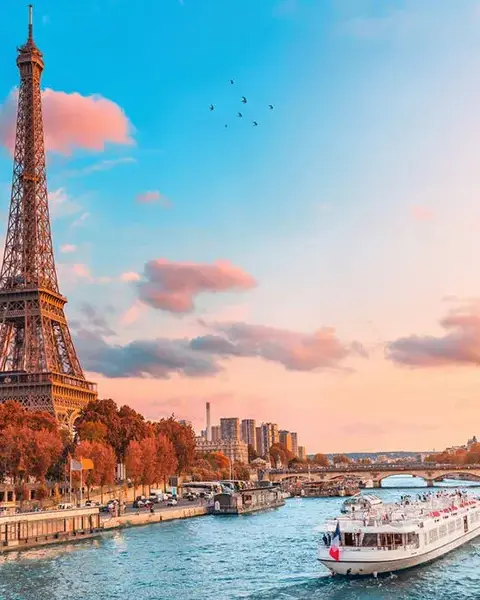
A boat on the river passes the Louvre, the Musée d'Orsay, Notre-Dame, the Eiffel Tower and more than a dozen bridges in about an hour. Sightseeing operators such as the Bateaux Mouches, Bateaux Parisiens and Vedettes du Pont Neuf run frequent daytime and evening sailings, and dinner cruises add a long, slow meal on the water.
Each summer the city turns parts of the riverbank into Paris Plages, with deckchairs, sand and outdoor activities. Away from the boats, the pedestrianised quays on both banks are among the best walks in the city, and the bouquinistes, the green-box booksellers on the parapets, sell old prints and postcards.
Book an evening cruise timed for the hour after sunset, so you see the monuments lit and catch the Eiffel Tower sparkle from the water. Private boat hire and dinner yachts are available for special occasions, at a much higher price than a standard sailing.
- Area: Central Paris, Pont de l'Alma to Île Saint-Louis
- Price: Standard cruises cost far less than dinner cruises; check operator
- Best time: Just after sunset
- Getting there: Metro Alma–Marceau or Pont Neuf for departures
A cruise makes a good first evening, and families with tired legs appreciate the rest. Sit on the open upper deck on the side facing the Left Bank for the best photos.
Montmartre and Sacré-Cœur Basilica

The white domes of the Sacré-Cœur crown the highest hill in Paris, and the steps in front of the basilica give one of the widest free views over the city. Entry to the basilica is free. Climbing the dome, a narrow spiral of about 300 steps, costs €8 for adults and is paid on site, and it rewards you with a view that reaches far beyond the Eiffel Tower on a clear day.
Behind the basilica, the old village of Montmartre keeps its cobbled lanes, vineyard and the artists' square of Place du Tertre. The Wall of Love (Le Mur des Je t'aime) in Square Jehan Rictus displays "I love you" in more than 250 languages, Place Dalida has the bronze bust that visitors rub for luck, and the tilted "sinking house" on Rue Paul Albert is a favourite photo stop.
Montmartre is busy with pickpockets and with people pressing string bracelets on visitors near the stairs. Keep walking, keep your bag zipped and use the funicular, which accepts a standard Metro ticket, to save the climb.
- Area: 18th arrondissement
- Price: Basilica free; dome €8 adults (on site)
- Best time: Early morning or sunset
- Getting there: Metro Anvers (line 2) then funicular
Couples and photographers do well here; go at sunrise for empty lanes and soft light over the rooftops.
Musée d'Orsay
Housed in the former Gare d'Orsay railway station, built for the 1900 World's Fair, the Musée d'Orsay holds the world's finest collection of Impressionist and Post-Impressionist art. Highlights include Van Gogh's Self-Portrait and Starry Night over the Rhône, Monet's Poppy Field, Renoir's Bal du moulin de la Galette, Manet's Le Déjeuner sur l'herbe, Degas's Women Ironing and Caillebotte's The Floor Scrapers.
The museum opens Tuesday to Sunday and closes on Mondays, with a late opening on Thursday evenings, the calmest time to visit. A renovation of the reception areas is under way in phases from March 2026 to summer 2028, so entrance arrangements may shift; check the official site before your visit.
Start on the top floor, where the Impressionist galleries are, and look out through the giant clock window towards the Louvre and Sacré-Cœur. The museum is a short walk across the Passerelle Léopold-Sédar-Senghor footbridge from the Tuileries Garden and Place de la Concorde.
- Area: Rue de la Légion d'Honneur, 7th arrondissement
- Price: Paid entry; free for EU residents under 26
- Hours: Closed Mondays; late Thursdays
- Getting there: RER C Musée d'Orsay or Metro Solférino
Short of time? The Orsay is smaller and easier to tackle than the Louvre in two to three hours.
Arc de Triomphe and the Champs-Élysées
Napoleon commissioned the Arc de Triomphe in 1806 to honour his armies, and it stands at the centre of Place Charles de Gaulle, where twelve avenues meet. Beneath the arch lies the Tomb of the Unknown Soldier from the First World War, with an eternal flame rekindled every evening at 6.30 pm.
Climbing the 284 steps to the rooftop terrace gives the best view of the Champs-Élysées running straight towards the Louvre and of La Défense in the opposite direction. Published 2026 adult prices are €22 from April to September and €16 from October to March. The rooftop works well at dusk, when the avenues light up and the Eiffel Tower starts to sparkle.
Never try to cross the roundabout on foot. Use the underground passage from the north side of the Champs-Élysées. The avenue itself is lined with flagship stores; neighbourhood cafés a block or two away cost noticeably less than those on the avenue.
- Area: Place Charles de Gaulle (8th, 16th, 17th arr.)
- Price: €16 to €22 depending on season (2026)
- Best time: Sunset
- Getting there: Metro or RER A Charles de Gaulle–Étoile
Come here for skyline views without the Eiffel Tower queues, and expect the stairs only; the lift has been reported out of service.
Centre Pompidou (Beaubourg)
The inside-out building by Renzo Piano and Richard Rogers, with its coloured pipes and glass escalator tube, houses Europe's largest collection of modern and contemporary art. Its sixth-floor terrace has long been a favourite free-feeling viewpoint towards the Eiffel Tower and Sacré-Cœur.
The Centre Pompidou closed to the public on 22 September 2025 for a five-year renovation covering asbestos removal, accessibility, energy upgrades and a new rooftop terrace. Reopening is planned for around 2030. During the works, parts of the collection travel through a touring programme and major exhibitions have been staged at the Grand Palais.
You can still admire the famous exterior and the Stravinsky Fountain with its Niki de Saint Phalle sculptures next door, then walk into the Marais for galleries, falafel on Rue des Rosiers and the Place des Vosges.
- Area: Place Georges-Pompidou, 4th arrondissement
- Price: Museum closed during works
- Reopening: Planned for around 2030
- Getting there: Metro Rambuteau (line 11)
For now the building mainly rewards architecture fans. Replace the museum visit with the Marais district or a Grand Palais exhibition while it is closed.
Notre-Dame de Paris

After the fire of April 2019 and five years of restoration, the Gothic cathedral of Notre-Dame reopened to the public on 8 December 2024. The restored interior is bright, the stonework cleaned, and the rose windows glow in the afternoon light. Entry to the cathedral is free; the towers (about €16) and the treasury carry separate fees.
A free timed slot can be booked on the official cathedral website or app. It is optional, but walk-up queues can run well over an hour in high season, so a reservation saves time. Published hours run from early morning to 7 pm on weekdays, with a late Thursday opening, and slightly different weekend times.
On the square in front, look for Point Zéro, the bronze star from which road distances in France are measured. Then explore the rest of the Île de la Cité: the Sainte-Chapelle with its stained glass, the leafy Place Dauphine and the Marché aux Fleurs flower market, which hosts a bird market on Sundays.
- Area: Île de la Cité, 4th arrondissement
- Price: Cathedral free; towers about €16
- Best time: Weekday morning or Thursday evening
- Getting there: Metro Cité (line 4) or RER Saint-Michel Notre-Dame
It suits every kind of visitor. Book the free slot on the official site only; paid "skip-the-line" offers are reselling free tickets.
 Get the bookingMentor app
How to plan three days around the top Paris attractions
Group sights by area and you can see all ten in three full days without rushing. Day one: Notre-Dame and Sainte-Chapelle in the morning, lunch in the Latin Quarter, the Louvre in the afternoon and a Seine cruise after sunset. Day two: the Musée d'Orsay at opening, a walk past the Pompidou exterior and through the Marais, then the Arc de Triomphe rooftop at dusk. Day three: Versailles all day, back in time for dinner in Montmartre.
Paris is compact, and the Metro is the quickest way between areas. Single tickets, the Navigo Easy card and day passes all work on the Metro, RER within Paris and buses; RER trips to Versailles and the airports cost more than a standard ticket. Walking between neighbouring sights, for example from the Louvre to the Musée d'Orsay across the river, is often faster than going underground.
The Paris Museum Pass covers the Louvre, Orsay, the Arc de Triomphe, the Notre-Dame towers and Versailles, among others, but you still need to reserve time slots for the busiest museums. It pays off when you visit three or more paid sights a day. Run the numbers against the individual prices above before you buy.
Best time to visit Paris for sightseeing
April to June and September to October bring mild weather and long days without the peak crowds of July and August. November to March is the off-season: hotel rates and queues drop, museums are calmer, and the Christmas lights and markets brighten December. Summer has the longest opening hours and Paris Plages, but expect the longest queues at the Eiffel Tower and Versailles.
Within the week, avoid the Louvre on Mondays and Wednesdays (it closes Tuesdays), the Orsay on Tuesdays (it closes Mondays) and Versailles on Tuesdays and weekends. Thursday late openings at the Orsay and Notre-Dame are among the calmest times to visit either.
A few dates change the city noticeably. The Fête de la Musique on 21 June fills streets and squares with free concerts, which is lively but slows sightseeing. During the European Heritage Days on the third weekend of September (19 and 20 September in 2026), ministries, embassies and other buildings normally closed to the public open their doors, often free, with long queues for the best-known ones. In July and August, check RER line works before planning a Versailles day, as summer closures on the RER C have occurred.
Shopping near the main Paris attractions
Shopping slots easily between sightseeing stops. The Avenue des Champs-Élysées, running from the Arc de Triomphe, is lined with flagship stores and luxury brands. Le Marais, a short walk from the Pompidou, mixes concept stores, independent designers and vintage shops in medieval lanes. Saint-Germain-des-Prés, next to the Latin Quarter, combines fashion boutiques with art galleries and antique dealers.
For department stores, Galeries Lafayette Haussmann is worth entering for its stained-glass dome and rooftop terrace even if you buy nothing, and Le Bon Marché on the Left Bank, one of the oldest department stores in the world, has the La Grande Épicerie food hall next door. Bargain hunters should head north to the Marché aux Puces de Saint-Ouen, one of the largest antique and flea markets in the world. For a city-by-city comparison, see our guide to the best shopping cities in the world.
Paris travel tips that save time and money
- Book timed tickets early. The Eiffel Tower, Louvre and Versailles release timed slots online. Summer and holiday slots sell out weeks ahead, so book as soon as your dates are confirmed.
- Mind the litter fines. Dropping a cigarette butt or litter in Paris carries a €135 fine, and the city has stepped up enforcement. Carry a pocket ashtray if you smoke.
- Under 26 and EU resident? Many national museums and monuments are free for EU residents aged 18 to 25 with ID. Non-EU visitors pay full price at most of them.
- Say bonjour first. Always greet staff with "bonjour" when entering a shop or café. Skipping it is considered rude and the service will reflect it.
- Eat a street away. Cafés facing major sights charge more for less. Walk two blocks and look for a set lunch menu (formule) for better value.
- Watch your belongings. Pickpockets work the Metro, the Eiffel Tower, Montmartre steps and the Louvre queues. Keep phones out of back pockets and bags zipped.
When you are ready, compare flights to Paris and hotels on bookingMentor, or see how Paris compares with other great cities in our top 100 cities in the world round-up.
Planning a trip to France? Read our France travel guide, compare hotels in France or search flights.
Paris sights to add once you have seen the top 10
With a fourth day, or a second trip, these places are close to the main sights and much quieter.
The Musée de l'Orangerie, in a corner of the Tuileries garden, was built to show Claude Monet's Water Lilies, eight large panels hung in two oval rooms, and an hour is enough. The Palais Garnier, the 19th-century opera house near the Grands Boulevards, is open for daytime visits without a performance ticket; look up at Marc Chagall's painted ceiling if the auditorium is open that day.
On the Left Bank, the Panthéon holds the tombs of Voltaire, Victor Hugo and Marie Curie, and the Jardin du Luxembourg beside it is where Parisians sit by the Medici Fountain and children sail toy boats on the pond. In the east, Père Lachaise Cemetery is free to walk and holds the graves of Chopin, Oscar Wilde, Édith Piaf and Jim Morrison.
To find a base near these, read our Paris city guide and compare hotels in Paris.
 AI trip planner







{{item.get_author.first_name}} {{item.get_author.last_name}}
{{item.comment_txt}}
{{item_reply.get_author.first_name}} {{item_reply.get_author.last_name}}
@ {{item_reply.reply_to}}, {{item_reply.reply_txt}}