
A good first trip to Italy covers two or three bases over 10 to 14 days, moves between them by high-speed train, and books the big museums ahead. Rome, Florence and Venice make the classic first route; add a coast or Sicily only if you have more than ten days. What most first-timers should skip is a rental car in the cities and a schedule with a new town every night.
Facts, prices and rules were checked against official sources in November 2026.
This guide is the starting point for planning. It sets out the big decisions, then links to our detailed guides on routes, timing and the coast so you can go deeper where you need to.
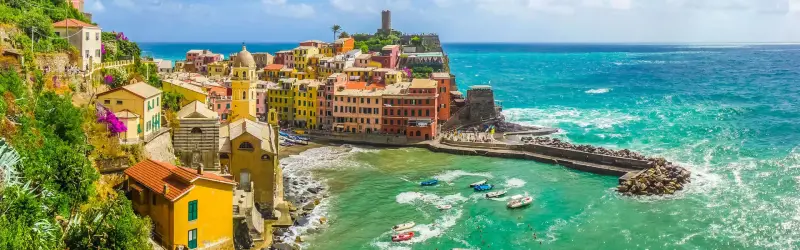
Step one: decide how long and where
Italy rewards slow travel. A useful rule is at least three nights per base, so you get two full days in each place and do not spend the trip packing.
| Trip length | Suggested bases | Notes |
|---|---|---|
| 7 days | Rome and Florence | Add Venice only if you accept a fast pace |
| 10 days | Rome, Florence, Venice | The classic first route |
| 14 days | Rome, Florence, Venice plus one coast | Choose Amalfi or Cinque Terre |
| 3 weeks | Add Sicily, Puglia or the Dolomites | Use a domestic flight for Sicily |
For a day-by-day plan with train legs, see our 10-day Rome, Florence and Venice itinerary. If you are trying to choose between the two famous coasts, the Amalfi Coast vs Cinque Terre comparison sets out who each suits.
Step two: pick your season
Spring and early autumn are the sweet spot for most of the country, while the mountains and some coasts have their own calendars. Our month-by-month guide to the best time to visit Italy compares Rome, the Amalfi Coast, the Dolomites and Sicily in one table, along with festivals and crowd patterns.
One planning point stands out: Italian public holidays and August push prices up sharply in coastal resorts. If your dates are flexible, shifting a week can change hotel costs more than any booking trick.
 Exclusive holiday package offers
Step three: understand the main regions
Rome and Lazio
The capital holds more major sights than anywhere else in the country, from the Colosseum to the Vatican. It needs at least three full days. Our top 10 attractions in Rome helps set priorities.
Florence and Tuscany
Florence packs Renaissance art into a walkable center, and it makes a strong base for day trips to Siena, Pisa, Lucca and the Chianti wine area.
Venice and the Veneto
Venice has no cars, so every trip happens on foot or by boat. Our guide to the best attractions in Venice lists what to see, and the city's access fee rules are covered in the 10-day itinerary.
The south and the islands
Naples, the Amalfi Coast, Puglia and Sicily feel different from the north in food, pace and landscape. They suit a second trip or a longer first one.
Beyond the big three
Bologna, Verona, Turin, Trieste and dozens of smaller cities give a less crowded side of Italy. Our roundup of cities in Italy compares them, and Trieste and Pordenone feature in our list of underrated European cities for 2027.
Getting around Italy
Trains
High-speed trains run by Trenitalia and Italo connect the main cities quickly and are usually the best way to travel between bases. Fares are dynamic, so booking a few weeks ahead pays off. Regional trains are cheaper and do not need advance booking, but they are slower and stop often.
From the airport
Most long-haul flights land in Rome Fiumicino or Milan Malpensa, with Venice, Naples and Florence taking many European connections. In Rome, the Leonardo Express train runs nonstop to Termini station; Aeroporti di Roma gives the fare as €14 and the journey as 32 minutes. That beats a taxi for solo travelers and couples, while a fixed-fare taxi can make sense for a family of four with luggage.
City transport
Buses, trams and metros are cheap by Western European standards, though in historic centers you will mostly walk. Rome's standard single ticket has cost €1.50 for 100 minutes of travel, with a fare rise under discussion, so check the machine. Tap-in contactless payment now works on many city networks, which saves hunting for a ticket office.
Cars
A car is useful in rural Tuscany, Puglia, Sicily or the Dolomites, but a burden in cities. Historic centers use limited traffic zones, known as ZTL, monitored by cameras, and driving into one without a permit can lead to a fine sent to your rental company. Pick up a car on the edge of town when you leave a city, not when you arrive.
Check the paperwork before you fly. The US Embassy in Rome has advised that a license issued outside the EU or EFTA must be accompanied by an International Driving Permit or a certified Italian translation. In the United States, only AAA and the American Automobile Touring Alliance issue the permit, so get it before departure; rental desks may not ask, but police at a roadside check can.
Domestic flights and ferries
Flights make sense for Sicily, Sardinia or a north to south hop. Ferries serve the islands and coasts, but many coastal routes are seasonal.
Money and costs
Italy uses the euro. Cards are widely accepted, including contactless payment, though small bars, market stalls and some rural places still prefer cash. Carry some coins for city buses in smaller towns and for public toilets.
Expect a few extra charges first-timers often miss. Hotels collect a city tourist tax per person per night, which varies by city and hotel category and is often paid at the property rather than included in an online booking. Many restaurants add a "coperto," a per-person cover charge for bread and service, listed on the menu. Tipping is not expected the way it is in the US; rounding up or leaving a few euros for good service is enough.
Some famous sites now charge for access that used to be free. Since February 2026 Rome charges €2 to go down to the Trevi Fountain basin, according to Rome's tourism office, and Venice charges day visitors on selected days. Cinque Terre's main paid trails require a park card.

Cards, ATMs and exchange rates
When a card machine or ATM offers to charge you in your home currency, choose euros instead. The conversion offered at the terminal usually comes with a worse rate than your own bank applies. Use ATMs attached to bank branches rather than standalone machines in tourist areas, which often add higher fees, and tell your bank about your trip if it still blocks foreign transactions.
 Get the bookingMentor app
A sample two-week first trip
With fourteen days, the classic three cities leave room for one more region without rushing. A balanced version looks like this: four nights in Rome, three in Florence, three in Venice, then four on a coast. Choosing Cinque Terre keeps the whole trip on the rail network, since it sits between Florence and the north. Choosing the Amalfi Coast means flying into Venice, working south, and finishing in Naples.
Another option for travelers who prefer cities to beaches is to swap the coast for Bologna and Verona, both on fast rail lines and both strong on food. Whichever you pick, keep the rule of at least three nights per base, and plan your heaviest sightseeing days for the middle of each stay rather than arrival and departure days.
Booking the big sights
Most of Italy's headline museums use timed entry, and the best slots go weeks ahead in spring and summer. Book these first, then build the rest of each day around them:
- Colosseum, Roman Forum and Palatine Hill
- Vatican Museums and Sistine Chapel
- Borghese Gallery in Rome
- Uffizi Gallery and Accademia Gallery in Florence
- The Last Supper in Milan
Timing matters as much as the list. The Colosseum archaeological park releases timed tickets 30 days before each date, so a spring visit means booking on the day sales open. In Florence, the Uffizi charges €25 for a standard high-season ticket (about US$29, £22), plus €4 if you book online, which buys a fixed entry time instead of a long wait.
Use the official sites wherever possible. Resellers often charge more for the same timed ticket, and some sell tours you do not need.
Eating and drinking like a local
Italian meals follow a rhythm that is worth learning before you arrive. Breakfast is light, often a pastry and coffee standing at a bar counter. Lunch can be the main meal, especially in smaller towns and on Sundays, when families gather for long meals.
A full restaurant menu runs from antipasto (starters) to primo (pasta, risotto or soup), secondo (meat or fish) with contorni (side dishes) ordered separately, then dessert. Nobody expects you to order every course. A primo and a shared antipasto make a perfectly normal meal.
Coffee has its own customs. A cappuccino is a morning drink for most Italians, and drinking at the bar counter usually costs less than sitting at a table, where service is added to the price. In the early evening, aperitivo is a social ritual: a drink, often a spritz or a glass of wine, served with snacks before dinner.
Regional food is the real reason to eat widely. Rome is known for carbonara, cacio e pepe and artichokes in season, Florence for steak and bean dishes, Venice for seafood and cicchetti (small bar snacks), and Naples for pizza. Ordering the local dish usually brings a better meal than looking for something familiar.
Traveling with children or limited mobility
Italy is welcoming to families. Children are part of restaurant life, including at dinner, and many museums offer free or reduced entry for young visitors. Pack a light stroller rather than a large one: cobbled lanes, steps and narrow sidewalks make big strollers a struggle in historic centers.
Travelers with limited mobility should plan around terrain more than distance. Venice's bridges, the hill towns of Tuscany and the vertical villages of the coasts are the hardest places. Rome and Florence are flatter in their centers, though paving is uneven. Choosing hotels near stations or main squares, and using taxis for longer hops, makes a big difference.
Entry rules for international visitors
Italy is in the Schengen area. Many visitors, including US and UK citizens, can enter visa-free for short stays, while others, including Indian passport holders, need a Schengen visa in advance. Check the Italian foreign ministry's visa tool for your passport.
The EU's new Entry/Exit System registers non-EU travelers' fingerprints and photos at the border, and the separate ETIAS travel authorization is due to follow for visa-exempt visitors. Our ETIAS launch status page tracks what is confirmed.
What to skip on a first trip
Skip a city-a-day schedule
Trying to see Rome, Florence, Venice, Milan, Naples and the Amalfi Coast in ten days means more time on trains and in hotel lobbies than in the places themselves. Fewer bases means a better trip.
Skip renting a car for city stays
Parking is scarce and expensive, ZTL fines are common, and trains are faster between major cities.
Skip restaurants with picture menus by major sights
Walking two or three streets away from the main squares usually brings better food at lower prices.
Skip unofficial "skip-the-line" offers on the street
Touts near the Vatican and Colosseum sell overpriced tours. Book on the official sites instead.
Skip day-tripping to Venice if you can stay a night
Day trips mean the busiest hours, the access fee on charging days, and missing the city at its quietest in the evening.
Where first-timers overspend
Hotels in the most famous squares cost much more than equally central streets a few minutes away. In Rome, Monti and Prati are good-value areas; in Florence, Santa Croce and the Oltrarno; in Venice, Cannaregio and Castello.
Walk-up train fares and taxis from airports are the other big drains. Booking trains early and using airport trains or buses where they exist saves a lot on a ten-day trip.
Practical tips
Dress codes apply in major churches: shoulders and knees covered. Many shops, especially outside big cities, close in the early afternoon. Dinner starts later than in the US or UK, often from 8 pm, and restaurants may not open for dinner before 7 pm.
Italy runs on 230 volts and uses type C, F and L sockets, according to the CIA World Factbook, so bring an adapter for US, UK or Indian plugs. For emergencies, dial 112, the single European emergency number; Italy's Ministry of Health confirms it is free from landlines and mobile phones.
Tap water is safe to drink, and many cities have public drinking fountains. Pickpocketing is the most common problem for visitors, especially on crowded buses and around major sights, so keep phones and wallets secure.
Packing for a first trip
Pack less than you think you need. Italian trains have limited luggage space, many hotels in old buildings have small elevators or none, and Venice has no vehicles to carry bags to your door. A medium suitcase or a large backpack per person is plenty for two weeks, since laundry services are easy to find.
Bring shoes broken in before the trip, a light layer for air-conditioned trains and museums, and a scarf or light shirt that covers shoulders for church visits. A photocopy or phone photo of your passport helps if the original is lost, and a small crossbody bag that zips closed is the simplest defense in crowds.
 AI trip planner










{{item.get_author.first_name}} {{item.get_author.last_name}}
{{item.comment_txt}}
{{item_reply.get_author.first_name}} {{item_reply.get_author.last_name}}
@ {{item_reply.reply_to}}, {{item_reply.reply_txt}}